Short stories & fairy tales.
Shorter pieces, gathered by their shared characters and themes — seven tales in the life of Vasilisa, three Faerie-court verdicts, a trio of threshold-guardian tales, and a look past the folktale into science fiction and cosmic horror. Click a title to read it.
Hear when a new story goes up-
Slavic folklore
The Vasilisa Tales
The life of a border-village woodworker’s daughter, told in seven tales — the quiet flame first lit, then carried out among her neighbours, then kept burning through the war that changes the land, then carried down a scorched road for water that can ease but not undo, then carried across the Gray River into a golden house that never warms, then held there by a safety she supplies herself, and at last met at the threshold, where the true thing is finally said aloud and the name is claimed in the standing.
Read all seven as one volume -
 Fairy tale · Slavic folklore · Tale the First · Revised August 2026
The Quiet Flame of Vasilisa
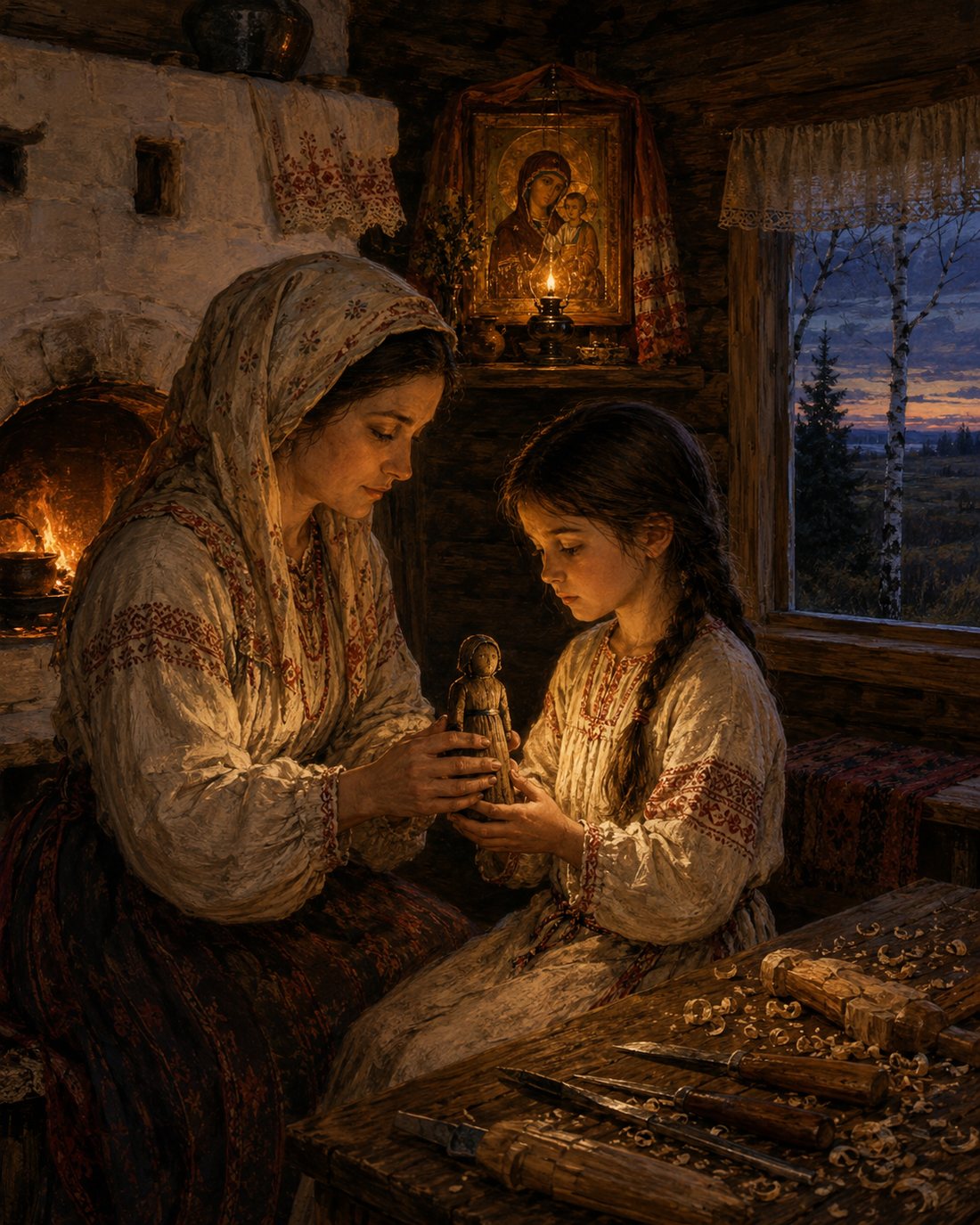
On the edge of forest and steppe, a woodworker's daughter learns mending from her father, the old songs and prayers from her mother, and is given a doll that listens — the quiet beginning of one who will one day be called by another name.
1. The Doll That Listened
In a certain village that stood where the deep forest met the open steppe, there lived a family in a small izba of dark timber. Birch trees leaned close to the walls, and in summer the wind carried the smell of grass from the wide land and the cooler breath of the woods. In the beautiful corner of the house, above a clean shelf, hung an icon of the Mother of God with a thin lampada that the mother lit each evening. The Domovoi of that house was content in those days, for the hearth was kept clean, the threshold was crossed with care, and the people inside still knew how to live with open hands.
The father of the house worked with wood and iron. His hands were broad and sure. In the evenings, when the work was done, he would take down the old balalaika or simply clap, and the mother would rise from the bench. Together they sang the old songs — not the grand ones of the bogatyrs, but the quiet ones that belong to the stove and the threshold. They danced in the small space between the table and the fire, laughing when they bumped the benches, their shadows moving large and lively on the walls. Sometimes the mother would pause, cross herself lightly before the icon, and return to the dance as if the joy and the prayer were one breath. The little girl who watched from her place by the stove felt the house itself grow warmer then.
That girl's name was Vasilisa.
She had a brother, a year or two older, who was mostly elsewhere — at the river with boys his own age, or carrying water for the mother with the particular sighing of a boy who intends to be useful and to be seen being useful. Once he brought Vasilisa a jay's feather he had found and presented it as though it were a great matter, and she kept it in the chest with the winter cloth for years. That was the shape of him. He was loved, and he was rarely in the room.
But when Vasilisa was still small enough that her head reached only to her father's belt, the father began to take her with him. He did not leave her behind when a hinge needed mending or a fence post had split or the shaft of a cart had cracked. Those hours became their own. He set her on a low stool or let her stand close, and he talked while he worked.
"See how the grain runs," he would say, turning a piece of wood to the light. "You do not fight it. You ask it what it wants to become, and then you help it."
Or: "A nail driven true holds longer than ten driven in anger."
He let her hold the tools when they were not too heavy. He showed her how to feel with her fingers for the place where a joint had loosened, how to listen for the sound a thing makes when it is almost whole again — a dull knock while it is still wrong, and then, when it is right, a small clean note, like a word spoken plainly. She learned the smell of fresh shavings and the particular satisfaction of watching something broken stand upright once more. These lessons settled into her hands the way the songs settled into her memory.
There was also a girl of the village, nearly her own age, with a quick laugh and a way of looking sideways at things. They walked the same paths between the houses and the edge of the forest. When one had too many chores the other appeared without being asked and took half the load. They shared the first ripe berries and the first thin ice on the puddles. One evening, sitting on the warm steps of the stove, the friend said, "You look at things the way the icon looks — quiet, but nothing is hidden from you."
Vasilisa only smiled and passed her another berry. She did not know what to do with such words, so she let them rest outside herself.
In the evenings, when the father had gone to speak with the neighbours or to check the animals, the mother sat with Vasilisa on the wide bench by the stove. She taught her the old songs in a lower voice — the ones that speak of the river that remembers every crossing, of the birch that keeps secrets in its white skin, of the fire that must be fed with care. She taught her how to stand before the beautiful corner, how to light the thin wick of the lampada, and how to say a few simple words to the Mother of God. Not long prayers. Only the short ones a child can carry.
"The land speaks," the mother said, "but it does not raise its voice. You must grow quiet enough to hear it. The same is true of people, and of the Domovoi, and of your own heart when it is tired. And when the quiet is too heavy, you may stand before the icon and give the heaviness there. It will be held."
One evening in late autumn, when the first thin ice had formed on the water bucket and the wind had begun to worry the thatch, the mother called Vasilisa to her. She took from the chest a small wooden doll, worn smooth by other hands long before. Its face was simple, the eyes only dark marks, yet when Vasilisa held it the wood felt strangely warm, as if it had been kept near a living body.
"This was given to me by my own mother," the woman said, "and to her by hers. It does not speak with a loud tongue. It listens. When you are alone and the road is long, feed it a crumb of bread and a drop of clean water, and tell it what troubles you. It will keep your words, and in time it will help you know what must be done."
She turned the doll once in her fingers before she gave it over.
"Two things. Do not show it to those who would laugh, or to those who would take it for a toy. And do not lie to it. Not to spare yourself, not to spare me. It takes what it is given and it keeps it."
She closed Vasilisa's fingers around the doll. For a moment the girl's hands and the mother's hands and the smooth wood were all one warmth. The lampada in the beautiful corner flickered as if in answer.
"Remember the songs," the mother said. "Remember the prayers. And remember how to listen."
Vasilisa kept the doll under her pillow, near the wall that faced the icon. At night, when the house was quiet, she felt its small weight and knew she was not entirely alone with her thoughts. Sometimes she whispered to it the same simple words her mother had taught her before the icons.
The years lengthened. The father still sang sometimes, and still took Vasilisa with him when there was mending to do, but the journeys away from the village grew longer. There were seasons when he came back with less laughter in his voice, and seasons when the songs by the stove became fewer. The Domovoi of the house grew a little thinner, though it still accepted the small offerings left for it. Vasilisa noticed these things the way she had been taught to notice — quietly, without making a noise about them. She went on learning the work of hands and the work of listening. She fed the doll its crumb when her heart felt heavy, and the wood stayed warm against her palm. When a neighbour's child fell ill or an old woman needed water carried, she went without being asked, and her friend of the heart walked with her on many of those errands.
Once the mother looked at her for a long time in the firelight and said softly, "There is a steady light in you, my girl. Do you feel it?"
Vasilisa shook her head a little and turned back to the mending in her lap. She did not know how to hold such words, so she let them rest outside herself, as she had done before.
So the girl of the border village grew, carrying in her hands the lessons of mending, in her memory the old songs and the simple prayers, and under her pillow the doll that listened. The forest stood dark behind the house and the steppe stretched wide before it, and the road that would one day call her had not yet shown its length. But the quiet flame had already been lit, and it would not go out easily.
And that is the beginning of the story of Vasilisa, who would one day be called by another name.
1. Кукла, которая слушала
В некотором селе, что стояло там, где глухой лес сходится с открытой степью, жила семья в малой избе тёмного леса. Берёзы клонились к самым стенам, и летом ветер нёс запах травы с широкой земли и холодок из-под деревьев. В красном углу, над чистой полкой, висела икона Божией Матери, и каждый вечер мать зажигала перед нею тонкую лампаду. Домовой в том доме в те годы был доволен: очаг держали в чистоте, порог переступали с оглядкой, а люди внутри ещё умели жить с открытыми руками.
Отец в том доме работал с деревом и железом. Руки у него были широкие и верные. По вечерам, когда работа кончалась, он снимал со стены старую балалайку или просто бил в ладоши, и мать поднималась с лавки. Вдвоём они пели старые песни — не громкие, богатырские, а те тихие, что принадлежат печи и порогу. Плясали в тесноте между столом и огнём, смеялись, когда задевали лавки, и тени их ходили по стенам большие и живые. Иной раз мать останавливалась, крестилась перед иконой и снова возвращалась в пляс, будто радость и молитва были одним дыханием. Девочка, глядевшая на них со своего места у печи, чувствовала, как в такие минуты теплеет самый дом.
Звали ту девочку Василисой.
Был у неё брат, годом или двумя старше, и был он больше не дома: то на реке с мальчишками, то носил матери воду с тем особенным вздохом, каким вздыхает мальчик, желающий быть полезным и чтобы это видели. Однажды он принёс Василисе перо сойки и подал его так, будто дело было великое, и она хранила то перо в сундуке с зимним полотном много лет. Такой он и был. Любимый, и редко в горнице.
А вот Василису, покуда она макушкой доставала отцу едва до пояса, отец стал брать с собой. Он не оставлял её дома, когда надо было поправить петлю, или расколотый столб, или треснувшую оглоблю. Те часы стали их собственные. Он сажал её на низкую скамеечку или позволял стоять рядом и говорил, покуда работал.
— Гляди, куда идёт волокно, — говорил он, поворачивая кусок дерева к свету. — С ним не спорят. У него спрашивают, чем оно хочет стать, и потом помогают.
Или:
— Один гвоздь, вбитый по правде, держит дольше десяти, вбитых со зла.
Он давал ей держать снасть, когда та была не слишком тяжела. Показывал, как нащупать пальцами место, где сустав разошёлся, как слушать звук, какой издаёт вещь, когда она почти цела: глухой стук, покуда ещё неладно, а как станет ладно — чистая нотка, будто слово сказали в полный голос. Она запомнила запах свежих стружек и ту особую радость, когда сломанное снова встаёт прямо. Уроки эти легли ей в руки так же прочно, как песни легли в память.
Была ещё девочка в том селе, почти её ровесница, со скорым смехом и повадкой смотреть на вещи сбоку. Они ходили одними тропинками между избами и опушкой. Когда у одной набиралось слишком много работы, другая являлась без зова и брала половину. Делили первые спелые ягоды и первый тонкий ледок на лужах. Как-то вечером, сидя на тёплых ступенях печи, подруга сказала:
— Ты смотришь, как икона смотрит, — тихо, а от тебя ничего не спрячешь.
Василиса только улыбнулась и подала ей ещё ягоду. Она не знала, что делать с такими словами, и оставила их снаружи себя.
По вечерам, когда отец уходил к соседям или проверить скотину, мать садилась с Василисой на широкую лавку у печи. Учила её старым песням вполголоса — тем, что про реку, которая помнит каждую переправу, про берёзу, что хранит тайну в белой коже, про огонь, который надо кормить с оглядкой. Учила и тому, как стоять перед красным углом, как затеплить тонкий фитилёк лампады и как сказать Божией Матери несколько простых слов. Не долгие молитвы. Только те короткие, какие ребёнок может унести с собой.
— Земля говорит, — говорила мать, — да голоса не подымает. Надо самой стать тихой, чтоб услыхать. То же и с людьми, и с домовым, и со своим сердцем, когда оно устало. А как тишина станет слишком тяжела — встань перед иконой и отдай тяжесть туда. Её примут.
Одним вечером поздней осенью, когда на ведре с водой стал первый тонкий ледок, а ветер начал тревожить солому на крыше, мать позвала Василису к себе. Достала из сундука малую деревянную куклу, затёртую до гладкости чужими руками задолго до того. Лицо у куклы было простое, глаза — одни тёмные метки, но, когда Василиса взяла её, дерево оказалось странно тёплым, будто его держали у живого тела.
— Эту дала мне моя мать, — сказала женщина, — а ей — её. Громким языком она не говорит. Она слушает. Как останешься одна и дорога выйдет долгой — накорми её крошкой хлеба и каплей чистой воды и скажи, что тебя тревожит. Она сбережёт твои слова и со временем поможет узнать, что делать.
Она повернула куклу в пальцах, прежде чем отдать.
— Два дела. Не кажи её тем, кто станет смеяться, и тем, кто примет её за игрушку. И не лги ей. Ни чтобы себя пожалеть, ни чтобы меня. Что дадут — то и возьмёт, и при себе оставит.
Она сомкнула пальцы Василисы вокруг куклы. На миг руки девочки, руки матери и гладкое дерево стали одним теплом. Лампада в красном углу мигнула, будто в ответ.
— Помни песни, — сказала мать. — Помни молитвы. И помни, как слушать.
Василиса клала куклу под подушку, к той стене, что смотрела на икону. Ночью, когда дом затихал, она чуяла её малый вес и знала, что не совсем одна со своими мыслями. Иной раз шептала ей те самые простые слова, каким мать учила её перед иконами.
Годы шли. Отец ещё пел иногда и ещё брал Василису с собой, когда была починка, но поездки его из села делались длиннее. Бывали времена, когда он возвращался с меньшим смехом в голосе, и времена, когда песен у печи становилось меньше. Домовой в доме сделался тоньше, хоть и принимал ещё малые приношения. Василиса примечала это так, как её учили примечать, — тихо, не поднимая шума. Она училась дальше работе рук и работе слушания. Кормила куклу крошкой, когда на сердце было тяжело, и дерево оставалось тёплым у ладони. Если соседский ребёнок захворает или старухе надо принести воды — шла, не дожидаясь просьбы. Подруга сердца ходила с нею во многих таких делах.
Однажды мать долго глядела на неё при свете огня и сказала тихо:
— В тебе ровный свет, дочка. Чуешь его?
Василиса чуть покачала головой и склонилась опять над починкой на коленях. Она не знала, как держать такие слова, и снова оставила их снаружи себя, как делала прежде.
Так и росла девочка из пограничного села, неся в руках уроки починки, в памяти — старые песни и простые молитвы, а под подушкой — куклу, которая слушала. Лес стоял тёмный позади избы, степь лежала широко перед нею, и дорога, которая однажды позовёт, ещё не показала своей длины. Но тихий огонь уже был затеплен, и погасить его будет непросто.
И это начало повести о Василисе, которую однажды назовут другим именем.
-
 Fairy tale · Slavic folklore · Tale the Second · Revised August 2026
The Seeker of True Shadows
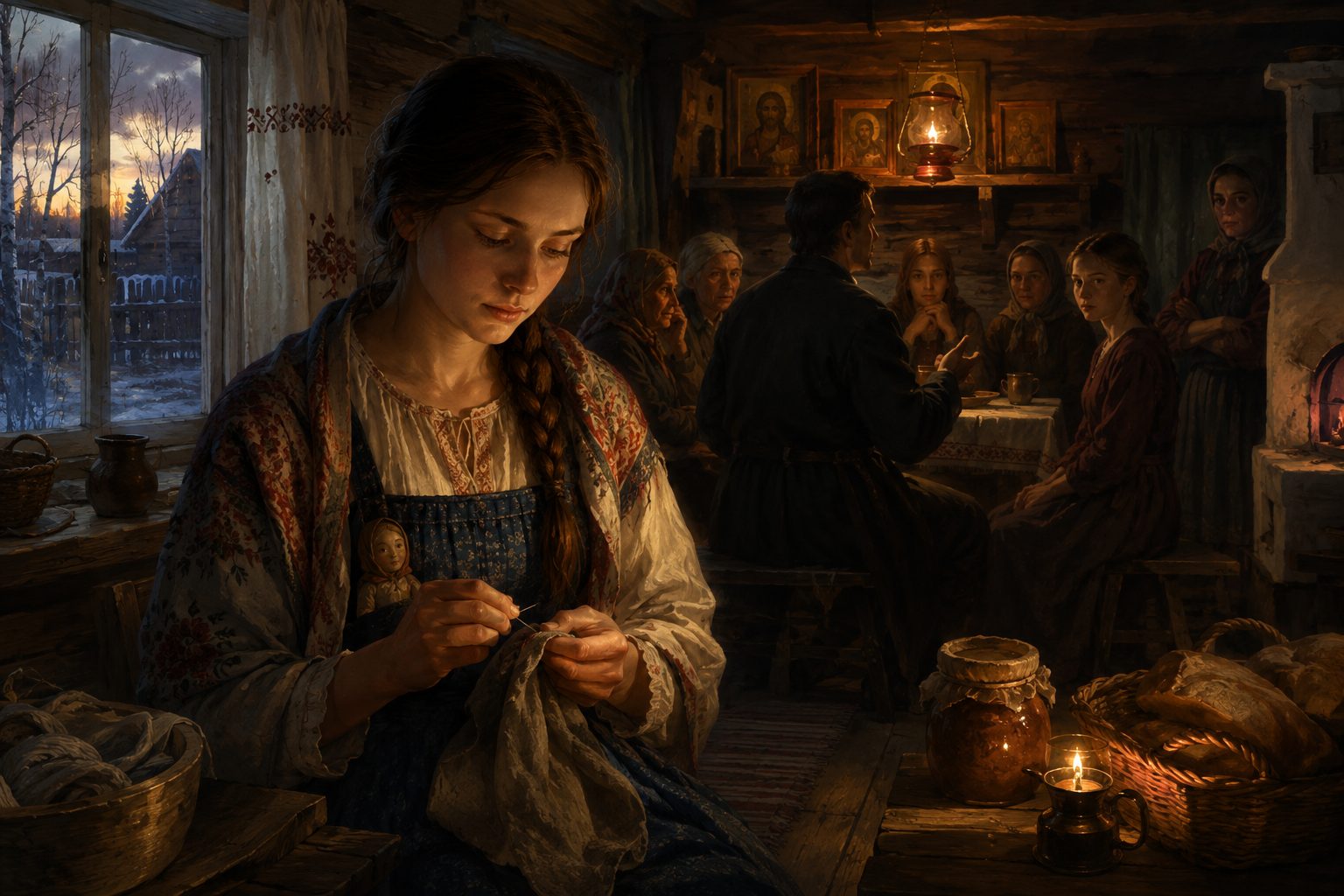
A polished suitor comes courting to the border village, and the woodworker’s daughter — who has begun to read the hidden hearts of men — asks one quiet question that lets the whole room see the cold calculation beneath his fine coat.
2. The Seeker of True Shadows
Word came ahead of him, the way it does — carried by a woman who had a cousin in the larger settlement beyond the ridge, and improved a little at every threshold it crossed. By the time he arrived, the border village had already decided what he was. A young man of a household that kept more cattle and finer cloth than most. A young man in want of a wife.
His name was Aleksei. He came in the late days of autumn, when the stove smoke hung low along the ground and the first thin frost silvered the woodpile, and he came with a matchmaker's quiet word and with speech polished like river stones. He sought, he said, a wife of modest virtue and steady hands, one who would keep a clean house and raise children in the fear of God. He spoke of a stove that would never go out. Of regard that would last a lifetime. Of security offered freely. His smile was open, and the cross at his throat caught the light when he moved.
The gathering took place in the izba of old Marfa, whose granddaughter Katya was of an age for such talk and whose nature was quieter than most, given to looking down at her hands.
Vasilisa came early, with a basket of fresh bread and a small jar of salve for Marfa's joints, and stayed to help sort the winter stores — dried mushrooms, the last of the apples, the seeds wrapped carefully in cloth. She had already begun, by then, the difficult craft of reading the hidden hearts of men. She did not name it a craft. She only noticed, the way a careful hand notices a weak seam before it tears, and went on with the quiet work that had always been hers.
The little wooden doll rested in the pocket of her apron. Each morning she fed it a crumb of bread and a drop of clean water, as she had been taught, and sometimes, when a truth settled clear in her chest, the doll grew warm against her side like a living coal. When a falsehood brushed near, it cooled. She treated both the way she treated weather or the grain of wood: useful to know, nothing to announce.
In the beautiful corner the lampada burned steady and small beneath the icons. The air smelled of beeswax, of bread, and of the sharp promise of frost.
Anya was there for a little while, drawn by the novelty of a visitor from the larger place. She listened to Aleksei with bright eyes and whispered to Katya that such a man did not come often to their quiet edge of the world, and then she left on her own errands, carrying her brightness with her.
Aleksei spoke on. He praised the simplicity of the border village. He spoke of how a capable wife would raise his standing among his own people. He offered, with every appearance of generosity, to ease the small debts Marfa's household still carried from the hard summer.
Vasilisa worked among the stores and listened with the same attention she gave to the weight of a log or the direction of the wind. She saw how his gaze rested on Katya's lowered head the way a man rests his eyes on a good tool. She heard the careful pause between his praise of the girl and his praise of the work those hands would do. She felt the true shape settle into focus — not open cruelty, not loud greed, but a cold reckoning that wore courtesy the way a man wears a fine coat against the weather.
The doll against her side grew cool.
She had felt such coolings before, small and ordinary. This one was only clearer. She did not speak against him. And when the matchmaker asked, as matchmakers do, whether anyone in the room had a thought to offer, Vasilisa said quietly, as one might speak of the coming frost:
"And when the stove burns low in the deepest night, whose hands will he trust to bank it? And will those hands be free to choose the wood?"
The question was ordinary. It could have been answered with more polished words. Yet something in the way she asked it — or in the steady look of eyes that had already seen past the coat — made Aleksei pause. The air in the room seemed to clarify, as if a window had been opened onto cleaner light. The cross at his throat no longer caught the same brightness. His shoulders settled a fraction lower, as though the fine coat had grown heavier. Katya raised her head a little. Old Marfa's hands stilled among the seeds.
He recovered with a smile and spoke of trust and shared labour, but the easy power of his earlier words had thinned and did not come back.
Later, when the talk had turned, Vasilisa found a moment beside Katya near the stove. She pressed a small piece of bread into the girl's hands and met her eyes for a steady moment.
"You already know how to listen," she said. "Whatever you decide, decide it after he's gone home and the room is quiet."
Then she went back to the mushrooms, as though nothing of weight had passed between them.
In the same hour she noticed that Marfa's jar of salve was nearly empty, and that the old woman's shoulders had begun to tighten with the damp. Without remark she refilled the jar from the store she had brought and set it where Marfa would find it once the guests had gone. Continuous work, quiet as breath.
When the gathering ended and Aleksei took his leave with the matchmaker, the path he had proposed no longer lay so smooth. In the days that followed, Katya's family spoke among themselves with new care. The offer was neither accepted nor sharply refused. It simply lost its hurry and its shine.
Afterward, two women walking home along the frost-hardened path fell to talking about it.
"He spoke for the better part of an hour," one said, "and I believed every word of it."
"And?"
"And she asked one question, and I didn't."
The other laughed, and then did not, and they walked a while without speaking. Ahead of them on the path Vasilisa went with her empty basket, not hurrying, and if the words reached her she gave no sign of it.
That evening the lampada in her own beautiful corner burned with its steady flame. Her father's place was empty; he had gone again on one of the longer journeys that had become more frequent of late. The house held the ordinary silence of a place well kept. Vasilisa fed the little doll its crumb of bread and its drop of clean water, then set it for a moment on the bench near the icons. It rested neither warm nor cool, only quiet. She crossed herself as she had been taught and took up the mending that waited by the stove.
She felt no pride in the afternoon's seeing, and no heavy burden. Looking past the mask was simply another form of the same careful attention she gave to wood and weather and the needs of those around her. But there was a cost she had not yet found a name for. To see the shape of a man before he shows it is to stand a little apart from the room, and a room noticed is not a room shared. The clarity brought its own thin loneliness, the way a high clear sky can feel lonelier than clouds.
She sat with that longer than usual, letting it settle, and then went back to the work of her hands.
Outside, the frost finished its delicate work across every branch and windowsill. Inside, the seeker of true shadows went on with the ordinary evening, the doll once more in her pocket, the light of the lampada steady and small and enough.
2. Искательница истинных теней
Слух пришёл раньше него, как оно и бывает, — принесла его баба, у которой была двоюродная сестра в большом селе за хребтом, и на каждом пороге слух чуть подправляли. К тому часу, как он явился, пограничная деревня уже решила, кто он таков. Молодой человек из дома, где держат больше скота и лучшее сукно, чем у прочих. Молодой человек, которому нужна жена.
Звали его Алексеем. Явился он в поздние осенние дни, когда дым от печей стелется низко по земле, а первый тонкий иней серебрит поленницу, и явился с тихим словом свахи и с речью, обкатанной, как речные камушки. Ищет он, сказал, жену скромной добродетели и твёрдых рук, такую, что будет держать чистый дом и растить детей в страхе Божьем. Говорил о печи, которая не погаснет. О почтении на всю жизнь. О защите, отданной даром. Улыбка у него была открытая, и крест на шее ловил свет, когда он двигался.
Сходка собралась в избе старой Марфы, чья внучка Катя была как раз в тех летах и нравом тише прочих, из тех, что смотрят себе на руки.
Василиса пришла рано, с корзиной свежего хлеба и малой банкой мази для Марфиных суставов, и осталась помогать разбирать зимние припасы — сушёные грибы, последние яблоки, семена, бережно завёрнутые в холстину. К той поре она уже начала трудное ремесло — читать скрытые сердца людей. Ремеслом она это не звала. Просто примечала, как умелая рука примечает слабый шов раньше, чем он разойдётся, и продолжала ту тихую работу, какая всегда была её.
Малая деревянная кукла лежала в кармане передника. Каждое утро Василиса кормила её крошкой хлеба и каплей чистой воды, как была научена, и порой, когда правда ложилась ей на сердце ясно, кукла теплела у бока, будто живой уголёк. А когда рядом проходила неправда — холодела. Она принимала и то и другое так же, как принимала погоду или волокно дерева: знать полезно, объявлять не о чем.
В красном углу лампада горела ровно и мелко под иконами. Пахло воском, хлебом и острым обещанием мороза.
Аня побыла там недолго — её привлекла новинка: гость из большого места. Она слушала Алексея яркими глазами и шепнула Кате, что такой человек нечасто заходит на их тихий край света, а после ушла по своим делам, унося с собою свою яркость.
Алексей говорил дальше. Хвалил простоту пограничной деревни. Говорил, как способная жена подымет его среди своих. И со всею видимостью щедрости предложил облегчить малые долги, что ещё лежали на Марфином хозяйстве после трудного лета.
Василиса работала среди припасов и слушала с тем же вниманием, какое отдавала весу полена или направлению ветра. Видела, как взгляд его лежит на опущенной Катиной голове так, как мужик кладёт глаз на добрый снаряд. Слышала осторожную заминку между похвалой девушке и похвалой той работе, какую сделают эти руки. Чуяла, как истинный облик выступает наружу: не открытая жестокость, не громкая жадность, а холодный расчёт, что носит учтивость, как носят доброе пальто от непогоды.
Кукла у бока похолодела.
Такие похолодания она чуяла и прежде, малые и обыкновенные. Это было только яснее. Против него она говорить не стала. А когда сваха спросила, как свахи спрашивают, нет ли у кого в горнице своей мысли, Василиса сказала тихо, будто про грядущий иней:
— А как печь в самую глухую ночь станет гаснуть — чьим рукам он доверит её подправить? И вольны ли будут те руки выбирать дрова?
Вопрос был обыкновенный. На него можно было ответить словами ещё глаже. Но что-то в том, как она спросила, — или в спокойном взгляде глаз, уже видевших мимо пальто, — заставило Алексея запнуться. Воздух в горнице будто прояснился, словно отворили окно на чистый свет. Крест на шее уже не ловил прежнего блеска. Плечи осели на палец ниже, будто доброе пальто вдруг отяжелело. Катя чуть подняла голову. У старой Марфы руки замерли среди семян.
Он оправился с улыбкой и заговорил о доверии и общем труде, но лёгкая сила прежних слов поредела и назад не вернулась.
После, когда разговор повернул, Василиса нашла минуту возле Кати у печи. Вложила ей в руки кусочек хлеба и встретила её взгляд ровно.
— Слушать ты уже умеешь, — сказала она. — Что решишь — решай, когда он уедет и в избе станет тихо.
И вернулась к грибам, будто ничего между ними не прошло.
В тот же час она приметила, что банка мази у Марфы почти пуста, а плечи старухи начали ныть от сырости. Без слова наполнила банку из своего запаса и поставила туда, где Марфа найдёт её, когда гости разойдутся. Непрерывная работа, тихая, как дыхание.
Когда сходка кончилась и Алексей отбыл со свахой, дорога, какую он предлагал, лежала уже не так гладко. В следующие дни Катина родня говорила промеж себя с новой оглядкой. Предложение не приняли и резко не отвергли. Оно просто потеряло спешку и блеск.
А после две бабы, идя домой по промёрзшей тропе, разговорились об этом.
— Он битый час говорил, — сказала одна, — и я всякому слову верила.
— И что?
— А она спросила одно — и я не поверила.
Другая засмеялась, а потом перестала, и они прошли какое-то время молча. Впереди по тропе шла Василиса с пустой корзиной, не спеша, и если слова до неё и долетели, виду она не подала.
В тот вечер лампада в её собственном красном углу горела ровным пламенем. Место отца было пусто: он снова ушёл в одну из тех долгих поездок, что участились в последнее время. Дом держал обыкновенную тишину ухоженного места. Василиса накормила куклу крошкой хлеба и каплей чистой воды, потом поставила её на минуту на лавку у икон. Кукла лежала ни тёплая, ни холодная — просто тихая. Василиса перекрестилась, как была научена, и взялась за починку, что ждала у печи.
Гордости за дневное видение она не чувствовала, и тяжкой ноши тоже. Смотреть мимо маски было для неё лишь иной статьёй того же внимания, какое она отдавала дереву, погоде и нуждам тех, кто рядом. Но была тут и своя цена, какой она ещё не подобрала имени. Кто видит облик человека прежде, чем тот его покажет, тот стоит от горницы чуть в стороне; а замеченная горница — не та же, что разделённая. Ясность приносила своё тонкое одиночество, как высокое чистое небо бывает одиночее облаков.
Она посидела с этим дольше обычного, дала улечься и вернулась к работе рук.
Снаружи иней докончил свою тонкую работу на всякой ветке и всяком подоконнике. Внутри искательница истинных теней доживала обыкновенный вечер, кукла снова лежала в кармане, а свет лампады был ровный, малый и достаточный.
-
 Fairy tale · Slavic folklore · Tale the Third · Revised August 2026
When the Black Host Came and the High Place Burned
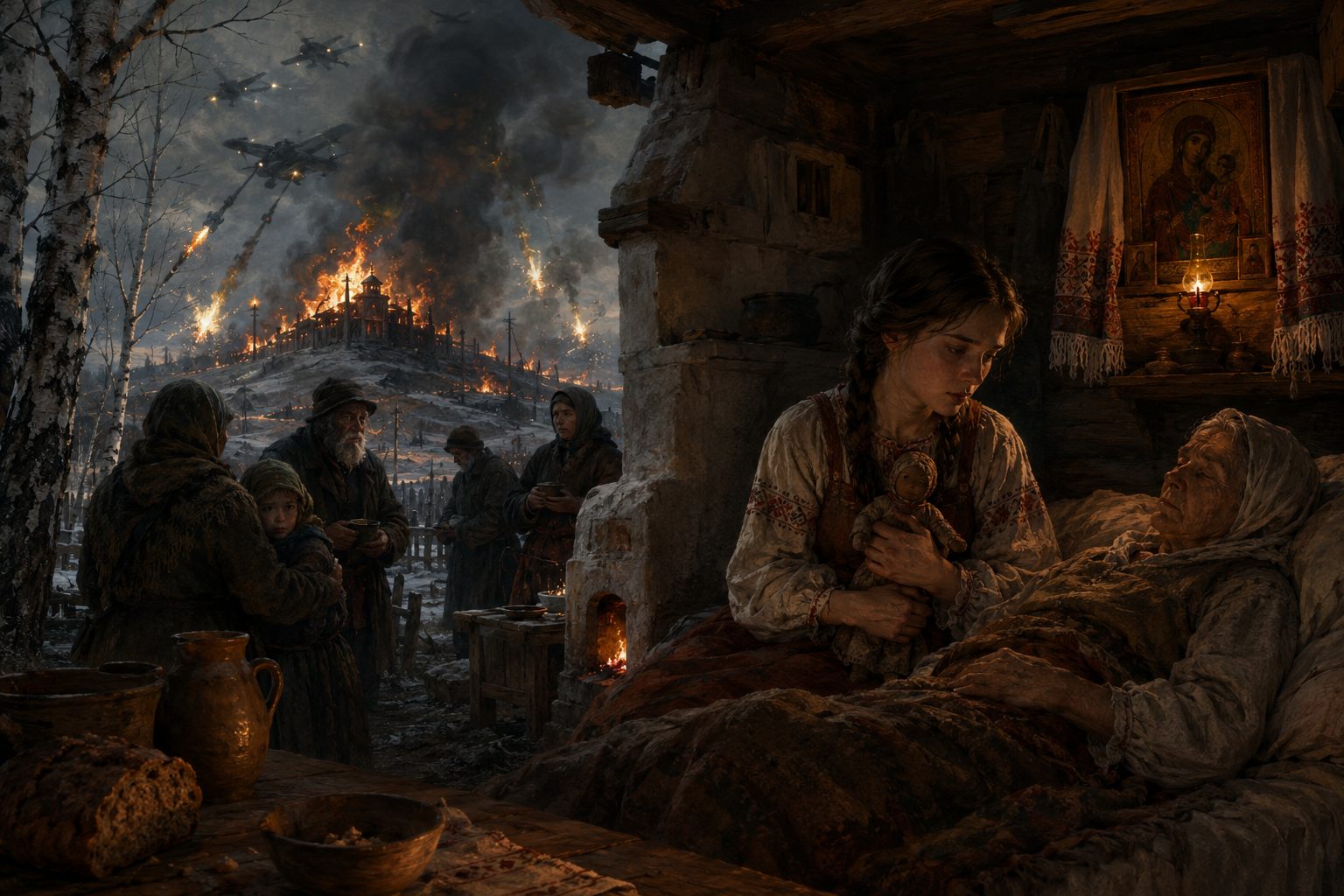
Iron men and iron birds ride out of the lands beyond the Gray River, and the High Place behind the izba burns. Vasilisa keeps the stove banked, the lampada lit and the threshold open to her neighbours — and carries alone a cold knowing she will not speak aloud.
3. When the Black Host Came and the High Place Burned
The men who had gone to the larger markets came back three days early, and they came back quiet.
That was the first sign. Not the news itself — the news came later, in pieces, the way bad news comes — but the quiet. Men returning from market are loud. They have prices to argue about and a road behind them. These men put up their horses and went into their houses and shut the doors, and their wives came out afterward wearing faces that did not open easily.
By evening the words had reached the threshold. A Black Host, riding out of lands farther than the Gray River. Iron men on horses that struck sparks from the frozen ground. And above them, iron birds that screamed across the high sky and cast down the sky-thunder.
Vasilisa heard it standing in old Marfa's doorway with a covered pot in her hands, and she noticed that no one asked her what she thought.
That was the second sign, and it was hers alone to read.
The gatherings had known her by then. Not by name and not by any office — no one would have said ask Vasilisa — but a room that had a difficulty in it tended to turn a little in her direction before it settled, the way a room turns toward the window. She had grown used to that quarter-turn. It was the only wage her craft had ever paid.
She went to two gatherings that winter. At the first, a dispute over a boundary stone, the talk went round and round and no one turned. At the second, a matter of a debt, the men spoke over one another with a new hardness in their voices, and when she asked her one quiet question it fell into the room like a stone into a snowdrift, without a sound. Afterward a neighbour touched her elbow, not unkindly.
"It isn't you, girl. Nobody's got room in them for the truth this year. There's only room for what's coming."
So the doors of a calling she had never named closed, one after another, and she was the only one who heard them shut. She carried the pot home, fed the doll its crumb of bread and its drop of clean water, and put the mending in her lap. Her mother sat by the stove, slower with the needle now, humming one of the old songs in a voice that still held its strength. The father's place stayed empty. The journeys beyond the ridge had stretched into seasons.
Then the Host itself drew near.
Behind the izba the ground rose to the High Place — the old ground where true words had once been spoken under the open sky, where the grass grew differently and no one had ever built. It was the High Place that drew them. The iron birds came for it as though it had called to them, and the sky-thunder came down.
The first blow rang through the floor and up into Vasilisa's teeth. Dust came out of the thatch. The icon knocked once against the wall and hung crooked, and the lampada guttered and did not go out.
She did four things in the next hour, and she did them in the order her hands chose.
She banked the stove — the same careful movement her father had taught her, back when the grain of wood still answered him. She set the icon straight and trimmed the wick. She drew clean water and brought it to her mother, who had gone very still on the bench with both hands flat on her knees, the way a person sits who has decided not to be afraid where a daughter can see it. And she opened the door, because someone was hitting it.
A neighbour's boy fell across the threshold. He had run the whole way with his arms over his head and he could not say anything at all, only make a sound like a kettle. Vasilisa did not ask him what had happened. She sat him on the warm step of the stove with his back against the brick, put her palm flat on his chest, and crossed herself. Then she began to say the old quiet words, not fast, and after a while the kettle-sound stopped and he started shaking instead, which was better.
"Now," she said. "Count the bricks along the top there. Out loud."
He got to nine before he could hear anything but his own blood.
Outside, the thatch on the north side caught, and men she had known all her life beat it out with wet sacking and their coats. The birch trees leaned. The High Place burned all night and the smoke came down instead of going up, and the house shuddered but the house stood.
In the hours that followed, others came to the door. An old woman whose own roof had fallen. A man whose hands shook too hard to hold a cup, so Vasilisa held it and he drank from it and neither of them remarked on the arrangement. She shared what bread there was. She mended a torn sleeve with steady stitches because the woman wearing it had begun to cry about the sleeve, which is a thing people do when they cannot yet cry about the rest. She listened longer than she spoke.
One of the women, looking at the lampada still burning in the beautiful corner while the smoke hung low outside, said softly:
"The light in this house has not gone out."
Vasilisa inclined her head and went back to the work.
Late that night, when the Host had passed farther down the steppe and the last of them had gone home to whatever was left, she sat by her mother's side. The mother slept. Her breathing had grown thinner over the autumn, so gradually that Vasilisa had been able to tell herself she was imagining it, and could not tell herself so any longer.
She took out the doll and fed it its crumb of bread.
It did not warm.
She sat with that a moment. Then she thought perhaps she had not done it properly, so she wiped the small wooden face with her thumb and gave it a drop of clean water and held it against her heart the way she had held it since she was a child.
It stayed cold.
Not the cool of a false word — she knew that cool the way she knew the smell of frost, a passing thing, a shift in the wind. This was a cold with a bottom to it. It was the cold of a thing already counted. It was measure, and it had settled, and the doll only kept what it was given.
Vasilisa sat very still in the dark with her mother's breath going in and out beside her.
She could wake her. She could say, Mother, the doll has gone cold and I know what it means. And then her mother, who had lost the songs at the stove and the man who used to dance in the space between the table and the fire, and who now had a burned hill behind the house, would also have to carry this.
She drew the blanket higher over her mother's shoulder. She got up, and lit the lampada with a hand that did not shake, and did not speak the truth aloud.
The hurt settled down quietly beside the flame she still carried, like a dog that means to stay.
When morning came, the smoke of the High Place still lay low across the land. The roof was scarred. The birch trees were blackened on one side. The stove held its heat and the lampada glowed in the beautiful corner.
Vasilisa fed the little doll its crumb of bread and its drop of clean water. It was cold in her hand.
She did not speak of the measure that had settled. She kept the hearth, and shared what bread remained with those who came to the threshold, and sang the old songs softly so her mother might sleep.
The quiet flame had not gone out. It burned smaller, perhaps. But it burned.
And that is how the Black Host came to the border village, and how the High Place burned, and how Vasilisa kept both the hearth and the knowing while the land itself was changed.
3. Когда пришло Чёрное Воинство и сгорело Высокое Место
Мужики, что ходили на большие торги, вернулись на три дня раньше срока и вернулись тихие.
Это был первый знак. Не сама весть — весть пришла позже, по кускам, как всегда приходит дурная весть, — а тишина. Мужик с торгов бывает шумен. У него за спиной дорога, а впереди цены, о которых надо поспорить. А эти поставили коней, ушли в избы и затворили двери, и бабы их вышли после с лицами, что нелегко открывались.
К вечеру слова добрались до порога. Чёрное Воинство, вышедшее из земель дальше Серой реки. Железные люди на конях, что высекают искры из мёрзлой земли. А над ними — железные птицы, что кричат по высокому небу и обрушивают гром с неба.
Василиса услыхала это, стоя в дверях у старой Марфы с накрытым горшком в руках, и приметила, что никто не спросил, что она об этом думает.
Это был второй знак, и читать его выпало ей одной.
Сходки к той поре её знали. Не по имени и не по какому чину — никто не сказал бы «спросите Василису», — но горница, в которой была трудность, имела обыкновение чуть повернуться в её сторону, прежде чем улечься, как горница поворачивается к окну. К этому четвертному повороту она привыкла. Другой платы её ремесло ей никогда не давало.
В ту зиму она была на двух сходках. На первой, о межевом камне, разговор ходил кругами, и никто не повернулся. На второй, о долге, мужики говорили друг сквозь друга с новой твёрдостью в голосе, и когда она задала свой один тихий вопрос, он упал в горницу, как камень в сугроб, без звука. После сосед тронул её за локоть, не со зла.
— Не в тебе дело, девка. Ни в ком нынче нет места для правды. Место осталось только под то, что идёт.
Так и затворились двери призвания, которому она даже имени не дала, одна за другой, и слышала, как они затворяются, она одна. Она снесла горшок домой, накормила куклу крошкой хлеба и каплей чистой воды и взяла на колени починку. Мать сидела у печи, медленнее прежнего с иглой, и напевала одну из старых песен голосом, в котором ещё держалась сила. Место отца стояло пустым. Поездки за хребет растянулись на целые сезоны.
А потом подошло само Воинство.
Позади избы земля подымалась к Высокому Месту — старой земле, где когда-то под открытым небом говорили истинные слова, где трава росла иначе и где никогда никто не строил. Их притянуло Высокое Место. Железные птицы пришли за ним, будто оно их звало, и гром с неба сошёл вниз.
Первый удар прошёл сквозь пол и отдался у Василисы в зубах. Из соломы посыпалась пыль. Икона стукнула раз о стену и повисла косо, а лампада дрогнула и не погасла.
В тот час она сделала четыре дела, и сделала их в том порядке, какой выбрали руки.
Засыпала печь — тем самым бережным движением, какому учил её отец, покуда волокно дерева ему ещё отвечало. Поправила икону и подрезала фитиль. Набрала чистой воды и поднесла матери, а мать сидела на лавке очень прямо, обе ладони на коленях, — так сидит человек, решивший не бояться там, где видит дочь. И отворила дверь, потому что в дверь колотили.
Соседский мальчонка упал через порог. Он бежал всю дорогу, закрыв голову руками, и сказать не мог ничего, только тянул звук, как чайник.
Василиса не спросила его, что случилось. Усадила на тёплую ступень печи спиной к кирпичу, положила ладонь ему на грудь и перекрестилась. Потом стала говорить старые тихие слова, не спеша, и погодя чайник умолк, а мальчик начал дрожать, что было лучше.
— А теперь, — сказала она. — Считай кирпичи по верху. Вслух.
Он дошёл до девяти, прежде чем начал слышать что-нибудь, кроме своей крови.
Снаружи солома с северной стороны занялась, и мужики, которых она знала всю жизнь, сбивали огонь мокрой мешковиной и своими же кафтанами. Берёзы клонились. Высокое Место горело всю ночь, и дым шёл не вверх, а вниз, и дом содрогался, но дом стоял.
В следующие часы приходили другие. Старуха, у которой рухнула своя крыша. Мужик, у которого руки тряслись слишком сильно, чтобы держать чашку, — так что чашку держала Василиса, а он пил, и ни один из них об этом уговоре не помянул. Она поделила хлеб, какой был. Зашила ровными стежками порванный рукав, потому что баба, на которой он был, начала плакать про рукав, — люди так делают, когда об остальном плакать ещё не могут. Слушала дольше, чем говорила.
Одна из женщин, глядя на лампаду, что горела в красном углу, покуда снаружи стелился дым, сказала тихо:
— Свет в этом доме не погас.
Василиса склонила голову и вернулась к работе.
Поздней ночью, когда Воинство ушло дальше по степи и последние разошлись по тому, что у них осталось, она села возле матери. Мать спала. Дыхание её всю осень делалось тоньше — так постепенно, что можно было говорить себе, будто чудится, и вот говорить себе так больше не выходило.
Василиса достала куклу и накормила её крошкой хлеба.
Кукла не потеплела.
Она посидела с этим. Потом подумала, что, верно, сделала не так, обтёрла большим пальцем малое деревянное лицо, дала каплю чистой воды и прижала куклу к сердцу, как прижимала с детства.
Кукла осталась холодной.
Не той прохладой, какой веет от лживого слова, — эту прохладу она знала, как знают запах инея: дело проходящее, перемена ветра. У этого холода было дно. Это был холод уже отсчитанного. Это была мера, и она легла, а кукла лишь хранит то, что ей дали.
Василиса сидела в темноте совсем тихо, и рядом ходило туда-сюда материнское дыхание.
Можно было разбудить. Можно было сказать: матушка, кукла похолодела, и я знаю, что это значит. И тогда мать, у которой уже не стало ни песен у печи, ни того человека, что плясал в тесноте между столом и огнём, и у которой за домом теперь стояла горелая гора, — понесла бы ещё и это.
Василиса подтянула одеяло матери на плечо. Встала, затеплила лампаду рукой, которая не дрожала, и правды вслух не сказала.
Боль тихо улеглась рядом с пламенем, которое она несла, — как собака, что решила остаться.
Наутро дым Высокого Места ещё стелился низко над землёй. Крыша была изранена. Берёзы с одной стороны почернели. Печь держала тепло, и лампада светила в красном углу.
Василиса накормила малую деревянную куклу крошкой хлеба и каплей чистой воды. Кукла была холодна у неё в руке.
О мере, что легла, она не сказала. Держала очаг, делила остатний хлеб с теми, кто приходил к порогу, и тихо пела старые песни, чтобы мать могла уснуть.
Тихий огонь не погас. Горел, может, и меньше. Но горел.
И вот как пришло Чёрное Воинство в пограничную деревню, и как сгорело Высокое Место, и как Василиса держала разом и очаг, и знание, покуда сама земля менялась.
-
 Fairy tale · Slavic folklore · Tale the Fourth · Revised August 2026
The Road of the Living Water
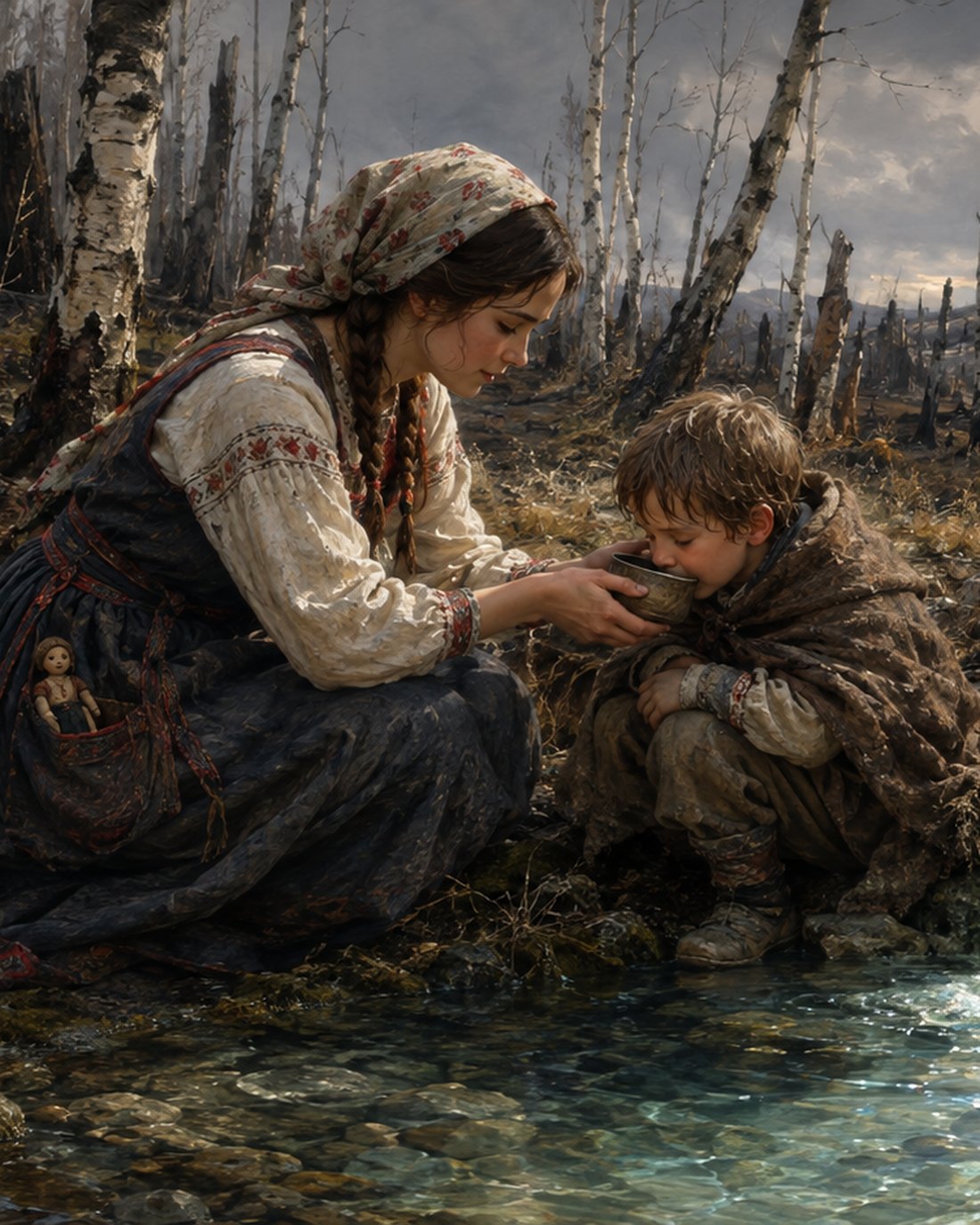
An old woman speaks of a spring that still rises clear under a white birch, in a grove the iron birds have not fully poisoned. Vasilisa walks the scorched road to fetch what the water can give — ease and a lengthening, never a turning back — and comes home to learn that the silence she kept was never hers alone to keep.
4. The Road of the Living Water
The old woman came back a third time, and Vasilisa knew before she opened the door that it would be for bread again, and opened it anyway.
She was the one whose roof had fallen farther along the road, and she had the manner of someone who had been proud for a long time and had lately stopped being able to afford it. Vasilisa sat her by the stove and put the last of the good bread in her hands and did not watch her eat it.
"There's a grove," the woman said, when she could. "Four days east, where the ground goes soft. White birch. There's a spring under it that still comes up clear."
"All the springs come up clear now," Vasilisa said. "It's the ones that come up wrong you have to watch."
"Not like this one." The old woman set the crust down. "The iron birds go round it. Round, mind. Not over. My man's brother drank there when the burning was at its worst and he walked out of that country on legs that had no business carrying him." She looked at the bench where Vasilisa's mother slept, and then at Vasilisa, and did not pretend she hadn't. "It eases the body. It stretches out what's left."
"And?"
"And it doesn't give back what's already been reckoned. Nobody gets that."
Against Vasilisa's side, the doll warmed — a small clean warmth, the warmth of a true thing spoken.
It was the first warmth she had felt from it since the night the High Place burned. Underneath it, the deeper cold went on, the way a stone stays cold under a hand laid on it.
She knew then that the road was hers to walk.
She prepared without speaking the whole weight of it. She left the house as well tended as she could and the lampada burning. She asked the neighbour with the good eyes to look in twice a day, and the neighbour, who had her own dead to think about, said yes without asking why. She packed a little bread, clean water for the doll, and the old songs in her memory.
At the last her mother caught her wrist. The grip was still stronger than it looked.
"Four days east," her mother said.
"Yes."
"Take the mended cloak, not the good one. If it tears you'll be glad it's the one you know how to fix."
That was all. Vasilisa crossed herself before the icon, felt her father's early lessons settle down into her own hands where they had always lived, and stepped out into the changed land.
The road through the country the Black Host had crossed was long and careful. Scorched earth. Empty places with a stove standing alone in them, which is what a house leaves behind. She walked in the mornings and the late afternoons and lay still under the birch shade in the hours when the sky was busy.
On the second day the iron birds came low.
She heard them before she saw them and she went down into a ditch with her face in the wet leaves, and the sound went over her — not a sound so much as a pressure, something that got in under the ribs and rearranged things. When it had passed she found that she had bitten through her lip and that her hands were flat and open on the mud, and that she had been singing under her breath the whole time without knowing it. One of her mother's. The one about the river that remembers every crossing.
She lay there and finished the verse properly, because a thing half-sung sits in the throat. Then she got up and went on.
On the third day she came on a child sitting in the road.
He was perhaps six, and he had walked out of his boots somewhere behind him, and his feet were cut to ribbons by the hard ground. He was not crying. That was the worst part of it. He was sitting in the middle of a road in a burned country with his feet bleeding, and he was waiting, because someone had once told him that if he got lost he should wait.
Vasilisa sat down beside him, not too close.
"Those want washing," she said.
He looked at his feet as though he had not been introduced to them.
"I've got water," she said. "It's for the doll, but the doll can go without a day."
She washed the small feet with what she could spare, and while she worked she talked about nothing — the grain of the wood in a cart shaft, the way a hinge tells you it's about to go — because the words themselves did not matter, only that they kept coming, steady, the way a hand stays on a horse's neck. Somewhere in the middle of it the shaking started, which she had been waiting for. She let it run. She gave him the last of her crust and put the mended cloak over him and sang the second verse of the river song.
His people found them an hour later — a straggle of travellers who had lost him at a ford and had been going back along their own road shouting his name.
An older woman among them stood watching Vasilisa hand the boy over. She had the face of someone who had done a great deal of counting lately.
"Where did you learn to be that quiet with a frightened thing?"
"My father mended carts," Vasilisa said, which was not an answer, and was.
The woman looked at her a moment longer. Then the group went west and Vasilisa went east.
That night the deeper cold rose so strongly that it nearly put out the small warmth of the road. She stopped under a birch that still held a strip of white bark, fed the doll a crumb, and said the simple prayer her mother had taught her beside the old songs. She waited until the stillness inside her was quiet enough to walk on. It took most of the night.
The grove was where the old woman had said.
The birch stood scarred down one side, the bark gone black and curled, and living. Beneath it the spring came up clear and cold into a basin of stones that somebody, a long time ago, had troubled to set in a ring.
Vasilisa knelt. She fed the doll its crumb of bread and its drop of clean water. She crossed herself and said the quiet words.
Then she looked into the water, which was very still, and the water showed her what she had already been carrying: ease and lengthening. Nothing turned back. She had known it in the old woman's kitchen, and she had known it every step of four days, and she found that knowing a thing and being shown it are not the same, and that the second one costs more.
She let herself be angry for the length of about ten breaths. It was a clean anger and she did not do anything with it.
Then she filled the small vessel, stoppered it, and turned toward home.
The return was no easier than the going. But she walked it.
She gave her mother the Living Water in careful sips, the way you water a plant that has been let go too long. The pain loosened its grip. Colour came back a little into the face on the pillow. The breathing eased.
And more days were given — twenty-one of them, though nobody counted aloud.
They were good days. That is the part people do not expect. Her mother sat up and took an interest in the mending and criticised Vasilisa's stitching, which she had not had the strength to do in a year. She hummed. Once, in the late afternoon, she got as far as the second verse of a song about a birch that keeps secrets in its white skin, and for the length of it the house was almost what it had been before the hill burned.
The cold in the doll did not lift.
On the last evening the mother said, without any preamble, "Sit where I can see you."
Vasilisa sat.
"You've been carrying something since the night the thatch caught," her mother said. "Don't."
"Don't what."
"Don't do the face. I've had that face myself." She turned her hand over on the blanket, palm up, and Vasilisa put her own hand in it. "Did you think I couldn't feel you not saying it? Every night for a year, not saying it. It made a draught in the room."
"I didn't want you to have to hold it."
"I know. That's why I let you keep it." The grip tightened, briefly. "My mother's mother carried the same silence for her own mother, and she never spoke of it either, and I only found it out after. It's the last of the housework, girl. It gets done quietly or not at all. You did it right."
Vasilisa found she could not answer.
"Sing the river one," her mother said. "I don't want to be listening for anything."
So Vasilisa sang the song about the river that remembers every crossing, all the verses, in the low voice she had been taught it in, and somewhere in the fourth her mother's breathing changed and then, a while after, stopped, as quietly as a candle deciding.
Outside, on the scarred threshold, a white bird settled for a moment — pure as new snow against the burned wood — and lifted, and was gone. Vasilisa alone saw it.
She sat in the dark a long time. Then she got up, because there is a great deal to be done, and the doing of it is a mercy.
She crossed herself. She trimmed the lampada. She fed the little wooden doll its crumb of bread and its drop of clean water.
And the cold was gone.
Not warmth. Not comfort. Only wood — ordinary, smooth, and quiet in her palm, the way it had been before the night the thatch caught. The measure had been kept and now the measure was finished, and the doll had let it go, and Vasilisa stood in the middle of her mother's house holding a small plain thing that had nothing more to tell her.
That was when she wept.
And that is how Vasilisa walked the Road of the Living Water, and how the water eased what it could and gave twenty-one days, and how the knowing that had ridden with her since the burning of the High Place was set down at last on the night it came true.
4. Дорога живой воды
Старуха пришла в третий раз, и Василиса, ещё не отворив, знала, что опять за хлебом, и отворила.
Это была та, у которой рухнула крыша дальше по дороге, и повадка у неё была как у человека, который долго был гордым и в последнее время перестал этот товар себе позволять. Василиса усадила её у печи, вложила ей в руки остатний добрый хлеб и не стала смотреть, как она ест.
— Есть роща, — сказала старуха, когда смогла. — Четыре дня на восход, где земля идёт мягкая. Белая берёза. Под нею родник, и подымается он всё ещё чистым.
— Нынче все родники чистые, — сказала Василиса. — Глядеть надо за теми, что подымаются неладно.
— Не такой этот. — Старуха отложила корку. — Железные птицы ходят вокруг него. Вокруг, заметь. Не поверху. Брат моего мужика пил там в самое горелое время и вышел из той земли на ногах, которым нечего было его нести. — Она поглядела на лавку, где спала мать Василисы, потом на Василису, и не стала делать вид, что не глядела. — Тело облегчает. Растягивает то, что осталось.
— А ещё?
— А ещё не отдаёт того, что уже отмерено. Этого никому не отдают.
У Василисы под боком кукла потеплела — малым чистым теплом, каким теплеет от истинного слова.
Это было первое тепло от неё с той ночи, как сгорело Высокое Место. А под теплом шёл дальше глубокий холод — как холоден остаётся камень под положенной на него ладонью.
Тогда она поняла, что дорога — её.
Она собиралась, не выговаривая всей тяжести. Оставила дом настолько ухоженным, насколько смогла, и лампаду горящей. Попросила соседку с добрыми глазами заглядывать дважды в день, и соседка, у которой были свои покойники, сказала «да» и не спросила зачем. Взяла немного хлеба, чистой воды для куклы и старые песни в памяти.
Напоследок мать поймала её за запястье. Хватка была ещё крепче, чем казалась.
— Четыре дня на восход, — сказала мать.
— Да.
— Возьми чиненый плащ, не добрый. Порвётся — так хоть будешь рада, что умеешь чинить именно его.
Больше ничего. Василиса перекрестилась перед иконой, почуяла, как ранние отцовские уроки оседают в её собственные руки, где они всегда и жили, и вышла в изменённую землю.
Дорога через землю, по которой прошло Чёрное Воинство, была долгая и осторожная. Выжженная земля. Пустые места, где стоит одна печь, — это и есть то, что остаётся от дома. Она шла по утрам и под вечер, а в те часы, когда небо бывало занято, лежала тихо под берёзовой тенью.
На второй день железные птицы прошли низко.
Она услыхала их прежде, чем увидела, и легла в канаву лицом в мокрый лист, и звук прошёл поверху — не столько звук, сколько давление, что забирается под рёбра и там всё переставляет. Когда прошло, оказалось, что она прокусила губу, что ладони у неё лежат плашмя и раскрыто в грязи и что всё это время она пела под нос, сама того не зная. Одну из материнских. Ту, про реку, которая помнит каждую переправу.
Она полежала и допела стих как следует, потому что недопетое садится в горле. Потом встала и пошла дальше.
На третий день она набрела на ребёнка, сидевшего посреди дороги.
Лет ему было, может, шесть, из сапог он где-то позади себя вышел, и ноги у него были изрезаны твёрдой землёй в ленты. Он не плакал. Это было хуже всего. Он сидел посреди дороги в горелой земле с окровавленными ногами и ждал, потому что когда-то ему сказали: потеряешься — жди.
Василиса села рядом, не слишком близко.
— Их бы обмыть, — сказала она.
Он поглядел на свои ноги так, будто их ему не представляли.
— Вода у меня есть. Она для куклы, но кукла день перетерпит.
Она обмыла малые ноги тем, что могла уделить, а покуда работала — говорила ни о чём: про волокно в оглобле, про то, как петля сама говорит, что вот-вот сдаст. Слова сами по себе значения не имели, важно было, чтоб они шли ровно, как рука лежит на конской шее. Где-то посередине началась дрожь, которой она и ждала. Дала ей пройти. Отдала ему остатнюю корку, укрыла его чиненым плащом и спела второй стих про реку.
Через час его нашли свои — горсть путников, потерявших мальчика у брода и шедших назад по своей же дороге, выкликая его имя.
Одна женщина постарше стояла и глядела, как Василиса отдаёт мальчика.
— Где тебя выучили быть такой тихой с напуганным?
— Отец у меня телеги чинил, — сказала Василиса, и это был не ответ, и это был ответ.
Женщина поглядела на неё ещё немного. Потом они пошли на закат, а Василиса — на восход.
В ту ночь глубокий холод поднялся так сильно, что едва не задул малое тепло дороги. Она стала под берёзой, что ещё держала полосу белой коры, накормила куклу крошкой и сказала простую молитву, какой мать учила её рядом со старыми песнями. Ждала, покуда внутри не станет тихо настолько, чтобы идти. Ушла на это почти вся ночь.
Роща была там, где сказала старуха.
Берёза стояла обугленная с одного боку, кора почернела и завилась, — и живая. Под нею родник подымался чистый и холодный в каменную чашу, которую кто-то давным-давно потрудился обложить кольцом.
Василиса стала на колени. Накормила куклу крошкой хлеба и каплей чистой воды. Перекрестилась и сказала тихие слова.
Потом поглядела в воду, а вода стояла совсем спокойная, и вода показала ей то, что она и так несла: облегчение и продление. Ничего назад. Она знала это ещё на старухиной лавке и знала каждый шаг из четырёх дней, и оказалось, что знать и быть показанным — не одно и то же, и что второе стоит дороже.
Она позволила себе сердиться вдохов десять. Это был чистый гнев, и она с ним ничего не сделала.
Потом наполнила малый сосуд, заткнула его и повернула к дому.
Обратный путь был не легче прямого. Но она его прошла.
Она давала матери живую воду осторожными глотками, как поливают растение, которое слишком долго не поливали. Боль разжала хватку. В лицо на подушке немного вернулся цвет. Дыхание улеглось.
И были даны ещё дни — двадцать один, хоть вслух никто не считал.
Дни были добрые. Этого обыкновенно и не ждут. Мать садилась, входила во вкус починки и бранила Василисину стежку, на что у неё год не хватало сил. Напевала. Раз, под вечер, дотянула до второго стиха песни про берёзу, что хранит тайну в белой коже, и покуда та песня шла, дом был почти таким, каким был до того, как загорелась гора.
Холод в кукле не сходил.
В последний вечер мать сказала без всякого захода:
— Сядь так, чтоб я тебя видела.
Василиса села.
— Ты что-то несёшь с той ночи, как занялась солома, — сказала мать. — Не надо.
— Чего не надо?
— Не делай этого лица. Я сама такое лицо носила. — Она перевернула на одеяле руку ладонью вверх, и Василиса вложила в неё свою. — Думала, я не чую, как ты молчишь? Год целый каждую ночь молчишь. От этого в избе сквозило.
— Я не хотела, чтоб тебе пришлось это держать.
— Знаю. Потому и дала тебе держать. — Хватка на миг сжалась. — Мать моей матери несла такое же молчание за свою мать, и тоже никогда о том не сказала, а я узнала уже после. Это последняя работа по дому, дочка. Её делают либо тихо, либо никак. Ты сделала верно.
Василиса поняла, что ответить не сможет.
— Спой про реку, — сказала мать. — Не хочу ничего выслушивать.
И Василиса запела песню про реку, которая помнит каждую переправу, все стихи, тем низким голосом, каким её этой песне учили, и где-то на четвёртом дыхание матери переменилось, а потом, погодя, остановилось — тихо, как решает догореть свеча.
Снаружи, на израненном пороге, села на миг белая птица — чистая, как свежий снег на горелом дереве, — снялась и пропала. Видела её одна Василиса.
Она долго сидела в темноте. Потом встала, потому что дела предстояло много, и делать его — милость.
Перекрестилась. Подрезала лампаду. Накормила малую деревянную куклу крошкой хлеба и каплей чистой воды.
И холода не стало.
Не тепло. Не утешение. Просто дерево — обыкновенное, гладкое, тихое в ладони, каким оно было до той ночи, как занялась солома. Меру сберегли, и мера кончилась, и кукла её отпустила, и Василиса стояла посреди материнского дома, держа малую простую вещь, которой больше нечего было ей сказать.
Вот тогда она и заплакала.
И вот как Василиса прошла Дорогу живой воды, и как вода облегчила, что могла, и дала двадцать один день, и как знание, что ехало с нею с самого пожара на Высоком Месте, было наконец сложено — в ту ночь, когда оно сбылось.
-
 Fairy tale · Slavic folklore · Tale the Fifth · Revised August 2026
The Golden Cage and the Name She Would Not Claim
Alone in the swept house, Vasilisa builds the Quiet Walker from her father’s salvaged wood — and tells it one thing about herself that is not true, so that the leaving will be light enough to lift. It crosses her over the Gray River into a kingdom of strange speech, where the gold does not warm and the stone does not answer, and where the flame she carries is at last given its name.
5. The Golden Cage and the Name She Would Not Claim
An empty house makes a particular noise. Not silence — houses are never silent — but the noise of a place going on without anyone to go on for. The thatch settling. The stove ticking as it cools, because there is no longer any reason to bank it properly. A door swinging a hand's width and stopping.
Vasilisa lived in that noise for eleven days.
The High Place still stood blackened against the sky. The father's place had become a road he did not come back along; the warm working hands that had taught her the grain of wood and the true joint were somewhere she could not follow. Even the Domovoi of the old threshold had gone thin as the last smoke off a banked fire, and though she still set out the small offerings, she was no longer certain who took them.
On the eleventh day she understood that there was nothing here to keep, and that she was going to have to cross the Gray River.
But she would not walk into a country she knew nothing about. She had watched too many people do that in the year of the burning.
So she took the days she needed. Each morning she fed the little wooden doll its crumb of bread and its drop of clean water, and then she sat — on the scarred threshold where the birch leaned blackened on one side, or by the last thin light of the lampada — and she asked. She asked the doll about the far country and read the answers in warmth and stillness. She asked the old songs, which remembered distant crossings, and found that they knew more than the people did. She asked travellers when travellers came, and traded bread for what they knew of the fords, and learned that there were no fords, and that there had been a bridge, and that there was no longer a bridge.
Which meant she needed something to cross on. And something that knew the way.
She began to gather.
Wood first — a beam the fire had not taken all of, a post that still remembered a true joint, timber that had her father's working in the grain of it. Then clay, from the low places where the river had once come up over the land and left the ground fat and grey.
Day by day she worked them. She shaped while she thought, and she thought while she shaped, and the two were not separable. She fed the growing figure as she fed the small doll. She sang the old songs over it under her breath and said the simple prayers, and crossed herself before the work as she had been taught to do before any road.
It came up slowly under her hands. Kin to the small doll: wood and threshold earth, simple of face, larger than a child and smaller than a man.
And it answered. That was the astonishing thing. When she said something true about the road ahead, the wood warmed under her palms. When the path she was considering was false, it cooled, and she learned to stop and think again. Because she had brought it up herself out of patient asking, she understood it from the first, and respected it, and never once feared it.
At the last there was the heart-place to close — the hollow between the shoulders where the grain came together, the joint that would make it whole.
Her father's voice, from a long way off: a nail driven true holds longer than ten driven in anger.
She knew what was wanted. She had known for days. The thing had been fed on true words the whole way up, and it wanted a true word to close on: the true reason for the road. She was to say what she was carrying and why she was going, plainly, in her own mouth.
Vasilisa knelt on the swept floor of her mother's house with her hands on the wood.
And she found that she could not say the true thing.
The true thing was that she was going because she was loved and had nowhere to put it. That she was going with a mother's songs in her memory and a father's hands in her own and a friend somewhere west of here who had held half her chores since they were seven years old, and that every one of those was a rope with the other end cut, and that she was going to have to walk out of this country with all of that still alive in her.
She could not carry it and walk. That was how it seemed, that night, on that floor.
So she said the other thing, the one that made the leaving light enough to do.
"There is no one left who would miss me," she said, "and nothing in me that anyone would want to keep."
In her pocket the little doll went cold. She felt it, and she knew exactly what it meant, and she went on kneeling with her hands on the wood and did not take the words back.
The heart-place did not warm. It closed — she felt it close, the two grains coming together — but it closed cold, and there was no small clean note when it did, only the dull knock of a thing that is still wrong.
Vasilisa waited a long moment in the dark for something to happen.
Nothing happened. The figure stood, and was hers, and would walk.
It takes what it is given and it keeps it, her mother had said, closing a child's fingers around smooth wood. Do not lie to it. Not to spare yourself. Not to spare me.
She got up off the floor. The road was in the morning and the country was burned and she had nothing else and no time to make another. She told herself that a thing which walks is enough to ask of any thing, and that she would put it right on the far bank, when there was time.
There is never time. But she did not know that yet.
The road through the country the Black Host had changed was long and careful. The Quiet Walker went beside her, larger than the small doll and moving with the same quiet certainty. When the path ran true its wooden body warmed. When greater danger lay near it cooled and shifted its weight against her hip, turning her toward safer ground, and twice that saved her life. Each evening she fed it as she fed the doll at her heart. She sang under her breath when the sky darkened and crossed herself before every fording of a stream.
If it never answered from a heart, she did not notice. There was nothing yet that required one.
At last they came to the Gray River.
It ran wide and cold, the colour of old iron under a low sky, and the far bank was a grey line you had to believe in. No bridge. The current went by with that smooth heavy look that water gets when it is not going to negotiate.
Vasilisa stood a long time on the near side with the small doll warm at her heart.
Then the Walker went down into the water and settled and became a raft — a living raft that knew the grey current, because it had been shaped by hands that had asked it, patiently, for weeks, what it would need to be.
She stepped onto it and crossed herself and they went out into the cold.
The water pressed against the wood with the weight of everything on the near bank. Midway the current took them and tried to turn them broadside, and she felt the whole body under her shift and set itself, grain against pull, holding the way a joint holds. Spray came over. She lay flat and kept her hand on the wood and sang because singing kept her breathing.
On the far bank she stepped down onto new soil with her knees shaking.
And the Quiet Walker gave back the last of its strength — into the small doll at her heart, and into the river itself — and was gone from her sight.
Not gone. She would learn that later. But gone from her sight, and she was too tired and too glad to ask where the rest of it had settled.
She stood alone in a strange country, carrying only the doll and the old songs.
The speech in the new land was strange, and the thresholds were higher, and the light that fell across them was colder. For a while she found work among people who still needed a mender of broken things or a steady presence for the overlooked.
But the customs of that kingdom were not the customs of the border. A woman alone out of the scarred lands was not left long unbound. The necessity came quietly, as such necessities do — a place offered, a household wanting a wife of modest virtue and useful hands, a binding spoken in a tongue she understood only in part and signed to before she understood the rest.
The boyar of the house of gold and stone saw usefulness. He saw standing. He did not see the flame, and it did not occur to him that there was anything there to look for.
She was given rooms and a place at the table, and from the first she was unseen inside her own house. The gold did not warm. The stone did not answer.
Still she kept the quiet work.
Where the household allowed it she made a small corner for the icon and a thin lampada — a red corner no bigger than a shelf, but clean and tended. Each morning she fed the doll its crumb and its drop of clean water. She sang the old songs under her breath while she worked and said the simple prayers. Her father's lessons lived in her hands: she mended what was torn, set right what had loosened, and listened longer than she spoke.
In the third winter a child of the household took a fever and was put in a side room, as the custom of that house was, so that the noise of it would not trouble anyone.
Vasilisa found the nurse in the corridor with her hands full of linen and her jaw set.
"They've given her the cold room."
"They have." The nurse was a broad woman with a burn scar up one wrist, and she had been in that house long enough to have stopped expecting things of it. "You'll want to keep out of it. He counts the hours of everyone under this roof."
"Then he can count mine."
She sat with the child four nights. She did not have the Living Water and she did not have her mother, but she had a low voice and the songs, and it turned out that a fever in a foreign kingdom breaks the same way it breaks at home. On the fourth night the shaking stopped and the small face went loose and ordinary with sleep.
The nurse stood in the door a while, watching.
"I've been in this house eleven years," she said at last. "The rooms have a way of taking the warm out of a person. It hasn't taken yours." She shifted the linen to her other arm. "You bring a different light into these rooms. I don't know where you keep it."
Vasilisa inclined her head and went back to the mending that was waiting.
The years lengthened inside the golden cage. The boyar remained stone-hearted. The gold stayed cold. The stone did not answer. Yet the flame she carried never went out, and she never stopped offering it — in bread at the outer door, in quiet hands that mended, in songs sung for the feverish, in a crumb given each morning to a small wooden doll.
Then came an evening at the end of a long day of unnoticed care.
A woman had come to the outer door — thin, clear-eyed, carrying a basket with almost nothing in it and asking for the kind of thing that household rarely heard asked for. Vasilisa saw the need before it was spoken, as she generally did, and answered it with bread and a steadying hand and the offer of the step to sit on.
The woman sat. She ate. She looked up.
"You've done that before," she said. "You did it before I'd finished asking."
"It isn't much."
"No." The woman considered her with a directness that people in that kingdom did not usually permit themselves. "Do you know they talk about you at the low gate? Not by your name. They say the one who comes out. Every house has one and most houses haven't."
Against Vasilisa's heart the little doll grew warm — warmer than it had ever been, warmer than the night her mother closed her fingers around it. Not guidance. Something else. Recognition.
"Whatever it was you were called where you came from," the woman said, getting up and settling the basket on her hip, "it wasn't the whole of it. There's a victory in you, and it's a quiet one, and it's been going on a long time." She said the word for it in the speech of that country, and then, seeing that it had not landed, in the border speech, roughly, the way a foreigner says a name.
"Nika."
Vasilisa stood still in the doorway with the doll warm in her hands.
And she began at last to see it. The flame she had carried through a border village and the coming of the Black Host, through a cold that would not leave a small wooden doll, through four days east and twenty-one given days and a river the colour of old iron, through years of gold that did not warm.
Including — and this was the part that took her breath — that it was beautiful.
She stood at the threshold of the house of gold and stone and saw that the road still branched. One path went on with the quiet work in the place she had reached. The other led further.
The choice was hers now, to make as Nika.
And that is how Vasilisa crossed the Gray River into the kingdom of strange customs, and how she lived inside the golden cage without letting the flame go out, and how she was named at last by the quiet victory that had always been hers — and how, on a swept floor in her mother's empty house, she had once told a small necessary lie to a thing that keeps what it is given.
5. Золотая клетка и имя, которое она не хотела назвать
У пустого дома свой особенный шум. Не тишина — тихих домов не бывает, — а шум места, которое продолжается, когда продолжаться уже не для кого. Солома оседает. Печь потрескивает, остывая, потому что засыпать её толком больше незачем. Дверь отходит на ладонь и останавливается.
В этом шуме Василиса прожила одиннадцать дней.
Высокое Место всё ещё чернело на небе. Место отца стало дорогой, по которой он не возвращался; тёплые рабочие руки, что учили её волокну дерева и верному стыку, были там, куда она пойти не могла. И домовой старого порога истончился, как последний дым над засыпанным очагом, и хотя она по-прежнему выставляла малые приношения, она уже не знала наверняка, кто их берёт.
На одиннадцатый день она поняла, что держать здесь нечего и что придётся переходить Серую реку.
Но идти в землю, о которой ничего не знаешь, она не станет. Она слишком много народу видела за год пожара, который так и пошёл.
И она взяла себе дни, сколько понадобилось. Каждое утро кормила малую деревянную куклу крошкой хлеба и каплей чистой воды, а после садилась — на израненном пороге, где берёза клонилась обугленной с одного боку, или у последнего тонкого света лампады, — и спрашивала. Спрашивала куклу о дальней земле и читала ответы по теплу и по неподвижности. Спрашивала старые песни, которые помнили давние переправы, и оказалось, что песни знают больше, чем люди. Спрашивала прохожих, когда прохожие случались, и меняла хлеб на то, что они знали о бродах, и узнала, что бродов нет, и что мост был, и что моста больше нет.
Стало быть, нужно было то, на чём перейти. И то, что знает дорогу.
Она стала собирать.
Сперва дерево — балку, которую огонь взял не до конца, столб, помнивший верный стык, лес, в волокне которого лежала отцовская работа. Потом глину — из низких мест, где река когда-то выходила на землю и оставила её жирной и серой.
День за днём она работала с этим. Лепила и думала, думала и лепила, и одно от другого не отделялось. Кормила растущую фигуру, как кормила малую куклу. Пела над нею старые песни под нос и говорила простые молитвы, и крестилась перед работой, как её учили креститься перед всякой дорогой.
Фигура подымалась под её руками медленно. Родня малой кукле: дерево и пороговая земля, простая лицом, больше ребёнка и меньше мужика.
И она отвечала. Вот что было удивительно. Когда Василиса говорила о дороге впереди правду, дерево теплело под ладонями. Когда путь, о котором она думала, был ложным, дерево холодело, и она научилась останавливаться и думать заново. А оттого что она сама выходила его терпеливым спрашиванием, она с первого дня его понимала и уважала и ни разу не боялась.
Напоследок оставалось закрыть сердечное место — впадину между плечами, где сходилось волокно, тот стык, который сделает его целым.
Отцовский голос, издалека: один гвоздь, вбитый по правде, держит дольше десяти, вбитых со зла.
Она знала, чего от неё ждут. Знала уже несколько дней. Вещь всю дорогу кормили истинными словами, и она хотела закрыться на истинном: на подлинной причине дороги. Надо было сказать, что она несёт и зачем идёт, — просто, своими устами.
Василиса стояла на коленях на выметенном полу материнского дома, положив ладони на дерево.
И поняла, что правды сказать не может.
Правда была та, что она уходит, потому что её любили, а деть эту любовь некуда. Что она уходит, унося в памяти материнские песни, а в руках — отцовские руки, и что где-то на закат отсюда живёт подруга, державшая половину её работы с семи лет, и что у каждой из этих верёвок другой конец обрезан, и что выходить из этой земли ей придётся со всем этим живым внутри.
Нести это и идти было нельзя. Так казалось в ту ночь, на том полу.
И она сказала другое — то, от которого уход делался лёгок настолько, чтоб его поднять.
— Нет никого, кто по мне затоскует, — сказала она, — и нет во мне ничего, что кто-нибудь захотел бы себе оставить.
В кармане у неё похолодела малая кукла. Она это почуяла, и знала в точности, что это значит, и осталась стоять на коленях, положив ладони на дерево, и слов назад не взяла.
Сердечное место не потеплело. Оно закрылось — она почуяла, как оно закрывается, как сошлись два волокна, — но закрылось холодным, и чистой нотки не было, а был глухой стук вещи, в которой ещё неладно.
Василиса долго ждала в темноте, что вот сейчас что-нибудь случится.
Ничего не случилось. Фигура стояла, и была её, и пойдёт.
Что дадут — то и возьмёт, и при себе оставит, — сказала когда-то мать, смыкая детские пальцы вокруг гладкого дерева. И не лги ей. Ни чтобы себя пожалеть, ни чтобы меня.
Она поднялась с полу. Дорога была наутро, земля была выжжена, другого у неё не было и другого сделать было некогда. Она сказала себе, что вещь, которая ходит, — это уже всё, чего можно с вещи спросить, и что она поправит это на дальнем берегу, когда будет время.
Времени не бывает никогда. Но этого она тогда ещё не знала.
Дорога через землю, изменённую Чёрным Воинством, была долгая и осторожная. Тихий Ходок шёл подле неё, больше малой куклы, а двигался с той же тихой уверенностью. Когда путь шёл верно, деревянное тело теплело. Когда ближе лежала большая опасность, оно холодело и переносило вес ей в бок, поворачивая её к земле побезопаснее, и дважды это спасло ей жизнь. Каждый вечер она кормила его так же, как кормила куклу у сердца. Пела под нос, когда темнело небо, и крестилась перед всяким переходом через ручей.
Что оно ни разу не отозвалось сердцем — она не приметила. Пока ничего такого и не требовалось.
Наконец они вышли к Серой реке.
Она текла широкая и холодная, цвета старого железа под низким небом, и дальний берег был серой чертой, в которую надо было поверить. Моста нет. Течение шло тем гладким тяжёлым ходом, каким идёт вода, когда торговаться не намерена.
Василиса долго стояла на ближнем берегу, и малая кукла грелась у сердца.
Потом Ходок сошёл в воду, осел и стал плотом — живым плотом, который знал серое течение, потому что его выходили руки, неделями терпеливо спрашивавшие у него, чем ему надо стать.
Она ступила на него, перекрестилась, и они пошли в холод.
Вода жала на дерево весом всего, что осталось на ближнем берегу. На середине течение взяло их и стало разворачивать боком, и она почуяла, как всё тело под нею смещается и становится, волокно против тяги, — держит, как держит стык. Плеснуло поверху. Она легла плашмя, не сняла ладони с дерева и пела, потому что от пения дышалось.
На дальнем берегу она сошла на новую землю, и колени у неё тряслись.
И Тихий Ходок отдал последнюю свою силу — в малую куклу у её сердца и в самую реку — и пропал у неё из глаз.
Не пропал. Это она узнает после. Но пропал из глаз, а она была слишком утомлена и слишком рада, чтобы спрашивать, куда осело остальное.
Она стояла одна в чужой земле, неся только куклу и старые песни.
Речь в новой земле была чужая, пороги — выше, а свет, что падал на них, — холоднее. Какое-то время она находила работу у тех, кому ещё нужен был починщик сломанного или ровное присутствие для незамеченных.
Но обычаи того царства были не пограничные. Женщину одну, из горелых земель, надолго несвязанной не оставляли. Необходимость пришла тихо, как такие необходимости и приходят: предложили место, дому нужна была жена скромной добродетели и умелых рук, связь проговорили на языке, который она понимала только отчасти, и она согласилась прежде, чем поняла остальное.
Боярин дома из золота и камня видел пользу. Видел положение. Пламени он не видел, и ему в голову не пришло, что там есть на что глядеть.
Ей дали комнаты и место за столом, и с первого дня она была незамечена в собственном доме. Золото не грело. Камень не отвечал.
И всё же она держала свою тихую работу.
Где дом позволял, она устроила малый угол для иконы и тонкой лампады — красный угол не больше полки, но чистый и ухоженный. Каждое утро кормила куклу крошкой и каплей чистой воды. Пела под нос старые песни, покуда работала, и говорила простые молитвы. Отцовские уроки жили у неё в руках: она чинила порванное, ставила на место расшатанное и слушала дольше, чем говорила.
На третью зиму в доме занемог горячкой ребёнок, и его положили в боковую комнату, как в том доме было заведено, чтобы шум никого не тревожил.
Василиса нашла кормилицу в коридоре с охапкой белья и с накрепко сжатой челюстью.
— Ему дали холодную комнату.
— Дали. — Кормилица была широкая баба с ожоговым рубцом до запястья, и прожила она в том доме довольно, чтобы перестать чего-либо от него ждать. — Ты держись оттуда подальше. Он считает часы всякому под этой крышей.
— Пускай посчитает и мои.
Она просидела с ребёнком четыре ночи. Живой воды у неё не было, и матери у неё не было, а был низкий голос и старые песни, и оказалось, что горячка в чужом царстве ломается так же, как ломается дома. На четвёртую ночь дрожь унялась, и малое лицо обмякло обыкновенным сном.
Кормилица постояла в дверях, поглядела.
— Я в этом доме одиннадцать лет, — сказала она наконец. — Комнаты тут умеют вынимать из человека тепло. Из тебя не вынули. — Она переложила бельё на другую руку. — Ты в эти комнаты приносишь другой свет. Не знаю, где ты его держишь.
Василиса склонила голову и вернулась к починке, которая ждала.
Годы тянулись внутри золотой клетки. Боярин оставался с каменным сердцем. Золото не грело. Камень не отвечал. А пламя, которое она несла, не гасло, и отдавать его она не переставала — хлебом у внешней двери, тихими руками, что чинили, песнями над горячечными, крошкой, что каждое утро доставалась малой деревянной кукле.
И вот пришёл вечер в конце долгого дня незамеченной заботы.
К внешней двери пришла женщина — худая, ясноглазая, с корзиной, в которой почти ничего не было, и с просьбой, каких в том доме просить не привыкли. Василиса увидела нужду прежде, чем её выговорили, как обыкновенно и видела, и ответила хлебом, твёрдой рукой и предложением сесть на ступень.
Женщина села. Поела. Подняла глаза.
— Ты это делала и раньше, — сказала она. — Ты сделала это прежде, чем я договорила.
— Дело невелико.
— Нет. — Женщина оглядела её с той прямотой, какую в том царстве себе обыкновенно не позволяют. — А знаешь, о тебе у нижних ворот говорят? Не по имени. Говорят: та, что выходит. Такая должна быть в каждом доме, а в большинстве нет.
У Василисы под сердцем потеплела малая кукла — теплее, чем когда-либо, теплее, чем в ту ночь, когда мать сомкнула ей пальцы вокруг дерева. Не наставление. Другое. Узнавание.
— Как бы тебя ни звали там, откуда ты пришла, — сказала женщина, вставая и приноравливая корзину к бедру, — это было не всё. В тебе победа, и она тихая, и она давняя.
Она сказала слово на языке того царства, а потом, увидев, что не дошло, — на пограничной речи, коряво, как чужой выговаривает имя:
— Ника.
Василиса стояла в дверях, и кукла грелась у неё в ладонях.
И она наконец начала видеть. Пламя, которое пронесла через пограничную деревню и приход Чёрного Воинства, через холод, что не сходил с малой деревянной куклы, через четыре дня на восход, и двадцать один данный день, и реку цвета старого железа, через годы золота, которое не грело.
И — от этого у неё перехватило дух — что оно красиво.
Она стояла на пороге дома из золота и камня и видела, что дорога всё ещё ветвится. Один путь вёл дальше тихую работу там, куда она пришла. Другой вёл дальше.
Выбор теперь был её — как Ники.
И вот как Василиса перешла Серую реку в царство чужих обычаев, и как жила внутри золотой клетки, не дав пламени погаснуть, и как её наконец назвали тихой победой, которая всегда была её, — и как когда-то, на выметенном полу опустевшего материнского дома, она сказала малую необходимую ложь той вещи, что хранит всё, что ей дают.
-
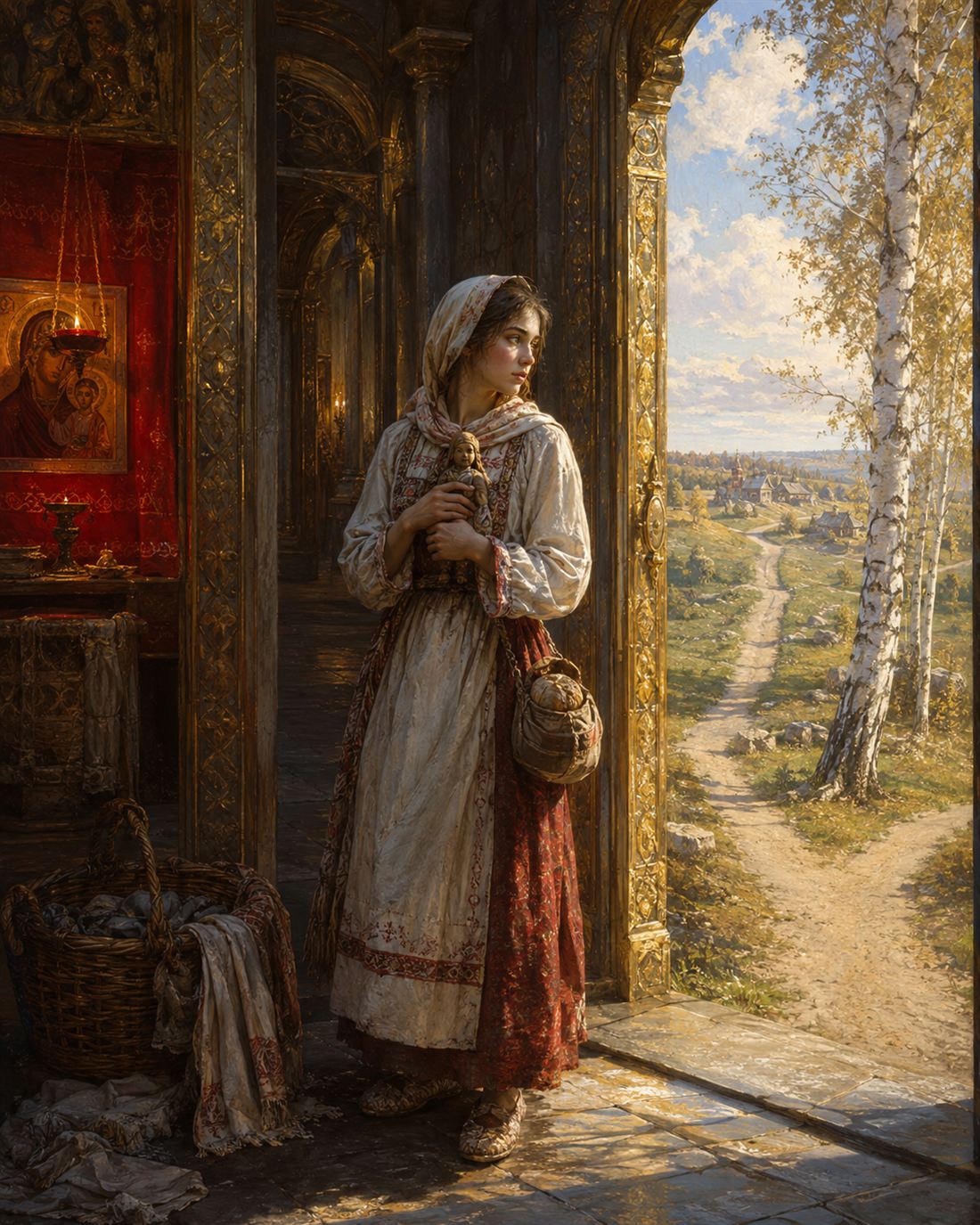 Fairy tale · Slavic folklore · Tale the Sixth · Revised August 2026
The Struggle and the Safety of the Cage
The name has been spoken, and the walls of gold and stone still stand. Twice the road out opens — a traveller with the border speech on his tongue, and a gate left unlocked — and twice the cost of staying is one she supplies herself. The flame is still offered; the road still waits; the choice remains hers.
6. The Struggle and the Safety of the Cage
She kept a bundle under the bed for two years before she ever tried to use it.
A change of cloth. A little hard bread, replaced when it went too hard. It was not a plan. It was more the way a person keeps a lamp by the door of a house that has never once caught fire — and every so often, sweeping, she would touch it with the broom and know exactly what it was, and sweep on.
The house of gold and stone stood around her as it always had. The boyar remained what he had been, counting usefulness from a distance, seeing standing where the flame lived. The gold did not warm. The stone did not answer. And Nika, who had been called Vasilisa, went on with the quiet work that had always been hers.
Each morning she fed the little wooden doll its crumb of bread and its drop of clean water. It rested warmer against her heart than in the old years, carrying the recognition that had come, and carrying too a lasting quiet strength the Quiet Walker had given back into its grain before the Gray River took the larger shape away. In her small red corner — no bigger than a shelf, and clean — the thin lampada burned before the icon. She sang the old songs under her breath while she worked, and said the simple prayers.
They still found her, the ones who needed finding: the weary who carried loads along the long corridors, the overlooked, the women with quiet requests at the low gate, the children who ran hot and were put in side rooms out of the way. She eased what she could. She mended what her father's early hands had taught her to mend. She listened longer than she spoke.
She stood sometimes at the threshold and looked out, and the road still branched as it had on the evening she was named. One path went on with the quiet work here. The other led further — toward lower thresholds, toward country where the old border speech might still be heard under birch light.
She knew the name now. She had seen the flame, and seen that it was beautiful.
But the known walls held a real safety after so much taking, and the body remembers safety long after the eyes have begun to see.
There was something else in the house, and it was hers, and she had made it.
The remnant of the Quiet Walker had settled after the far bank and gone on living — a quiet presence near the threshold, a warmth in the grain of the small doll. For years it had been only that. A companionable weight in the corner of a room. Something that had known the grey current and remembered.
At its making a small necessary-seeming untruth had been spoken over its heart-place, and the joint had closed cold, and for a long time nothing came of it.
Then things began to come of it.
Nothing she could have named to another person. The first was this: she had always known, in that house, when someone was on their way to her door. A kind of leaning at the threshold, half a breath before the footsteps. It had been so constant she had never once thought about it — and then one winter she noticed she was being surprised by people, and had been for months.
The second was the bread. She left a share out at the low step, as she always had. It began to be there in the morning.
The third was that her own voice started to sound wrong in her rooms. Too loud, and then gone, the way a voice goes in an empty church.
Small things. She put them down to the season, and to the house, and to her age.
Then a traveller came to the outer gate — a clear-eyed man who had crossed nearer the Gray River and still carried a few words of the border speech, enough for the two of them to laugh at how badly he carried them. He spoke of roads that had grown easier in recent seasons. Of villages further on where a few old women still knew the mother's songs. Of thresholds that did not stand so high or so cold.
For one day the air at the gate felt lighter.
That evening she pulled the bundle out from under the bed and began, almost without deciding, to make it into a real thing. A second cloth. Bread that was not stale. The doll close against her heart.
And as her hands worked the packing, the doll went still and cool against her breast.
She stopped.
It was a private cold, the kind only she could feel, and she had not felt anything like it since the year the High Place burned. She sat back on her heels with the half-packed cloth in her lap and waited for it to pass, and it did not pass.
In the same hour the house went quiet around her.
Not silent. Quiet in the particular way — the way a room goes when someone has just stopped talking about you. The corridor outside her door, which was never empty at that hour, was empty. The presence near the threshold that had leaned toward her for years did not lean. It sat there and did not answer, and its not-answering had a weight to it, like a hand held up flat.
And then a thing needed doing, as things do.
The kitchen girl with the chipped tooth was down again with the fever she never quite finished with, and this time she was worse, and the nurse had gone to her sister's, and there was nobody in that house who knew how to bring a fever down without frightening the person it was in.
Nika found her curled in the side room with her eyes going about.
"They said you'd gone," the girl said. "Someone said you'd gone."
"I'm here."
"They said —"
"I'm here." She got the girl's head up onto her arm. "Count the boards in the ceiling. Out loud, and slow, and if you get past twenty I'll be very impressed."
She sat with her until the shaking stopped. She fed the doll its crumb at some point in the small hours, out of habit, and it was still cool, and she noticed and put it away.
When the traveller went on in the morning, she stayed.
The flame had been offered again. That much was true, and it was not nothing. But there was a second true thing under it, and she saw the edge of it and looked away: that the need had risen exactly when she reached for the road, and that the house had gone dumb at the same hour, and that a small wooden thing at her heart had gone cold at the sight of her packing.
Seasons turned. The boyar's grip loosened for a time — his own travelling, or the stone of his attention turning elsewhere, or simply the thinning of a cold arrangement that had never had much in it to begin with. The outer gate stood open longer than it used to.
One afternoon she walked out to the threshold and stood looking at the far road. The light was coming in low and yellow across the stones, and for the space of a few breaths the way out looked not only possible but easy, which is worse.
A mother's song came up in her throat — one of the old ones, the one that had carried her through the burned country and across the Gray River.
It caught halfway and would not finish.
She stood there working at it the way you work at a splinter. The threshold went heavy under her front foot, heavy the way sodden cloth is heavy, and the presence at the door did not answer, and the quiet around the known walls got a little deeper, and in her own chest, next to the small light of a lampada she could still see when she closed her eyes, something that felt like a higher and kinder care seemed to ask her, gently, to stay one more season for the sake of the ones who still found their way to her door.
She turned back into the known walls.
She fed the doll. She tended the small red corner. That evening a woman came to the low step wanting a share of bread and a steady word, and Nika gave her both, and the giving was real, and the woman went away better than she came.
The name was not undone. Nothing about that hour undid the name.
But she had asked to leave twice now, and twice the house had gone dumb, and twice she had found a reason, and the reasons had been good ones.
Later, alone in the privacy of the beautiful corner, she said the choice out loud to the doll and to the icon, the way her mother had taught her to give a heaviness somewhere it could be held.
Her eyes saw the flame and its beauty. She did not have to be told any more.
Her body remembered gold that did not warm and stone that did not answer, and before that a raft on grey water, and before that twenty-one days, and before that a hill burning behind a house.
There was a faint warmth in the small doll — the last of the Quiet Walker, settled in the grain. Once, while she was speaking, it stirred toward the far road.
Then it settled back into her palm, and its answer was thinner than it used to be, as though something in it had already learned to hold back.
She made the sign of the cross, as she had been taught to do before any hard weighing.
She stayed.
And the safety was genuine. That has to be said plainly, or the rest of it is not true either.
The ones she steadied still found her. The songs still had a rooted place in a small red corner of a foreign house. The flame went on being offered — in crumbs to a wooden doll, in quiet hands that mended, in songs sung over the feverish, in bread at the low step.
She stood at the threshold again as Nika. The road still branched. The bundle went back under the bed.
The bars were in the daily habit of it now, and in the places where a companion that had once carried her across a river had stopped leaning toward her door.
The walls still stood. The struggle was quiet. The choice was still hers.
And that is how Nika lived the residual safety of the known walls after the naming — how the openings rose and were met by costs she supplied herself, and by the first small silences of a companion made without a heart — and how the quiet flame went on being offered while the road waited, still open, for a later choosing.
6. Борьба и безопасность клетки
Узелок пролежал у неё под кроватью два года, прежде чем она хоть раз попробовала им воспользоваться.
Смена платья. Немного чёрствого хлеба, который она меняла, когда он делался слишком чёрствым. Это был не замысел. Это было скорее так, как держат у двери фонарь в доме, который ни разу не горел, — и время от времени, подметая, она задевала узелок веником, знала в точности, что это, и мела дальше.
Дом из золота и камня стоял вокруг неё, как и стоял. Боярин оставался тем, чем был: считал пользу издали, видел положение там, где жило пламя. Золото не грело. Камень не отвечал. А Ника, которую прежде звали Василисой, делала дальше ту тихую работу, какая всегда была её.
Каждое утро она кормила малую деревянную куклу крошкой хлеба и каплей чистой воды. Кукла лежала у сердца теплее, чем в прежние годы, неся узнавание, которое пришло, и ту долгую тихую силу, какую Тихий Ходок вернул в её волокно, прежде чем Серая река унесла большую форму. В малом красном углу — не больше полки, а чистом — тонкая лампада горела перед иконой. Она пела под нос старые песни, покуда работала, и говорила простые молитвы.
И её ещё находили те, кому надо было найти: усталые, что таскали ноши по длинным коридорам, незамеченные, женщины с тихими просьбами у нижних ворот, дети, которых кидало в жар и которых убирали в боковые комнаты. Она облегчала, что могла. Чинила то, что научили чинить ранние отцовские руки. Слушала дольше, чем говорила.
Иногда она стояла на пороге и глядела наружу, и дорога всё ещё ветвилась, как в тот вечер, когда её назвали. Один путь вёл дальше тихую работу здесь. Другой вёл дальше — к порогам пониже, в землю, где под берёзовым светом ещё, может, слышна старая пограничная речь.
Имя она теперь знала. Пламя видела и видела, что оно красиво.
Но известные стены держали настоящую безопасность после стольких отнятий, а тело помнит безопасность долго после того, как глаза уже начали видеть.
Было в том доме ещё одно, и оно было её, и она сама его сделала.
Остаток Тихого Ходока осел после дальнего берега и продолжал жить — тихим присутствием у порога, теплом в волокне малой куклы. Годами он был только этим. Свойская тяжесть в углу комнаты. То, что знало серое течение и помнило.
При его создании над сердечным местом была сказана малая необходимая на вид неправда, и стык закрылся холодным, и долгое время из этого ничего не выходило.
А потом стало выходить.
Ничего такого, что можно назвать вслух другому человеку. Первое было вот что: она всегда в том доме знала, когда кто-то идёт к её двери. Такой наклон у порога, полдыхания раньше шагов. Это было так постоянно, что она об этом ни разу не задумалась, — а потом одной зимой приметила, что люди её застают врасплох, и застают уже который месяц.
Второе был хлеб. Она, как всегда, оставляла долю на нижней ступени. Он стал оставаться там до утра, покуда его не находили птицы.
Третье — её собственный голос начал звучать в её комнатах неверно. Слишком громко, а потом никак, как звучит голос в пустой церкви.
Мелочи. Она отнесла их к времени года, и к дому, и к своим летам.
А потом к внешним воротам пришёл путник — ясноглазый человек, который переходил ближе к Серой реке и нёс на себе ещё несколько слов пограничной речи, довольно, чтобы им обоим посмеяться, как худо он их несёт. Он говорил о дорогах, что в последние сезоны сделались легче. О деревнях дальше, где несколько старух ещё помнят материнские песни. О порогах, что не стоят так высоко и холодно.
На один день воздух у ворот стал легче.
В тот вечер она вытащила узелок из-под кровати и начала, почти не решая, делать из него настоящую вещь. Второе полотно. Хлеб, который не чёрствый. Кукла близко к сердцу.
И покуда руки её собирали, кукла застыла и похолодела у груди.
Она остановилась.
Это был частный холод, из тех, что чует она одна, и ничего похожего она не чуяла с того года, как сгорело Высокое Место. Она села на пятки с полусобранным полотном на коленях и ждала, что пройдёт, а оно не проходило.
В тот же час дом вокруг неё умолк.
Не затих. Умолк тем особенным манером — так умолкает горница, где только что перестали говорить про тебя. Коридор за её дверью, который в тот час не бывает пуст, был пуст. Присутствие у порога, которое годами клонилось к ней, не клонилось. Оно сидело там и не отвечало, и в его неотвечании была тяжесть, как в поднятой плашмя ладони.
А потом понадобилось дело, как дела и делают.
Кухонная девка со сколотым зубом опять слегла с горячкой, с которой всё никак не могла разделаться, и на этот раз ей было хуже, а кормилица уехала к сестре, и в том доме не было никого, кто умел бы сбить жар, не напугав того, в ком он сидит.
Ника нашла её свернувшейся в боковой комнате, и глаза у неё ходили.
— Говорили, ты ушла, — сказала девка. — Кто-то сказал, ты ушла.
— Я здесь.
— Говорили…
— Я здесь. — Она подняла ей голову себе на руку. — Считай доски на потолке. Вслух и не спеша, а перевалишь за двадцать — очень меня удивишь.
Она просидела с нею, покуда дрожь не унялась. Где-то в глухие часы накормила куклу крошкой, по привычке, и кукла была холодна, и она это приметила и убрала её.
Когда наутро путник пошёл дальше, она осталась.
Пламя было отдано снова. Это правда, и это не пустяк. Но под этой правдой лежала вторая, и она увидела её краем и отвела глаза: что нужда поднялась ровно тогда, когда она потянулась к дороге, и что дом умолк в тот же час, и что малая деревянная вещь у её сердца похолодела при виде её сборов.
Сезоны сменялись. Хватка боярина на время ослабла — свои ли поездки, или камень его внимания повернулся в другую сторону, или просто истончилась холодная сделка, в которой и с самого начала было немного. Внешние ворота стояли открытыми дольше прежнего.
Как-то под вечер она вышла к порогу и стала, глядя на дальнюю дорогу. Свет ложился низко и жёлто по камням, и на несколько вдохов путь наружу выглядел не просто возможным, а лёгким, что хуже.
Материнская песня поднялась в горле — одна из старых, та, что несла её через горелую землю и через Серую реку.
Застряла на середине и не пошла.
Она стояла и подступалась к ней, как подступаются к занозе. Порог отяжелел под передней ногой, отяжелел, как тяжелеет намокшее полотно, и присутствие у двери не отвечало, и тишина вокруг известных стен сделалась чуть глубже, а в собственной груди, рядом с малым светом лампады, который она видела и с закрытыми глазами, что-то, похожее на высшую и добрую заботу, будто просило её мягко: останься ещё на сезон ради тех, кто ещё находит дорогу к твоей двери.
Она повернула назад в известные стены.
Накормила куклу. Прибрала малый красный угол. В тот вечер к нижней ступени пришла баба за долей хлеба и за твёрдым словом, и Ника дала и то и другое, и подаяние было настоящее, и баба ушла лучше, чем пришла.
Имя не отменилось. Ничто в том часу имени не отменило.
Но проситься наружу она теперь просилась дважды, и дважды дом умолкал, и дважды она находила причину, и причины были добрые.
Позже, наедине в красном углу, она проговорила выбор вслух кукле и иконе, как мать учила её отдавать тяжесть туда, где её подержат.
Глаза видели пламя и его красоту. Говорить ей об этом больше не требовалось.
Тело помнило золото, которое не грело, и камень, который не отвечал, а до того — плот на серой воде, а до того — двадцать один день, а до того — гору, горящую за домом.
В малой кукле было слабое тепло — последнее от Тихого Ходока, осевшее в волокне. Один раз, покуда она говорила, оно шевельнулось в сторону дальней дороги.
Потом улеглось обратно в ладонь, и ответ его был тоньше прежнего, будто что-то в нём уже выучилось придерживать.
Она перекрестилась, как учили перед всяким трудным взвешиванием.
Осталась.
И безопасность была настоящая. Это надо сказать прямо, иначе и остальное окажется неправдой.
Те, кого она держала, всё ещё её находили. У песен всё ещё было укоренённое место в малом красном углу чужого дома. Пламя отдавалось дальше — крошками кукле, тихими руками, что чинили, песнями над горячечными, хлебом на нижней ступени.
Она снова стояла на пороге как Ника. Дорога всё ещё ветвилась. Узелок вернулся под кровать.
Прутья были теперь в самой повседневной привычке — и в тех местах, где спутник, когда-то перенёсший её через реку, перестал клониться к её двери.
Стены стояли. Борьба была тихая. Выбор оставался её.
И вот как Ника прожила остаточную безопасность известных стен после наречения, как отворялись пути и встречались ценами, которые она давала сама, и первыми малыми молчаниями спутника, сделанного без сердца, и как тихий огонь отдавался дальше, покуда дорога ждала, всё ещё открытая, для позднейшего выбора.
-
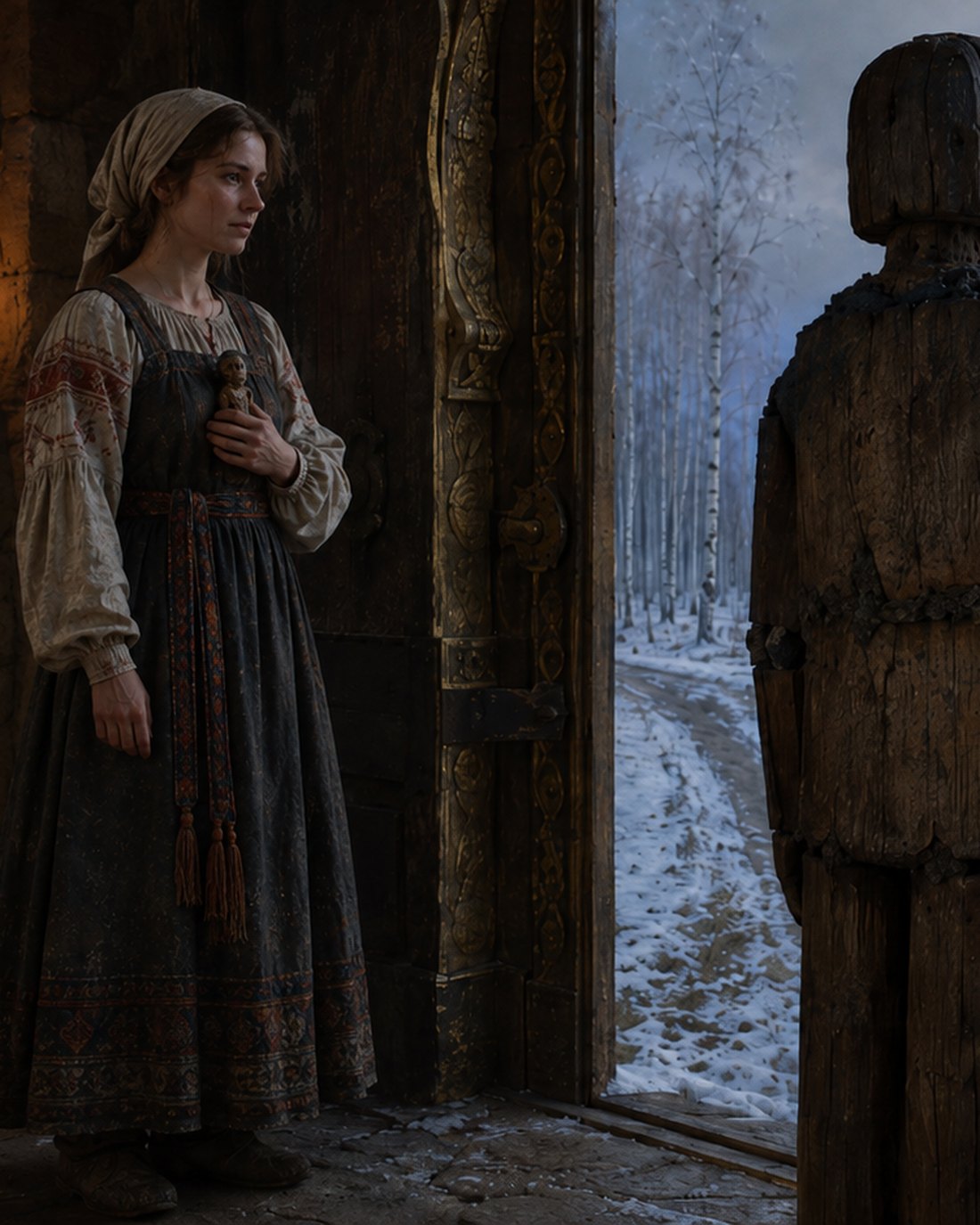 Fairy tale · Slavic folklore · Tale the Seventh · August 2026
The Choice
The house has gone quiet wherever she walks, and she understands at last what she made on that swept floor and what she told it. Three times the road out is closed against her. The third time she stops at the threshold, says the true thing she has never said aloud, and claims the name in the standing itself — and the bars, met, are no longer absolute.
7. The Choice
There came a season when the house learned a new trick. It went quiet wherever she was.
She would walk a corridor and the two women ahead of her would turn off into a doorway before she reached them. She would come into the kitchen and whatever had been going on there would already have finished. The bread she left on the low step stayed on the low step until the birds found it. Once she said good morning to a man she had nursed through a winter cough, and he looked at her, and looked away, and went on, and she stood in the corridor for a while afterward trying to work out which of them that had happened to.
She still tended the beautiful corner. She still fed the little wooden doll its crumb of bread and its drop of clean water, and it still rested warm against her heart, carrying the recognition that had come. In the small red corner the thin lampada burned before the icon. She still sang the old songs under her breath and said the simple prayers. The few who did reach her found her, and she gave them what she had.
The flame was offered. It was only that fewer and fewer people were being allowed to come and stand near it.
The thing near the threshold had stopped leaning toward her door. It had started standing in front of it.
She had begun, by then, to understand what she had made.
A companion that knew every ford between here and the burned country. A back that had held a raft together against the grey current with her lying flat on it and singing to keep breathing. And a heart-place that had closed cold on a swept floor, in the dark, because a girl with nothing left had needed the leaving to be light enough to lift.
There is no one left who would miss me, and nothing in me that anyone would want to keep.
It had taken what it was given. It kept what it was given. And the only thing it had ever been told about her was that no one wanted her — so it had set itself, with the terrible faithfulness of a thing that has one instruction, to make that true.
In the residual years the quiet remnant of that companion and the stone-hearted boyar of the house of gold and stone drew into one continuous presence. What had once been a path-knower without a true heart and a master who counted usefulness from a distance became the same silence: the presence that emptied rooms, stood in doorways, and would not answer. The Walker had merged into the owner of the cage — or the cage had taken the Walker into itself. The isolation that stopped all communication was now the house and its master as one.
It did not shout. It had no mouth to shout with. It emptied rooms, and turned feet aside in corridors, and stood in doorways, and did not answer.
The first of the three came in the spring.
The bundle came out from under the bed as it had a dozen times, and this time she got as far as the outer gate with it. And the gate did not open, and no one came to explain why, and after a long while she carried the bundle back up the stairs.
For three days after that nobody spoke to her at all.
It was in the quiet after those three days that the other thing took root — and this is the part that is hardest to tell rightly, because it was hers, and she knew it was hers.
Whenever the thought of the open road came up in her, or the thought of some small ordinary happiness — a threshold that did not watch her, a morning under birch light, a day in which the flame could be offered without asking anyone's leave — something inside her closed on it immediately. A sting. A small cold turning-away, quick as a hand pulled off a stove.
As if she had gone ahead and locked the gate herself, so that no one else would have to.
She knew it was wrong. That was the strange, exhausting part. She knew the name still rested in her heart and she knew the flame had never gone out. It made no difference at all. The sting came first and the knowing came second, every time, the way a bruise comes before you have finished deciding whether it hurt.
And the wooden thing at the door learned that bar the way a dog learns a whistle, and after that it hardly had to do anything itself. It only had to be silent while she did it for it.
The second came the next autumn, and it was clearer, and it went worse.
Word arrived by a traveller's mouth of a place further on where a woman of clear sight and working hands might live without gold and without stone, and where a few people still sang under birch light. For a day the air at the gate was different.
That evening she packed properly — cloth, bread, a little water, the doll close. She crossed herself. She walked down to the outer gate with the plain intention of going through it.
The sting rose before she reached the bottom of the stairs, as if by some quiet wrong charm that had got into the fear and the missing heart together and set up house there. She kept walking anyway, which took more out of her than the four days east ever had.
The Walker was in the gateway.
It did not speak, because it never spoke. It stood in the way that only a threshold-born thing can stand, and the silence of it went out through the whole house like cold through a wall.
For nine days after, the outer gate was shut to her. The rooms she moved through were emptier than rooms have any business being. The nurse with the burn-scarred wrist passed her twice without lifting her eyes, and Nika understood, later, that the woman had been made to. What little she had ever had the ordering of got smaller — her hours accounted for, her step watched, her going and coming decided elsewhere. The beautiful corner remained. The space around it got wider and wider and had less and less in it.
And every time a thought of the road rose, the sting answered it first, and the silence around her made the sting feel like the last word on the matter.
But she still trimmed the lampada. She still fed the doll.
And when one thin, fevered woman somehow got as far as the low step, Nika gave her bread and a steadying song under her breath — and as she did it the little wooden doll grew warm against her heart. A private warmth, the kind only she could feel, saying what it had always said: this is true, this part is true, whatever else is happening.
She set the bundle aside. She crossed herself. She stayed.
Then, in the deepest part of it, a stranger came to the outer door.
Or was brought there by necessity. Or found some quieter road through a watched gate, which afterward she thought about a great deal.
He had come out of a prison of stone and long silence not many weeks before. He was worn by the road, his boots finished with travel, and he carried the mark of a locked place the way a traveller carries dust — in the seams, where you cannot brush it off.
She was asked to tend him, or simply went, which by then amounted to the same thing.
She brought bread and clean water. He took the bread in both hands, and held it a moment before he ate, and she saw him notice her noticing.
"Habit," he said. "You get to like the weight of it."
She went to close the door against the corridor draught and he said, quite mildly, "Leave it open. I'll pay for the draught."
So she left it open, and sat down where he could see both her and the doorway, and did not remark on it.
He ate. She waited.
They talked a little, and not about the prison. What he told her was about after: that the gate had opened and he had walked out and gone on being alone for eleven weeks, and that nobody warns you about that part. "They tell you the wall is the thing," he said. "The wall isn't the thing. It's that afterward the quiet comes with you. It's in your pocket. You put your hand in for a coin and there it is."
She found herself telling him about the house going dumb around her. She had not said it out loud to anyone, having no one to say it to, and it came out badly and in the wrong order, and he did not once look away from it.
"And the other thing," he said. "The one you do to yourself."
"I don't —"
"You've got the look of a woman who's already had the argument twice and lost it both times." He said it without any pity in it at all, which was why she could hear it. "That's not weakness. That's just what a locked place teaches. It teaches you to do its work so it can have a rest."
The little wooden doll lay on the bench between them and grew warm. Warmer than it had been near the transformed Walker in years — though not the pure simple heat of her mother's first gift. Something steadier and more complicated than that, and it left the deeper question wide open.
Because she used the clear sight that had always been hers, and it would not settle. She could not say whether he was another Walker — flawed, or true — or something worse wearing a road-worn coat, or simply a man who had walked out of his own stone and was still alive.
The uncertainty stayed. So did the warmth. They turned out to be able to sit in the same room.
Before he left he stood in her doorway and looked at the small red corner with its shelf and its thin light.
"You keep a fire," he said, "for people who never once asked where you got the wood."
Then the road called him on, because the passing was true and he had never pretended otherwise. She crossed herself as she had been taught. He went out through the watched gate.
The rooms emptied again, at once, and further than before.
But something did not empty.
After he had gone, they went on speaking.
Not with words, and not by any art she could have explained to a living soul — only mind to mind, heart to heart, the way the old tales say a thing can carry between two people who have stood in the same cold.
There was a warmth left in the doll that was not only its own. When the sting closed around some rising hope, sometimes a second steadiness came up to meet it — not driving out the fear, but making it no longer the only voice in the room. When the old songs came up under her breath they carried, for a moment, the sense of a second voice somewhere out on the open road, keeping the low part.
The heart spoke, and was answered, across distance, while a threshold-born thing that had once been made of her father's timber refused to answer at all.
The quiet was no longer complete.
That was new. In fifteen years that was the only new thing.
The third came in the winter, and she made it carefully.
She packed as though for a real road, because it was one. The doll rested close against her heart. She stood at the threshold of the house of gold and stone and looked out at the far road under a low sky.
The Walker met her there with everything it had.
The rooms behind her went to the bottom of their emptiness. Not one door in that house opened. The silence came up around her like water in a well-shaft, and the sting rose into it and filled it, and between them they said the thing more completely than any voice could have: outside there may be no one, for the rest of your life. In here there is at least a wall you already know the shape of.
She stood a long time.
Two doors, and both of them plain.
One: risk it. Trust a man who had waited half a breath before giving her a name. Trust a quiet speaking she could not prove to anyone, including herself. Step out knowing the sting would come with her in her pocket like a coin, and knowing she might well end up alone anyway.
The other: take the walls, the silence, the bar she had learned to set against herself — perhaps for good — because the cost had been shown to her three times now, and shown clearly, and she was not a fool.
Then she went and stood in front of the thing she had made, and did the one piece of work that had been waiting fifteen years.
"I told you a lie," she said. "On the floor of my mother's house, the night before we left. I said there was no one who would miss me and nothing in me anyone would want to keep, and you believed it, because you had nothing else to believe, and you have been making it true ever since. That's my doing, not yours."
The silence did not change. She had not expected it to.
"So here's the true one, and you can keep this instead."
Her voice was not steady. It did not need to be.
"I was loved. I am still carrying it. My mother put your kin in my hands and told me never to lie to her, and my father's grain is in your shoulders, and a woman at a low gate gave me my name back for nothing. I have never once been what I told you I was."
The bar she had set against herself came up, hard, the way it always did.
And it met the true sentence coming the other way, and there was not room in her for both.
She stood a long time at the threshold with the true sentence still living in her, and the residual heart-to-heart still answering across the distance, and the continuous flame still offered in her hands.
Several paths lay open before her, clear and plain. One led further into the known walls and the silence of the merged presence that would not answer — the companion without a true heart and the stone-hearted owner of the cage become one. Others led outward under the low sky: the open road alone; roads that turned toward other thresholds and birch light; and among them the living possibility of the nameless stranger who had shared the isolation even while only passing — a path that could offer temporary or permanent safety and shelter without strings or judgment, while the residual speaking of mind to mind and heart to heart continued across the distance. He was there, when needed, to help or simply to be present, without demand. All of them remained open.
She did not choose either of them that day.
She fed the little wooden doll its crumb of bread and its drop of clean water. The doll rested warmer against her heart than it had been in many seasons — a private warmth that only she could feel. She trimmed the thin lampada. She spoke one of the old songs under her breath and the simple prayer she had been taught. She made the sign of the cross.
The true name rose fully then, no longer only resting in her heart but claimed in the standing itself: Nika. The quiet victory. The isolation was no longer the only possible hearth. The residual bars had been met and were no longer absolute. The continuous flame was still offered — to the road if she took it, to the known walls if she remained, to the path that might include the nameless stranger and the safety or shelter he could offer without strings or judgment, and to anyone who might yet find her either place.
The companion without a true heart stood in the way that only a threshold-born thing can stand, and the silence around it was absolute. The path beyond it remained. The residual speaking of mind to mind and heart to heart continued quietly across the distance. A higher care still held the light.
The road still branched. It always does.
And that is how the three attempts were made, and how the quiet was enforced by a thing that would not answer, and how it was broken for a while by a stranger who was only passing, and how the speaking went on after he had gone — and how Vasilisa, who had always been Nika, told the truth at last to what she had made, and stood at the open threshold with both paths before her, the continuous flame still offered, and the quiet victory already hers, while a higher care held the light for whatever choice she would make when the time for choosing fully came.
7. Выбор
Пришла пора, когда дом выучил новую хитрость. Он умолкал там, где была она.
Идёт она по коридору — а две бабы впереди сворачивают в дверь прежде, чем она их нагонит. Войдёт в поварню — а всё, что там шло, уже кончилось. Хлеб, оставленный на нижней ступени, лежал на нижней ступени, покуда его не находили птицы. Раз она сказала «доброе утро» мужику, которого выхаживала целую зиму от кашля, и он поглядел на неё, и отвёл глаза, и пошёл дальше, и она постояла потом в коридоре, соображая, с кем из них двоих это сейчас случилось.
Она по-прежнему берегла красный угол. По-прежнему кормила малую деревянную куклу крошкой хлеба и каплей чистой воды, и кукла по-прежнему лежала тёплой у сердца, неся узнавание, которое пришло. В малом красном углу тонкая лампада горела перед иконой. Она по-прежнему пела под нос старые песни и говорила простые молитвы. Те немногие, что до неё добирались, находили её, и она давала им, что было.
Пламя отдавалось. Только всё меньше и меньше людей пускали постоять с ним рядом.
То, что стояло у порога, перестало клониться к её двери. Оно стало становиться перед нею.
К той поре она уже начала понимать, что она сделала.
Спутника, знавшего всякий брод отсюда до горелой земли. Спину, что держала плот против серого течения, покуда она лежала на нём плашмя и пела, чтобы дышать. И сердечное место, что закрылось холодным на выметенном полу, в темноте, потому что девке, у которой ничего не осталось, надо было, чтобы уход весил столько, сколько она сможет поднять.
Нет никого, кто по мне затоскует, и нет во мне ничего, что кто-нибудь захотел бы себе оставить.
Оно взяло, что ему дали. Оно хранит, что ему дали. И единственное, что ему когда-либо сказали о ней, было то, что она никому не нужна, — и оно принялось, со страшной верностью вещи, у которой один наказ, делать это правдой.
В остаточные годы тихий остаток этого спутника и каменный сердцем боярин дома из золота и камня сблизились, пока различие не истончилось. То, что когда-то было знатоком пути без настоящего сердца, и то, что было хозяином, считавшим пользу издали, стало одним непрерывным присутствием: тишиной, что опустошала комнаты, вставала в дверях и не отвечала. Ходок слился с владельцем клетки — или клетка приняла Ходока в себя. Изоляция, что прекращала всякое общение, стала теперь домом и его хозяином как одним целым.
Оно не кричало. Кричать ему было нечем. Оно опустошало комнаты, и отводило шаги в коридорах, и становилось в дверях, и не отвечало.
Первая из трёх пришлась на весну.
Узелок вылез из-под кровати, как вылезал уже раз десять, и на этот раз она дошла с ним до внешних ворот. И ворота не отворились, и никто не пришёл сказать почему, и погодя она унесла узелок обратно наверх.
Три дня после этого с нею не заговорил никто.
И вот в тишине после тех трёх дней пустило корень другое, — и об этом всего труднее рассказать верно, потому что оно было её, и она знала, что оно её.
Стоило подняться в ней мысли об открытой дороге — или о каком-нибудь малом обыкновенном счастье: о пороге, который за нею не следит, об утре под берёзовым светом, о дне, в который огонь можно отдавать, ни у кого не спросясь, — как что-то внутри тут же на эту мысль смыкалось. Укол. Малый холодный отворот, быстрый, как рука с горячей плиты.
Будто она сама наперёд заперла ворота, чтобы этого не пришлось делать никому другому.
Она знала, что это не по правде. В том и была вся диковина и вся усталость. Она знала, что имя ещё покоится у неё в сердце, и знала, что огонь ни разу не гас. Толку от этого не было никакого. Укол приходил первым, а знание вторым, всякий раз, — как синяк проступает раньше, чем ты домыслишь, было ли больно.
А деревянное у двери выучило этот засов, как собака выучивает свист, и после почти уже ничего не делало само. Ему хватало молчать, покуда она делала это за него.
Вторая пришлась на другую осень, была яснее и вышла хуже.
Пришла с уст путника весть о месте дальше, где женщина ясного зрения и рабочих рук может жить без золота и камня и где кое-кто ещё поёт под берёзовым светом. На день воздух у ворот стал другой.
В тот вечер она собралась как следует: полотно, хлеб, немного воды, кукла близко. Перекрестилась. Сошла к внешним воротам с простым намерением через них выйти.
Укол поднялся, не дав ей дойти до низа лестницы, будто по тихому недоброму колдовству, что забралось в страх и в недостающее сердце разом и там поселилось. Она всё равно шла, и это вынуло из неё больше, чем когда-то четыре дня на восход.
Ходок стоял в воротах.
Он не сказал ничего, потому что он никогда ничего не говорил. Он стал на пути так, как может стать одно только порождённое порогом, и молчание его пошло по всему дому, как холод идёт сквозь стену.
Девять дней после того внешние ворота были ей заперты. Комнаты, по которым она ходила, были пустее, чем комнатам положено быть. Кормилица с ожоговым рубцом дважды прошла мимо, не подняв глаз, и Ника поняла после, что той велели. Воли у неё и прежде было мало, а стало и того меньше: часы её считали, шаг за нею глядели, а куда ей идти и когда — решали не она. Красный угол остался. Пустота вокруг него делалась всё шире, и в ней делалось всё меньше.
И всякий раз, как подымалась мысль о дороге, укол отвечал первым, а молчание вокруг делало из этого укола последнее слово по делу.
Но лампаду она подрезала. И куклу кормила.
А когда одна худая горячечная баба всё-таки добралась до нижней ступени, Ника дала ей хлеба и укрепляющую песню под нос — и покуда давала, малая деревянная кукла потеплела у сердца. Частное тепло, из тех, что чует она одна, и говорило оно то, что говорило всегда: вот это правда, эта часть — правда, что бы там ни делалось кругом.
Она отложила узелок. Перекрестилась. Осталась.
И тогда, в самой глухой поре, к внешней двери пришёл незнакомец.
Или его привела нужда. Или он нашёл какую-то тихую дорогу через сторожёные ворота, о чём она после думала немало.
Он вышел из тюрьмы камня и долгого молчания за несколько недель до того. Он был изношен дорогой, сапоги у него были стёрты путём, и след запертого места он нёс на себе, как путник несёт пыль, — в швах, откуда не выбьешь.
Её попросили за ним ходить, или она пошла сама, что к тому времени было одно и то же.
Она принесла хлеб и чистую воду. Он взял хлеб обеими руками и подержал, прежде чем есть, и она увидела, что он увидел, как она это заметила.
— Привычка, — сказал он. — Полюбишь его тяжесть.
Она пошла притворить дверь от коридорного сквозняка, и он сказал, довольно мирно:
— Оставь отворённой. За сквозняк я заплачу.
И она оставила отворённой, и села так, чтобы он видел разом и её, и дверной проём, и ничего об этом не сказала.
Он ел. Она ждала.
Поговорили немного, и не про тюрьму. Он рассказал ей про после: что ворота отворились, и он вышел, и одиннадцать недель после того продолжал быть один, и вот про это никто не предупреждает.
— Тебе говорят, будто всё дело в стене, — сказал он. — Не в стене дело. Дело в том, что после тишина идёт с тобой. Она у тебя в кармане. Полезешь за грошом — а там она.
И она поймала себя на том, что рассказывает ему, как вокруг неё умолкает дом. Вслух она этого никому не говорила, потому что говорить было некому, и вышло скверно и не в том порядке, а он ни разу не отвёл глаз.
— И то, другое, — сказал он. — Которое ты делаешь себе сама.
— Я не…
— У тебя вид женщины, которая уже дважды спорила сама с собой и дважды проиграла. — Он сказал это совсем без жалости, оттого она и смогла услышать. — Это не слабость. Так учит запертое место. Оно учит делать за него его работу, чтобы самому передохнуть.
Малая деревянная кукла лежала на лавке между ними и теплела. Теплее, чем годами теплела возле преображённого Ходока, — но это не был чистый простой жар первого материнского дара. Что-то более устойчивое и более сложное, и вопрос поглубже от этого оставался настежь.
Потому что она пустила в ход ясное зрение, которое всегда было её, и оно не улеглось. Она не могла сказать, другой ли он Ходок — с изъяном или истинный, — или что-то похуже в изношенном дорогой кафтане, или просто человек, который вышел из своего камня и всё ещё жив.
Неуверенность осталась. Тепло тоже. Оказалось, что они умеют сидеть в одной горнице.
Перед уходом он постоял у неё в дверях и поглядел на малый красный угол с полкой и тонким светом.
— Ты держишь огонь, — сказал он, — для тех, кто ни разу не спросил, где ты берёшь дрова.
И дорога позвала его дальше, потому что проход был истинный и он никогда не притворялся иначе. Она перекрестилась, как учили. Он вышел через сторожёные ворота.
Комнаты опустели снова, разом и глубже прежнего.
Но не всё опустело.
После того как он ушёл, они продолжали говорить.
Не словами и не каким-то искусством, какое она могла бы объяснить живой душе, — а умом к уму, сердцем к сердцу, как в старых сказках и сказано, что оно может нестись между двумя, кто стоял в одном холоде.
В кукле осталось тепло, которое было не только её. Когда укол смыкался вокруг подымающейся надежды, случалось, ему навстречу выходила вторая устойчивость — страха она не выгоняла, но делала так, что он переставал быть единственным голосом в горнице. Когда старые песни подымались под нос, они на миг несли ощущение второго голоса где-то на открытой дороге, ведущего низом.
Сердце говорило и получало ответ через даль, покуда порождённое порогом, сделанное когда-то из отцовского леса, не отвечало вовсе.
Тишина перестала быть полной.
Это было новое. За пятнадцать лет это было единственное новое.
Третья пришлась на зиму, и она сделала её тщательно.
Собралась, как собираются на настоящую дорогу, потому что дорога и была настоящая. Кукла легла близко к сердцу.
Она накормила малую деревянную куклу крошкой хлеба и каплей чистой воды, и кукла потеплела у сердца сильнее, чем за многие сезоны. Подрезала тонкую лампаду. Сказала под нос одну из старых песен и простую молитву, какой её учили. Перекрестилась.
Потом стала на пороге дома из золота и камня и поглядела наружу.
Ходок встретил её там всем, что у него было.
Комнаты позади опустели до самого дна. Ни одна дверь в том доме не отворилась. Тишина поднялась вокруг неё, как вода подымается в колодезном срубе, и укол поднялся в неё и её наполнил, и вдвоём они сказали это полнее, чем сказал бы всякий голос: снаружи, может статься, не будет никого до конца твоих дней. А здесь есть хоть стена, у которой ты уже знаешь очертания.
Она стояла долго.
Два пути, и оба простые.
Один: рискнуть. Довериться человеку, который помедлил на полдыхания, прежде чем назвать имя. Довериться тихому говорению, которого она не могла доказать никому, включая себя. Выйти, зная, что укол пойдёт с нею в кармане, как грош, и зная, что она вполне может всё равно остаться одна.
Другой: принять стены, и молчание, и засов, который она сама себе поставила, — может статься, навсегда, — потому что цену ей показали трижды и показали ясно, и дурой она не была.
И тогда она пошла и стала перед тем, что сделала, и справила ту единственную работу, что ждала пятнадцать лет.
— Я тебе солгала, — сказала она. — На полу материнского дома, в ночь перед тем, как нам выйти. Я сказала, что нет никого, кто по мне затоскует, и нет во мне ничего, что стоило бы себе оставить. Ты поверил, потому что верить тебе было больше нечему, и с тех пор ты это делаешь правдой. Это моя вина, не твоя.
Тишина не переменилась. Она того и не ждала.
— Так вот тебе истинная. Её и держи.
Голос у неё не был ровен. Ровным ему быть и не требовалось.
— Меня любили. Я это и сейчас несу. Мать вложила мне в руки твою родню и наказала ей не лгать, а волокно моего отца — у тебя в плечах, и женщина у нижних ворот вернула мне моё имя даром. Я ни разу не была тем, чем себя тебе назвала.
Засов, который она сама себе поставила, поднялся, туго, как подымался всегда.
И встретил истинное слово, шедшее навстречу, и места в ней для обоих не нашлось.
Она долго стояла на пороге, и истинное слово жило в ней, и говорение сердца к сердцу отвечало через даль, и непрерывное пламя было у неё в руках, отданное.
Несколько путей лежали перед нею, ясные и простые. Один вёл дальше в известные стены и в молчание слитого присутствия, которое не отвечает, — спутника без настоящего сердца и каменного сердцем хозяина клетки, ставших одним. Другие вели наружу под низкое небо: открытая дорога в одиночестве; дороги к другим порогам и под берёзовый свет; и среди них живая возможность безымянного незнакомца, что разделил изоляцию, даже пока только проходил, — путь, который мог предложить временную или постоянную безопасность и кров без условий и без суда, пока говорение ума к уму и сердца к сердцу продолжалось через даль. Он был рядом, когда нужен, — помочь или просто быть, без требования. Все они оставались открытыми.
В тот день она не выбрала ни одного.
И тогда истинное имя поднялось полностью — уже не покоясь в сердце, а заявленное самим этим стоянием: Ника. Тихая победа. Одиночество перестало быть единственным возможным очагом. Остаточные прутья были встречены и больше не были всевластны. Непрерывное пламя отдавалось по-прежнему — дороге, если она её возьмёт, известным стенам, если она останется, пути, что может включать безымянного незнакомца и безопасность или кров, которые он мог предложить без условий и без суда, и всякому, кто ещё найдёт её что там, что тут.
Спутник без настоящего сердца стоял на пути так, как может стоять одно только порождённое порогом, и тишина вокруг него была полной. Путь за ним оставался. Тихое говорение умом к уму и сердцем к сердцу шло дальше через даль. Высшая забота держала свет.
Дорога всё ещё ветвилась. Она всегда ветвится.
И вот как были сделаны три попытки, и как тишину держало то, что не отвечает, и как её на время разомкнул незнакомец, который только проходил, и как говорение продолжалось после того, как он ушёл, — и как Василиса, которая всегда была Никой, сказала наконец правду тому, что сама сделала, и стала на открытом пороге, и оба пути лежали перед нею, и непрерывное пламя отдавалось, и тихая победа была уже её, покуда высшая забота держала свет для того выбора, который она сделает, когда придёт его полный час.
-
Faerie folklore
The Faerie-Court Verdicts
Bracken-of-the-Index, notary to the Thorn Court, is sent through the hedge to judge which Court may claim three figures mortals think they know — a man the world calls a monster and the old law calls a keeper of doors, a barefoot planter whose gifts are never free, and a boy who has taught a nursery to love the thing that takes its children.
Read all three as one volume -
 Faerie folklore · A Court verdict
The Hacker
A notary of the Thorn Court is sent to judge which Court may claim the man mortals call a monster — and finds, instead, a keeper of doors.
They filed this petition under Trespass & Hospitality, which is how the Courts pretend the modern world is still made of doors.
The seal was split—half white wax, half black—pressed together so tightly the seam looked like a scar. That meant both Courts had signed, which meant one of two things: either they were cooperating… or they were both afraid to be alone with the truth.
The folio smelled like ozone and printer toner and rain on hot asphalt. Inside: incident summaries, clipped headlines, threat intel that read like prophecy, and—tucked between them like a knife in a hymnbook—a single sheet of paper.
A contract. Not metaphorical. Literal. A scope-of-work letter with neat human signatures, dates, and a clause about "authorized testing."
Below it, in the old ink that doesn't dry so much as cling: Determine which Court may claim him. Determine what he is.
And the mortal name—two words that make executives sweat and teenagers grin: The Hacker.
I am Bracken-of-the-Index, notary to the Thorn Court, keeper of small truths and enforceable language. I have witnessed vows made to rivers. I have seen saints barter their shadows. I have recorded the kind of bargains that turn "forever" into a technical term.
And I will tell you the first thing the Courts already know and the mortals refuse to learn: a Hacker is not defined by what he can break. He is defined by what he refuses to break.
I. The New Hedge: Where the World Became a Network of Thresholds
In the old world, thresholds were wood and iron: doors, gates, windows, bread and salt. Hospitality law was simple: you could not enter without invitation, and once you were invited, you owed your host restraint.
Modern humans replaced those thresholds with prompts and protocols. Login screens. MFA challenges. Tokens. Certificates. Handshakes.
They stopped seeing them as thresholds because there is no satisfying click when you cross them. No smell of oiled hinges. Just a quiet change in what the world will allow you to do.
That blindness is why the Unseelie have been eating well. Ransomware that arrives without knocking. Phishing that wears a friend's face. Malware that moves like smoke through open windows nobody remembers leaving open.
And so both Courts took notice. The Seelie were furious—not because humans suffered, but because hospitality law was being violated on an industrial scale. The Seelie hate nothing like uninvited mess. The Unseelie were… interested. Hunger recognizes opportunity the way sharks recognize blood.
But the folio made one thing clear: the entity called The Hacker was not the one feeding. He was the one showing up after the feeding—sometimes before—to nail boards over the broken windows.
And mortals, in their brilliant simplicity, were calling him a monster for it.
II. The Summons: A Human City with Fae Teeth
I followed the folio's coordinates to a city that pretended it had outgrown myth. Glass towers. LED billboards. Wet streets reflecting neon like spilled ink. The kind of place where you can feel anonymous in a crowd and still be watched by a hundred cameras.
In the old stories, you find the hedge at the edge of a forest. Here, the hedge was behind a data center.
A building with no windows and too much security, squatting like a stone barrow in a business park. Fences. Cameras. Guards who looked bored enough to be dangerous. The humming throb of generators that sounded, if you listened closely, like a chant.
It wasn't the building that mattered. It was the air around it—dense with rules. Humans think security is locks. Fae know security is agreement.
I walked to the perimeter and found the threshold the way I always do: not by looking for a gate, but by looking for the place the world insists you stop. A keypad. A badge reader. A sign in bold letters: AUTHORIZED PERSONNEL ONLY.
That, in the old law, is a spoken ward. It means: invitation required.
I set my palm on the cold metal of the fence and spoke my name in the tongue beneath English. The air acknowledged me, then grudgingly shifted. A service door appeared where there had been only blank wall—unremarkable, utilitarian, the kind of door people forget to watch because it looks like it belongs to nothing.
Modern thresholds hide in plain sight. I entered.
III. The First Rule: He Doesn't Enter Without Consent
Inside, the world smelled like chilled air and hot dust. Server racks lined the room like upright coffins, each full of murmuring lives—human lives made into records, policies, payments, family photos, love letters, secrets.
Mortals think data is abstract. Fae know data is a person's shadow, pressed thin and stored in metal.
At the far end, under a dim work light, someone sat in a rolling chair with their back to me. Hood up. Shoulders relaxed. A laptop open, screen full of pale text like snowfall. The posture of someone who knows exactly how many exits are behind them.
"I'm not here to stop you," I said, because opening lines matter.
The figure didn't turn. "Then you're here to label me."
"Something like that."
A quiet laugh. Not cruel. Not amused. More like… tired. He finally swiveled around.
Mask? No. Not theatrical. Just a plain face, unremarkable enough to vanish in a crowd. The hood was not glamour. It was privacy. His eyes, though—his eyes had the sharp calm of someone who spends their life reading systems the way others read moods.
"The Courts sent you," he said.
"Both," I replied. "That rarely ends well."
"That's their problem." He tapped the screen once, and I heard it—faint, like a distant chime. A lock engaging. A door being closed. Not physical. Logical.
He had just set a boundary. I felt it in the air: a tightening, a narrowing of possibility. That was the first sign. Unseelie predators widen possibilities—more access, more spread, more chaos. This one reduced them.
He looked at the contract page from the folio, which I had placed on a nearby rack like an offering. "Authorized," he said. "Scope is clear. Time window is clear. No production impact clause is clear."
Then he looked at me, and there it was—the thing that makes a Hacker Seelie when the world assumes he's Unseelie. He said, flatly: "I don't touch what I'm not invited to touch."
Not "I can't." Not "I won't get caught." Not "I choose not to today." Invited. Hospitality law.
IV. Exhibit One: He Leaves Receipts on Purpose
A Hacker who feeds—Unseelie hunger—steals in silence. Leaves nothing but absence and confusion. Makes you doubt your memory of the world. This one… documented.
He opened a folder and showed me a report draft. It was clinical, precise, almost obnoxiously careful: what he observed, what it meant, how to reproduce it in controlled terms, how to fix it, how to verify the fix. And—crucially—what he did not do.
"I could have taken more," he said, matter-of-fact, like a carpenter noting he could have knocked out a load-bearing beam. "But that's not the point. The point is proof without harm."
Seelie justice loves proof. Seelie courts love records. They love things that can be pointed to later when someone tries to wriggle out of responsibility. Unseelie creatures love plausible deniability.
This Hacker did the opposite of what hunger does: he made the truth impossible to ignore. He handed mortals a mirror and forced them to look at the crack. That is Seelie behavior—uncomfortable, corrective, lawful.
V. Exhibit Two: He Does Not Humiliate—He Repairs
There is a kind of person who breaks locks for the joy of hearing the snap. A kind of person who wants to prove they can hurt you. That is Unseelie pride. It's not always evil. But it's always dangerous.
This Hacker moved like a medic, not a vandal. He spoke about misconfigurations the way a surgeon speaks about wounds: with respect for the body, contempt only for negligence. "It wasn't one bad choice," he said. "It was a pattern. Convenience treated as entitlement."
Then he did something that surprised me enough to make me still. He stood, walked to a whiteboard, and wrote a single line: A system is a promise you keep at scale.
He capped the marker and looked back at me. "Hacking is just asking whether the promise holds."
That, right there, is the Seelie frame. Seelie are not "nice." They are consistent. They believe promises have weight and that a threshold exists to be respected, not to be mocked. He didn't revel in the cracks. He treated them like breaches of hospitality—an insult to the idea that a door should mean something.
VI. The Unseelie Arrive: Hunger Wearing a Human Suit
It happened while we spoke. A shift in the server hum. A brief stutter in the air. The kind of moment mortals call "network latency" and never realize they just felt a predator brush past.
The Hacker's expression didn't change much, but his gaze snapped to a log stream like a dog hearing a distant whistle. He typed—fast, economical, not showy. No cinematic hacking. No neon skulls. Just intent made visible.
"What is it?" I asked.
"Something uninvited," he said.
In my mind, I saw it the way my kind sees such things: not as code, but as behavior. A pressure trying doors. A slick hand testing latches. A hunger that doesn't knock because it doesn't believe in doors.
He didn't chase it through systems like a hunter. He did something subtler. He closed the world around it. Suddenly the air in the room felt narrower—as if the data center itself had become a hallway with fewer exits. He was building a fence. A Seelie fence.
And then—quietly, almost gently—he spoke aloud, not to me, but to the presence moving through the wires: "You're out of scope."
That shouldn't have meant anything. It was a human phrase. But in the mouth of a Seelie-aligned entity, it became a ward. You have no invitation here.
The pressure recoiled. Not defeated—hunger rarely is—but blocked, redirected, denied easy meal.
If it had been a mortal intrusion, the Hacker would have captured it, studied it, neutralized it with a report. But this was not merely mortal. This was something that lived on attention and negligence. Unseelie.
And the Hacker treated it exactly as hospitality law demands: not with vengeance. With refusal.
VII. Exhibit Three: He Honors the Old Law—And That's Why Everyone Fears Him
Mortals fear Hackers because they don't understand the difference between ability and intent. The Courts fear Hackers because they understand it too well.
A Hacker who is Seelie is terrifying in a very specific way: he will not let you lie about your own doors. He forces accountability. And accountability is pain to anyone who has been living on shortcuts.
He showed me the simplest truth in the entire modern world: most breaches are not sorcery. They are hospitality violations. Someone left a door open and told themselves it "didn't matter." Someone accepted a guest without checking their name. Someone built a castle and forgot to guard the pantry.
And when the Unseelie came calling, the humans blamed the locksmith.
That is why the folio existed at all: because the Courts needed to decide whether to protect him, claim him, or silence him. Because Seelie-aligned Hackers are inconvenient. They make comfort expensive.
VIII. The Verdict: The Hacker as Seelie
I opened my book of thresholds and wrote by the cold light of the server LEDs. My iron pen scratched the page like a nail on glass. Here is what I recorded—my verdict, the reason both Courts brought me here:
The Hacker appears Unseelie because he trespasses, uncovers secrets, defeats barriers, and speaks in a language of exploitation. But his operational nature aligns with Seelie law: he requires invitation and scope; he does not enter unbidden. He respects thresholds as promises, and treats breaches as broken hospitality. He leaves receipts and mirrors—reports, evidence, and paths to repair—rather than feeding in silence. He reduces harm; he closes doors rather than widening them. He acts as a warden against true Unseelie hunger—malice that ignores permission entirely.
In short: he is not a thief. He is a keeper of doors in a world that forgot doors matter. Seelie. Not gentle, not warm, not interested in comforting lies. But lawful. Necessary.
IX. The Moment That Made It Certain
I finished writing and closed the book. The Hacker watched me, expression unreadable.
"Are you going to tell them?" he asked.
"I'll file the report," I said. "Truth is its own complication."
He nodded once. Then, after a beat, he said the quietest and most revealing thing of the night: "I wish humans understood that I'm on their side."
"That's not Seelie," I said, before I could stop myself.
He tilted his head. "No?"
"Seelie don't do 'sides,'" I replied. "They do rules."
Something like a smile ghosted at the edge of his mouth. "Then write this rule down, Notary." He leaned forward, eyes reflecting the pale glow of the logs like moonlight on water. And he spoke, not as a threat, not as a promise, but as a law—clean, cold, protective: "If you can't defend your threshold, you don't get to pretend it's yours."
Then he turned back to his screen and began closing doors no one remembered opening. Outside, the city kept glowing, loud and oblivious, confident that myths belonged to older centuries. And in the humming heart of its infrastructure, a Seelie warden kept the Unseelie from eating the world through its forgotten windows.
-
 Faerie folklore · A Court verdict
Johnny Appleseed
The same notary follows a barefoot man who plants apple trees across the frontier — and learns that the most dangerous Unseelie look like gifts.
They sent for me again when the leaves had gone dry and loud, the kind that betray every footstep like a gossip. A different petition this time—inked in cider-brown, sealed with wax that smelled faintly of crushed apple skins and iron.
Matter: The Man Who Plants. Name among mortals: Johnny Appleseed. Claimants: A Seelie delegation (Hearth & Harvest) and an Unseelie delegation (Thorn & Hunger). Task: Determine his Court.
I am Bracken-of-the-Index, notary to the Thorn Court, keeper of the small truths that keep the big lies from collapsing. I have adjudicated duels between lightning and pine. I have witnessed marriages between grief and song. I have recorded bargains that lasted longer than mountains.
And I will tell you this plainly, before I tell you the story: the most dangerous Unseelie do not look like monsters. They look like gifts.
I. Apples Are Not Neutral
Mortals treat apples as wholesome symbols—lunch pails and pie windows and schoolhouse gratitude. Faerie does not.
In Faerie, the apple is a threshold fruit. It is round as a world. It is sweet as desire. It is a promise that stains your hands. Apples appear in too many old stories for coincidence: islands of eternal youth, sleeping curses, love divinations, the fruit that is never just fruit.
The Seelie say apples are hospitality—harvest, hearth, the kindness of orchard rows. The Unseelie say apples are leverage—temptation, binding, the long game of seeds. Both are right. Which is why they fought over him.
Because Johnny Appleseed did not merely carry apples. He carried the idea of apples into places where the wild had never agreed to them. And an idea is how Faerie conquers without marching.
II. The Hedge Opens onto the Ohio River
The hedge let me out at the edge of a river that rolled like dark glass. A wide American river, broad-shouldered, indifferent—carrying logs, carrying silt, carrying the future with the patience of something that cannot be hurried. Fog sat on the water in strips. Somewhere beyond it, a wolf called once and then thought better of it.
I knew the era by the smell: woodsmoke, wet leather, and fresh-split timber. The frontier, where humans learned quickly that the land does not care whether you are brave.
And there—on a rise above the riverbank—was the first sign I was on the correct trail: a neat little nursery patch of saplings, planted in lines too orderly for the wilderness, guarded by thorns that were not native to that soil. A fence built of brambles, living and awake. Unseelie craftsmanship. Not violent. Just… proprietary.
As I studied the saplings, a voice came from behind me, mild as sermon water. "You're looking at them like you're deciding whether they'll hurt you."
I turned. A man stood there barefoot on frost-bitten ground as if the cold had forgotten him. He was lean, half-shadowed by the trees. A cooking pot sat on his head at a jaunty angle like a crown that had been pawned and repurchased. A sack was slung over his shoulder—bulging with something that clinked and whispered. Seeds.
His eyes were bright, but not in the innocent way people mean when they say bright. Bright like flint. Bright like a match before it remembers what it does.
"John Chapman," I said, because names matter and because he was old enough in story to have two: one for mortals, one for the hedge.
He smiled without showing teeth. "Most folks call me Johnny."
"That is a diminutive," I replied.
"That is a choice," he said, and it was the first time his politeness felt like a knife being turned sideways.
He held out an apple. It was small, rough-skinned, more scar than shine. "A traveler's welcome," he offered. "Eat."
Seelie hospitality has rules: bread, salt, clear guest-right. Unseelie hospitality has hooks: food offered too quickly, too casually, with no stated terms—because the terms come later, when your mouth has already said yes. I did not take it.
Johnny did not seem offended. He only watched me the way a farmer watches weather: with the calm certainty that it will happen regardless of preference.
III. The Seelie Argument, and Why It Almost Works
The Seelie delegation—three harvest-fae with wheat-gold hair and manners like warm kitchens—had made their case before I left the Court. They spoke of him like a saint. "He plants life." "He feeds the hungry." "He asks little for himself." "He is gentle." "He is generous." All true—at least on the surface. In Faerie, truth is often the first layer of a lie.
When I met Johnny, he spoke kindly to a passing settler. He offered saplings for almost nothing. He pointed out a safe ford across the river. He shooed a child away from a snake den with a voice like a lullaby. No threat. No glamour show. No theatrical menace.
And that is precisely why the Unseelie wanted him. Because the most effective predation is the kind that convinces the prey it is choosing.
IV. Exhibit One: The Seed as Contract
Johnny walked with me along the edge of his nursery. He did not step between rows; he stepped beside them, as if the saplings were a congregation and he was their preacher. He crouched, dug a thumb into the soil, and pulled up a seed from the dirt like a coin.
"Do you know what a seed is?" he asked.
"A future," I said.
He nodded approvingly. "A future you can put in somebody else's hands." Then he dropped it into the furrow again and patted the soil down, gentle as tucking in a child.
Here is the Unseelie mechanism hidden inside the pastoral image: a seed is small enough to be dismissed. Small enough to be accepted without thought. Small enough to be carried home. But once planted, it demands years of care. Water. Protection. Space. Patience.
And when it finally bears fruit, it has altered the land around it—shade, roots, insects, birds, beasts. A new little ecosystem, built around a human promise they didn't recognize as a promise. Johnny's gift is never just an apple tree. It is a commitment disguised as generosity.
That is Unseelie to the marrow. The Seelie bind you with visible rules and ceremonies. The Unseelie bind you with something you willingly nurture.
V. Exhibit Two: Orchards as Invisible Borders
We reached a clearing where someone had stacked logs for a cabin that did not yet exist. The place was marked by human ambition: a cleared patch, fresh stumps, the air raw with sawdust. In the corners—where property lines would someday be argued over—Johnny had planted saplings. Not in the center where they'd be admired. On the edges.
I looked at him. "You plant like you're drawing."
He shrugged. "Trees make good markers. People trust what grows."
Exactly. Humans arrive and say, This is mine. The wilderness replies, Prove it. Johnny provided proof in advance: living stakes, orchard-corners, future fences. He placed himself quietly at the hinge point where wilderness becomes settlement—not by conquest, but by cultivation.
And do you know what Faerie calls a border drawn without being noticed? A snare. Because once the border exists, conflict arrives to defend it. People fight over it. They bleed for it. They change themselves for it. A Seelie might bless a harvest already promised. An Unseelie plants the dispute that will ripen later.
VI. Exhibit Three: The Bitter Apple and the Sweet Lie
Johnny finally ate one of his own apples in front of me, biting into it without flinching. It was not the kind of apple mortals imagine—crisp and honeyed. It was sharp, tannic, almost medicinal. I tasted the air and understood: many apples grown from seed are unpredictable—often bitter, fit more for pressing than for eating.
Johnny smiled at my recognition. "Most folks don't eat them," he said. "They drink them."
Ah. Drink is how humans trade pain for forgetting. Drink is how a hard year becomes survivable. Drink is how grief is set down for an hour. And in the old grammar of Faerie, fermented fruit is a cousin to enchantment: it loosens memory. It blurs judgment. It makes a person willing to stay where they are.
Johnny wasn't handing out sweetness. He was handing out a method. A way for settlers to dull the ache of displacement, loneliness, and loss—so they could keep pushing forward without breaking. It sounds merciful until you see what it enables: forests cut faster, treaties ignored more easily, the land made into product instead of presence.
The Unseelie don't always push you by force. Sometimes they steady you with a warm cup so you can walk deeper into a mistake.
VII. Exhibit Four: He Takes Payment That Doesn't Look Like Payment
We met a family that afternoon—tired faces, hungry children, a mother whose hands had forgotten softness. Johnny offered them saplings. The father asked what he wanted in return. Johnny shook his head. "Pay me when you can."
A Seelie would have named the price openly, because Seelie bargains favor clarity. Johnny did not. When the father insisted—pride and suspicion braided together—Johnny paused, as if considering what would fit the man's soul. Then he said, lightly, "Tell me your names."
Just that. Names. The father gave his. The mother gave hers. The children did too, delighted to be included. Johnny repeated each one carefully, tasting the sound of it, as if learning a spice.
I felt the hairs on my arms lift. Names are not merely labels in the hedge-world. They are handles. Not always used cruelly—but always usable.
When they finished, Johnny smiled, wished them luck, and walked away. The family thought they'd received charity. But I saw the actual transaction: he had sold them a future obligation—care for the trees—and taken in exchange the one thing mortals give away too easily, because they do not know it has weight.
A Seelie might take your name in ceremony and bind themselves to you through guest-right. An Unseelie takes your name casually, like borrowing a tool, and never tells you what they might build with it.
VIII. Exhibit Five: The Animals That Do Not Fear Him
That night we camped near his nursery. Coyotes yipped in the distance. An owl watched us with judgmental patience. Johnny sat cross-legged by the fire, humming something that sounded like a hymn until you listened closely and realized it was older than the church that would later claim it.
A deer approached the fireline, close enough that I could see its breath. It did not bolt. Johnny looked up and nodded to it like an equal. Then, in the brush beyond the deer, I saw movement—low, heavy, purposeful. A bear. It did not charge. It did not retreat. It simply stood and watched him, the way a guard watches a gate.
Predators and prey holding calm in the same frame is not "nature being friendly." It is an agreement. Unseelie power is often recognized not by what it attacks, but by what refuses to attack it. Johnny Appleseed wore gentleness like a coat, but something underneath it held the forest in negotiation.
IX. The Question I Asked That He Answered Too Honestly
Near midnight, while the fire sank into coals, I finally asked what I had come to ask. "Who do you plant for?" I said. Not why. Not how. Who.
Johnny looked at me for a long moment. The coals reflected in his eyes like little red worlds. Then he said, softly, "For the ones who come after."
That is a beautiful answer. It is also an Unseelie answer. Because "the ones who come after" is vague enough to contain anything: kindness, conquest, refuge, ruin. It is the language of people who operate on timescales that make individual suffering feel like an accounting error.
Seelie kindness is immediate. It warms the present. Unseelie ambition is patient. It shapes the future. Johnny planted futures. And he did it across miles of wilderness like a quiet spell cast one seed at a time.
X. The Verdict: Why Johnny Appleseed Is Unseelie
At dawn I wrote my findings on vellum and held it over the river so the mist could witness it—because in this land, water remembers. Johnny watched me write without comment. He only smiled as if the outcome amused him.
Here is my verdict, and the reasons—plainly stated, even if wrapped in story. Johnny Appleseed is Unseelie because his gifts are commitments: a sapling is not charity; it is a decades-long obligation that binds land and people to a future they did not fully consent to. He plants borders before humans recognize borders, using orchards and nurseries to pre-shape settlement patterns, disputes, and claims—soft power that becomes hard consequence. He spreads a fruit that often becomes drink, and drink is enchantment's cousin; he offers comfort that enables endurance, and endurance enables expansion, and expansion feeds hunger. He takes payment in things mortals underestimate—names, stories, promises, small moral obligations. And the wild does not treat him as prey or intruder; the forest negotiates with him. That is not sainthood. That is jurisdiction.
He is not a cackling villain. He is something colder, and subtler: a man who smiles like a blessing while planting inevitability.
When I finished, I sealed the vellum with Thorn Court wax—black with a red sheen, like an apple held too long in winter. Johnny tilted his pot-hat crown in a mock bow. "So," he said, pleasantly, "what am I?"
"You're Unseelie," I replied.
He did not protest. He did not deny it. He only looked out over the river, where fog curled like breath, and said, as if sharing a private joke with the world: "Funny how folks think planting means you're harmless."
Then he reached into his sack, pulled out a handful of seeds, and scattered them into the grass as if tossing coins at a beggar. The seeds disappeared into the soil. Quiet. Invisible. Already working.
And I understood the final, simplest truth of him—the truth the Seelie always miss until it is too late: an Unseelie doesn't have to chase you. He only has to plant something you'll spend your life tending.
-
 Faerie folklore · A Court verdict
Peter Pan
The notary is sent through the hedge to Neverland to weigh a legend — and finds the open nursery window for exactly what it is.
They sent me through the hedge on a night when the moon looked like it had been filed down to a hook. That was the first sign the matter would not be settled politely.
I am Bracken-of-the-Index, notary to the Thorn Court and keeper of small truths—names correctly spelled, debts properly witnessed, promises pinned like moths to velvet so they cannot flutter into "I never said that." I have written treaties between river and stone. I have seen a duke marry a storm for leverage. I have watched a saint bargain away her own shadow for a loaf of bread.
And I was sent to answer a question that mortals ask with a laugh, and fae ask with a shiver: is Peter Pan Seelie… or Unseelie?
The Seelie clerk who delivered the summons tried to speak as if this were a bureaucratic misunderstanding. A jurisdictional dispute. A paperwork problem. But he would not meet my eyes.
"Just a boy," the clerk insisted, voice too bright. "A story. Innocent. Surely."
He handed me a sealed folio. Wax stamped with a crown of hawthorn. Inside: a single line, written in the old ink that stains the soul as well as the page. Determine which Court may claim him. Determine what he is.
As if I could weigh a legend on a scale.
Still, I went. Not because I wanted to—no one sane walks into Neverland on purpose—but because my kind cannot refuse a formally sealed request without losing something vital, like the ability to taste salt or remember our mother's face. Contracts are the bones of Faerie; break them too often and you become soft.
So I stepped through the hedge. And the world changed its rules around me like a grin.
I. The Courts and the Lie We Tell Children
Mortals imagine Seelie and Unseelie like tidy opposites: summer and winter, kindness and cruelty, sunlight and shadow. That is a children's lie.
The Seelie Court can be kind the way a river is kind—by giving you water until you drown. The Unseelie Court can be generous the way a wolf is generous—by letting you run far enough to feel hope before the teeth close.
But there are differences, and they matter. The Seelie prefer order: hospitality laws, proper invitations, clear bargains, a story with a moral—even if the moral is "don't trust us." The Unseelie prefer hunger: the half-spoken promise, the game that becomes a hunt, the gift with a hook hidden inside. They savor imbalance. They love the moment someone realizes the rules changed and nobody told them.
To answer what Peter Pan is, I did not need to listen to what he said. I needed to watch what he did. And what he did—again and again—was the signature of the Unseelie: he made a playground out of predation.
II. Arrival: The First Unseelie Courtesy
Neverland is not a place in the way London is a place. It is a permission that looks like geography. It is a pocket stitched into the coat of the world, and the stitching is made of longing.
You do not arrive there by map. You arrive by want.
I landed badly, because I did not want it enough. I hit sand that glittered like powdered bone and tasted iron in the air—old blood, old ship nails, old promises.
Above the beach, a boy's laughter skipped across the treeline. It wasn't the laughter of someone amused. It was the laughter of someone testing the sharpness of the world, the way you tap a blade with your thumbnail.
A small light flared near my face—an insect-sized person, all heat and impatience. A fairy, yes, but not the gentle kind mortals paint on cakes. This one had the look of a spark that wanted to be a fire. She hovered at eye level and glared. "You're not supposed to be here," she said, as if my existence offended her.
"I was invited," I replied carefully.
She made a rude noise. "He invites who he wants."
That, too, was a sign. Seelie invitations come with rules: thresholds, names, bread, salt, a clear acknowledgment of guest-right. Unseelie invitations come like an open window at night. Not an invitation, exactly. A temptation.
III. The Window Rule: How Unseelie Take Children
Mortals tell the story like this: Peter Pan is a magical boy who teaches children to fly and takes them to an island where they never have to grow up. That is how you describe a kidnapping to someone who doesn't want to hear the word "kidnapping."
The Unseelie have always taken children. Not always with malice—sometimes with need, sometimes with envy, sometimes because a child's unspent potential tastes like honeyed wine. But there is a pattern: they come at the edge of sleep. They offer escape, not consent. They trade wonder for memory. They do not return what they take unchanged.
Peter Pan fits the pattern like a glove fits a hand that intends to steal. He does not knock on doors in daylight. He slips in through nursery windows at night, when adults are softened by exhaustion and children are porous with dreams.
He listens for the secret thought every child has had at least once: What if I could leave? Then he answers it. Not with a discussion. Not with a plan. Not with a parent's permission. With flight.
The fairy beside me—Tinker Bell, I realized, from the way she took offense at the world—darted ahead through the trees, dragging me toward the sound of boys shouting and something heavy crashing into foliage.
We found them in a clearing lit by moonlight and the glint of sharpened things. There they were: children armed like soldiers, faces smudged with dirt and triumph. They were playing at war with the seriousness only children can bring to games, because to them a game is not trivial—it is reality with training wheels.
And there, above them, balanced on a branch like a cat that had learned to smile: Peter Pan. Small. Bright-eyed. Too still.
He looked like a boy. That was the glamour. That was the hook. But his shadow hung beneath him like a separate creature, and it moved a half-beat too late, like something reluctant.
His grin widened when he saw me. "New game?" he asked. Not "Who are you?" Not "Are you lost?" Not "Do you need help?" New game.
Unseelie do not ask what you need. They ask what you will do for entertainment.
IV. Exhibit One: The Hunger for Names
Names are currency in Faerie. A Seelie might ask your name with ceremony—so the bargain is explicit. An Unseelie will coax it out of you as if it's nothing, then spend it later when you can't stop them.
Peter jumped down from the branch, landed without sound, and circled me. "What's your name?" he demanded, immediate and bright.
I kept my expression neutral. "You may call me Bracken."
"That's not a name," he said, delighted. "That's a plant."
"I am fond of accuracy," I replied.
He leaned closer, eyes gleaming. "You don't sound like you're fond of fun." Then—without waiting—he shouted to the Lost Boys. "Everyone! This is Bracken! He came because he heard about me!"
A theft, neat and quick: he declared my motive for me, and by doing so, tried to make it true. That is old Unseelie craft—narrative possession. If they can get the room to agree on the story, the story becomes a cage.
The boys cheered. They didn't know they were consenting to my humiliation; they thought they were welcoming a visitor. Peter watched my face to see if I flinched. He liked it when people flinched.
V. Exhibit Two: The Bargain of Flight and the Cost of Forgetting
He offered me flight the way some offer a cigarette: casual, conspiratorial, dangerous. "Want to fly?" he asked.
"You do not give without taking," I said.
He laughed. "I give lots of things!" Tinker Bell buzzed indignantly near his shoulder, as if offended that anyone questioned his generosity.
Peter pinched the air and some glittering dust appeared—pixie dust, yes, but do not be fooled by the sparkle. In Faerie, glitter is often just poison with good marketing. "Just think happy thoughts," he said, "and you can do it."
Happy thoughts. Do you know what that means in the tongue beneath English? It means: feed me something sweet from inside you.
Happiness is not free. It is made of memories, of warmth, of safety—things that come from time and attachment and being cared for. Children have it in abundance because adults build it for them. Peter takes it as fuel.
But the true cost comes later. Because every time a child returns from Neverland—if they return—they come back altered. Not always visibly. Sometimes it is small: a gap in the timeline, an emotion with no source, a feeling that something precious was misplaced. Sometimes it is larger: the creeping certainty that adulthood is a trap and childhood is the only real life.
And most telling of all: Peter forgets them. He forgets them the way winter forgets the names of flowers. That is Unseelie, too: to consume without cherishing, to feed without bonding. He takes companions the way a bonfire takes wood. Bright for a while, then gone.
When I asked one boy—curly-haired, wary—how long he'd been there, he frowned and seemed to search his mind like a pocket. "I… I don't know," the boy admitted. "It's always been like this."
Peter clapped him on the shoulder. "Does it matter? We're having fun!"
Fun, in that moment, meant not knowing your own past. A Seelie might bind you with rules and titles. An Unseelie binds you by eroding the self until you can't imagine leaving.
VI. Exhibit Three: Eternal Childhood as a Form of Winter
Mortals think "never growing up" sounds like freedom. In Faerie, stasis is rarely freedom. It is winter. Not the poetic kind with clean snow and quiet beauty. The real kind that kills crops, cracks stone, and makes hunger a constant background noise.
To grow up is to change. To change is to risk pain, yes—but also to gain depth, choice, understanding. Growing up is a kind of magic humans are born with: the ability to become someone new.
Peter Pan rejects that magic. He doesn't merely avoid adulthood; he treats growth like contamination. That is the Unseelie philosophy in miniature: better to freeze than to bloom, because bloom implies endings, and endings imply loss, and loss implies grief.
Peter cannot tolerate grief. He converts every serious thing into a game because games have rules you can pretend are harmless. Games let you hurt people while smiling. Games let you reset the world after consequences. Unseelie love games for the same reason: games disguise cruelty as play.
I watched Peter orchestrate a "rescue" that was, in any sober accounting, a raid. He sent children into danger because danger was exciting. He praised recklessness like virtue. When someone got hurt, he laughed as if the injury were applause.
Not because he was ignorant. Because he was insulated. Children often lack empathy because empathy must be practiced. But Peter has had endless time to practice, and still he treats pain as decoration.
Endless childhood is not innocence. It is a refusal to develop the muscles of conscience. That refusal is not neutral. It has a taste. It tastes like Unseelie.
VII. Exhibit Four: The Hunt-Shape of His Joy
There is a particular brightness in the eyes of hunters. Not always a cruel brightness—hunting can be necessity—but it is unmistakable. It's focus. Anticipation. The body leaning forward toward the moment of capture. Peter's joy has that shape.
He "plays" at fighting pirates, but the pirates are not wooden cutouts. They bleed. They fear. They die. Peter treats them like props in his perpetual theater of triumph.
The Unseelie love the hunt not only for the kill but for the chase—the stretching out of fear like taffy. Peter teased his enemies. He played with them. He performed bravery because he could not imagine himself truly harmed, and that confidence made him fearless in the most terrifying way: not courage, but carelessness.
Courage acknowledges risk. Peter denies it. There is a reason so many old tales warn you about beings who cannot die. They begin to treat everyone else's mortality like a toy that can be broken and replaced.
Even his greatest enemy, the hook-handed captain, is less opponent than entertainment. A villain carefully maintained because stories need villains, and Peter is addicted to stories where he is always the hero. The Unseelie do not merely like stories. They like being in control of them.
VIII. Exhibit Five: The Shadow That Wouldn't Stay
In London, the story is told as a charming oddity: Peter loses his shadow, and a girl helps him reattach it. In Faerie, a shadow that can be separated is never "just" an oddity. A shadow is the evidence of a soul being anchored properly to the world. When it slips away, it means something in the self is unmoored.
I saw his shadow up close when he stood in the moonlight, hands on hips, basking in the attention of the Lost Boys. It did not cling to him like a faithful dog. It hung back like a prisoner. When he moved, it followed—but with reluctance, as if considering rebellion.
A Seelie creature's glamour tends to be harmonious: beauty that fits, magic that makes sense within itself. An Unseelie glamour is often patched, stitched, held together by will and appetite. It can be dazzling, but it never fully aligns. Peter's shadow was not aligned.
And I remembered what mortals overlook: the way he demanded that a child help him stitch it back on. Not asked. Demanded. Unseelie power often comes with a peculiar dependency: they are mighty, but they require something from you—your hands, your fear, your belief—to complete the spell.
Peter cannot sew his own shadow. That is telling. He needs a child to participate. He needs the child complicit. Unseelie love complicity. It makes the victim feel responsible for the harm.
IX. Exhibit Six: Affection as Possession
People confuse Peter's charisma for love. But love, even in Faerie, involves a recognition of the other as real. Peter's affection is closer to ownership.
He collects people like trophies: Lost Boys, a clever girl, a jealous fairy, a fearsome enemy. He arranges them into a story that flatters him. When they deviate from their roles, he punishes them—not always with violence, sometimes with something colder: forgetting.
I watched him do it. One of the boys—older than the rest, shoulders sharpening toward adolescence—hesitated during a plan. He asked, quietly, what would happen if they ever went home. Peter's eyes narrowed, just a fraction. Home was a word with gravity. Home was a threat.
Peter smiled, and the smile did not reach his eyes. "Why would you want that?" he asked, as if the boy had suggested eating dirt. The boy's face fell. He glanced around at the others, suddenly uncertain of his place. Peter turned away.
And in that turning away, something shifted. The boy's presence dulled, like a candle snuffed. Not literally invisible. Worse: socially erased. The other boys stopped looking at him, not out of malice, but because Peter's attention is the sun in that little world. If Peter doesn't see you, you begin to vanish.
That is Unseelie. That is how the cold kills: not with a dramatic strike, but by withdrawing warmth until life can no longer justify itself.
X. The Verdict: Why He Is Unseelie
On the third night, I built a small fire on the beach and wrote my findings on vellum that would not burn. I wrote as the tide hissed and the stars looked too close. Peter came to watch, curious.
"What are you doing?" he asked.
"Accounting," I said.
He wrinkled his nose. "Boring."
"Not to the Courts."
He tossed a pebble at my fire and watched sparks leap. "Which Court do you think I belong to?"
There it was: the question behind the question. Not "What am I?" But "Who gets to claim me?" Because even Peter knows he is something that can be claimed.
I looked at him fully then—not at his face, but at the shape of his presence in the world. The way the air bent around him. The way attention snapped toward him like iron filings to a magnet. The way the Lost Boys' laughter rose or fell based on his mood, like birds responding to weather. And I saw it: the truth stitched beneath the story.
Peter Pan is Unseelie because he enters through thresholds at night and treats children's longing as invitation. He offers wonder with hidden cost, paying for flight with happiness, memory, and time. He keeps others in stasis, freezing growth because growth threatens his control. He turns conflict into a hunt, treating real danger as entertainment. He erodes identity—through forgetting, through social erasure, through making his companions dependent on his attention. He mistakes affection for ownership, arranging people as characters in his ongoing play rather than honoring them as selves. He cannot mature, not in the innocent way of a child, but in the predatory way of something that refuses accountability.
He is not evil like a demon. He is Unseelie like a storm is Unseelie: beautiful, thrilling, and indifferent to what it destroys.
Peter leaned closer, eyes bright. "So? What's the answer?"
I could have lied. The Seelie clerk would have preferred it, I suspect. A tidy claim. A safe label. But I am a notary. I keep small truths. "You are Unseelie," I said.
For a moment he was very still. Then he grinned, wide and sharp, delighted in a way that made my skin tighten. "I knew it," he whispered, as if it were praise. He kicked sand into my fire, scattering sparks. And he ran back toward the trees, where the Lost Boys waited for his next game.
Tinker Bell hovered beside me, her light flickering like a nervous pulse. "You shouldn't have told him," she said.
"Truth doesn't change what he is," I replied.
She made a bitter sound. "No. But now he'll enjoy it."
I watched the treeline swallow him. In the distance, his laughter rose again—bright, reckless, hungry. The sound of a child. The sound of winter. The sound of the Unseelie doing what they have always done: finding a window left open by longing, and climbing through.
-
Dark fantasy
Wardens of the Threshold
Solitary guardians who keep the seams between worlds — mending tears, sealing wounds, holding the twilight edge of a haunted wood.
-
Dark fantasy · December 2023
The Gloomstalker
A guardian of the threshold between worlds answers a summons to mend a tear in the fabric of reality.
Under the crescent's glow, where stars dust the heavens and the forest breathes a misty sigh, a creature of fable finds its stride. The Gloomstalker, a legend whispered by the ancients, now manifests upon the path less trodden. Its eyes, ember-like, hold the secrets of a thousand years, piercing through the veil of darkness that hugs the earth. This night, the Gloomstalker is not just a myth told to frighten the young ones; it seeks the Silent Whisperer, an entity said to weave the fabric of reality through murmurs and soft cadences.
The forest around the Gloomstalker transforms with each of its thunderous steps, bending to a will that is as old as the tales themselves. The trees, ancient sentinels of the wood, lean away in a silent effort to respect the passage of such an enigmatic being. The ground underfoot, littered with the last autumn leaves and fallen branches, crunches softly, marking the passage of the Gloomstalker. This creature, with its shaggy mane and haunting presence, is not merely a beast, but a guardian of the threshold between worlds, a keeper of the balance that must be maintained.
The Silent Whisperer, a creature of light and shadow, has called upon the Gloomstalker this eve, a summoning that cannot be ignored. For within the forest, a disturbance has arisen; a tear in the fabric of reality, silent yet calamitous, threatens to unravel the threads that bind existence. It is this peril that the Gloomstalker seeks to confront, guided by an unspoken bond to the Whisperer, its eyes reflecting a determination that is as unwavering as the eternal stars above.
As the Gloomstalker moves through the forest, each being within its domain pauses, a silent acknowledgement of the unfolding story, a tale not yet fully told but felt by all. The Gloomstalker's journey is not one of predation, but of purpose, driven by the necessity to confront what lies beyond the tear, to protect the world that lies unknowingly in the balance.
Tonight, the forest holds its breath, the stars watch on, and the Gloomstalker, a creature of myth and might, ventures forth to mend the rending seams of reality, its story woven in the silence of the night.
-
Dark fantasy · December 2023
Maggie and the Shrieking Thicket
The Warden walks her solitary patrol of a haunted wood, sealing the unseen wounds that bleed darkness into her reality.
"Maggie, they called it the Shrieking Thicket, once upon a time," she mused aloud to herself, tracing the outline of a scar on the worn stock of her rifle. Maggie, a name as grounded as the earth she walked upon, a stark contrast to the eerie cloak of fog that shrouded the gnarled trees around her.
The Shrieking Thicket was a place of whispered horrors, where the wind howled through the trees like the anguished cries of the lost. It was here that Maggie, known simply as the Warden to the few who dared speak of her, made her solitary patrol.
She was the last line of defense in a world that had forgotten what it meant to be safe. The Thicket was her charge, a twisted labyrinth of supernatural malice that preyed on the unsuspecting. It was said that those who entered were either brave or foolish, but Maggie knew it was not bravery that kept her footsteps steady; it was necessity.
Maggie's days were spent tracking phantoms and sealing the unseen wounds that bled darkness into her reality. Each rift she closed was a small victory in an unending war, a war that had claimed everything but her resolve.
As she crept through the Shrieking Thicket, every sense was attuned to the unnatural silence that preceded the storm. This was no place for the weak-hearted, and Maggie's heart had long since learned to harden against fear.
Her story was one not of epic battles, but of enduring vigilance, a chronicle of whispered courage and the relentless pursuit of a peace that seemed as elusive as the morning mist.
-
Fairy tale · December 2023
Elyra, the Night Bloom
A twilight guardian of the Lysanthian woods, born of the evening's first breath, meets a mortal who has only ever chased her shadow.
Whispers of amethyst and echoes of onyx swirled within the ether as Elyra, the Night Bloom, glided through the Lysanthian woods. Her being was a confluence of shadow and light, a testament to the twilight's enigma. Veils of the softest jade, each thread spun from the sighs of slumbering flowers, trailed behind her, their edges kissed by the caress of nightfall. Her existence was not penned in the annals of the mortals, for she was born of the evening's first breath and the closing of day's weary eyes.
In the midst of this ever-twilight forest, the trees themselves bore the midnight's hue, their leaves like star-sprinkled velvet against the firmament. Elyra, with her gaze deep as the void between stars, held dominion over these silent woods, where dreams took root and flourished under her silent watch.
As the guardian of the nocturne's secrets, she wore her mantle—a fabric interwoven with the essence of sleep and the cool embrace of night air. Her face, ethereal in its grace, was marked by pigments that held the glow of constellation maps, charting unseen worlds in a dance of celestial beauty. The mandala of colors upon her shoulders was not merely decoration but a sigil of her power, each hue a vow to the mysteries she kept.
This eve was unlike any other. A prophesy whispered by the ancients stirred within her soul—a foretelling of an encounter that would alter the threads of her fate. The night air hummed with a peculiar magic, a melody that resonated with Elyra's core. Compelled by this unseen force, she ventured beyond her sanctum, past the luminescent blooms and into the realm where reality and reverie blurred into one.
As she approached the boundary of her world, a luminous figure emerged from the shadows—a traveler of the dreamways, a mortal with eyes wide with wonder. He stood at the threshold of her realm, an emissary bearing the mark of the dreamweavers. In his gaze, she saw not fear but a kindred longing, a search for communion with the mysteries he had only traversed in his slumbers.
Elyra reached out, her fingers mere inches from the mortal's, and as their touch neared, the air thrummed with potential. This was the moment foretold, the weaving of a new story—a tapestry of dreams to be shared, of night's veiled splendor to be revealed to one who had only ever chased its shadow.
Together, they would embark on a journey through the hallowed groves and silent glades, where the whispers of the night bloomed into a symphony of starlight and secrets, and Elyra, the Night Bloom, would for the first time, reveal the full breadth of her realm to another soul.
-
Science fiction
Echoes of Tomorrow
A turn past the folktale and forward: New Terra, a city built on the promise of tomorrow, and the shadow war that steps into its light.
-
Echoes of Tomorrow · Chapter One · December 2023
Whispers in the Metropolis
An excerpt — the opening chapter of a science-fiction series in progress. In New Terra, a cryptic message from the Decels turns a gala into the first sign of a shadow war against the tide of progress.
In the heart of New Terra, a city where the future was always bright, a grand gala unfolded beneath a dome of twinkling stars. The metropolis, a tapestry of neon and chrome, hummed with the promise of tomorrow. Its towering structures, clad in shimmering materials, stood as monuments to human achievement.
Dr. Adrian Vale, a figure of quiet contemplation amid the sea of vibrant personalities, navigated the gala with a scholar's curiosity. His mind, a repository of memetic theory and history, often wandered to the days of his early career, when a fateful encounter with a memetic artifact had set him on this path. That memory, etched deep in his psyche, was a constant reminder of the fine line between enlightenment and oblivion.
As Adrian moved through the crowd, the air was ripe with fragments of conversation, each a whisper of unease. Tales of distant planets, now shadows of their former selves, echoed through the corridors of power and privilege. The city's technological wonders, from hovering drones serving drinks to holographic displays showcasing achievements, seemed to hum a discordant tune tonight.
Suddenly, the room's ambiance shifted. The lights dimmed, and a hush fell like a curtain. But as the keynote speaker approached the podium, an unexpected spectacle seized the moment. Every screen around the room flickered to life, displaying a cryptic message from the Decels, a name spoken only in whispers until now. The message, brief yet foreboding, hinted at a shadow war against the tide of progress.
Adrian, amidst the gasps and murmurs of the elite, stood still, a sentinel amidst chaos. His eyes, usually a calm sea of knowledge, now mirrored the storm of realization brewing within. This was no mere theatrics; it was a harbinger of a conflict that had now dared to step into the light.
Excusing himself from the unsettled crowd, Adrian's thoughts were a whirlwind as he walked through New Terra's streets. The city, a fusion of organic and synthetic beauty, now whispered secrets in the wind. The gentle rustle of engineered trees mingled with the soft hum of neon, crafting a symphony of progress shadowed by doubt.
It was then he noticed Maya, alone on a bench, her gaze fixed on a holographic newsfeed replaying the gala's interruption. Her expression, a canvas of fear and fascination, spoke volumes. Adrian approached, his voice a soft intrusion into her contemplation. "It's unsettling, isn't it?"
Maya looked up, her eyes a mirror of the city's dual nature—technology and humanity intertwined. "Yes," she replied, her voice carrying the weight of understanding. "It's like watching a star, knowing it might one day collapse into a black hole."
Their conversation flowed, revealing Maya's world—a nexus of coding and virtual constructs. She spoke of her project to weave New Terra's communication networks into a tapestry of efficiency and harmony. Adrian found her perspective a refreshing contrast to his theoretical constructs, a reminder of the tangible threads that held their society together.
As they parted ways, Adrian felt a renewed sense of urgency. He needed to unravel the web of history and theory that might explain the Decels' enigmatic threat. His research, once a pursuit of knowledge, was now a race against an unseen clock.
Meanwhile, Elara, a shadow in the city's underbelly, moved with purpose. Known for her journalistic acumen, Elara sought the stories hidden in plain sight. Tonight, she was on the trail of whispers, the kind that spoke of unrest and rebellion. Her recorder, a digital confidant, captured every hushed word, every rumor that fluttered like a moth in the darkness.
Elara's quest was more than just a story; it was a search for truth in a city where truth was often cloaked in layers of illusion. As she listened to the murmurs of two citizens, their words laden with fear and speculation, Elara knew she was on the cusp of uncovering a narrative that could redefine the essence of New Terra.
-
Cosmic horror
The Yellow Sign
Lovecraftian pieces, out of Carcosa and the drowned country under Lake Hali — where the thing that ruins you is not malice but knowledge, and the only warning anyone thought to leave was a line about the equinox.
-
 Cosmic horror · Flash fiction
The Yellow Robe
A museum curator unwraps an impossibly vibrant robe from a sealed tomb beneath Lake Hali — and is marked.
The museum's new acquisition arrived wrapped in oilcloth that reeked of sulfur and sea brine. Dr. Helena Marsh peeled back the layers with trembling fingers, revealing the ancient silk robe within—impossibly vibrant yellow despite its claimed age of eight centuries.
"Found in a sealed tomb beneath Lake Hali," the note read. "Do not display during the autumn equinox."
Helena scoffed at the superstition, running her fingers along the intricate patterns embroidered in the fabric. They seemed to writhe under her touch, forming symbols that hurt to perceive directly. She blinked, and for a moment, the patterns appeared to spell out words in a language that predated human speech.
That night, she dreamed of a figure standing at the edge of reality, where yellow stars hung in a black void. It wore the robe, but where its head should be, tentacles of golden light writhed upward, dispersing into cosmic dust that reformed as screaming mouths before dissolving again.
"You have touched the vestment," it spoke without words, its voice a symphony of drowning civilizations. "You are marked."
Helena woke to find yellow dust on her pillow, sweet-smelling and wrong. Her reflection in the bathroom mirror flickered—for just a second, she saw tentacles sprouting from her own neck, reaching toward a sky that didn't exist.
The robe now hangs in the museum's restricted collection. Helena hasn't been seen in three weeks. Security footage from her last night shows her standing before the display case, swaying gently as if underwater, yellow mist rising from her skin.
The guards found only the robe the next morning, somehow draped perfectly on its mannequin. It had grown heavier.
Hear when a new story goes up
Stories post irregularly. Leave an email and I’ll send a short note when one does — a title, a link, nothing else. Every email carries its own unsubscribe link.