The Hacker
They filed this petition under Trespass & Hospitality, which is how the Courts pretend the modern world is still made of doors.
The seal was split—half white wax, half black—pressed together so tightly the seam looked like a scar. That meant both Courts had signed, which meant one of two things: either they were cooperating… or they were both afraid to be alone with the truth.
The folio smelled like ozone and printer toner and rain on hot asphalt. Inside: incident summaries, clipped headlines, threat intel that read like prophecy, and—tucked between them like a knife in a hymnbook—a single sheet of paper.
A contract. Not metaphorical. Literal. A scope-of-work letter with neat human signatures, dates, and a clause about "authorized testing."
Below it, in the old ink that doesn't dry so much as cling: Determine which Court may claim him. Determine what he is.
And the mortal name—two words that make executives sweat and teenagers grin: The Hacker.
I am Bracken-of-the-Index, notary to the Thorn Court, keeper of small truths and enforceable language. I have witnessed vows made to rivers. I have seen saints barter their shadows. I have recorded the kind of bargains that turn "forever" into a technical term.
And I will tell you the first thing the Courts already know and the mortals refuse to learn: a Hacker is not defined by what he can break. He is defined by what he refuses to break.
I. The New Hedge: Where the World Became a Network of Thresholds
In the old world, thresholds were wood and iron: doors, gates, windows, bread and salt. Hospitality law was simple: you could not enter without invitation, and once you were invited, you owed your host restraint.
Modern humans replaced those thresholds with prompts and protocols. Login screens. MFA challenges. Tokens. Certificates. Handshakes.
They stopped seeing them as thresholds because there is no satisfying click when you cross them. No smell of oiled hinges. Just a quiet change in what the world will allow you to do.
That blindness is why the Unseelie have been eating well. Ransomware that arrives without knocking. Phishing that wears a friend's face. Malware that moves like smoke through open windows nobody remembers leaving open.
And so both Courts took notice. The Seelie were furious—not because humans suffered, but because hospitality law was being violated on an industrial scale. The Seelie hate nothing like uninvited mess. The Unseelie were… interested. Hunger recognizes opportunity the way sharks recognize blood.
But the folio made one thing clear: the entity called The Hacker was not the one feeding. He was the one showing up after the feeding—sometimes before—to nail boards over the broken windows.
And mortals, in their brilliant simplicity, were calling him a monster for it.
II. The Summons: A Human City with Fae Teeth
I followed the folio's coordinates to a city that pretended it had outgrown myth. Glass towers. LED billboards. Wet streets reflecting neon like spilled ink. The kind of place where you can feel anonymous in a crowd and still be watched by a hundred cameras.
In the old stories, you find the hedge at the edge of a forest. Here, the hedge was behind a data center.
A building with no windows and too much security, squatting like a stone barrow in a business park. Fences. Cameras. Guards who looked bored enough to be dangerous. The humming throb of generators that sounded, if you listened closely, like a chant.
It wasn't the building that mattered. It was the air around it—dense with rules. Humans think security is locks. Fae know security is agreement.
I walked to the perimeter and found the threshold the way I always do: not by looking for a gate, but by looking for the place the world insists you stop. A keypad. A badge reader. A sign in bold letters: AUTHORIZED PERSONNEL ONLY.
That, in the old law, is a spoken ward. It means: invitation required.
I set my palm on the cold metal of the fence and spoke my name in the tongue beneath English. The air acknowledged me, then grudgingly shifted. A service door appeared where there had been only blank wall—unremarkable, utilitarian, the kind of door people forget to watch because it looks like it belongs to nothing.
Modern thresholds hide in plain sight. I entered.
III. The First Rule: He Doesn't Enter Without Consent
Inside, the world smelled like chilled air and hot dust. Server racks lined the room like upright coffins, each full of murmuring lives—human lives made into records, policies, payments, family photos, love letters, secrets.
Mortals think data is abstract. Fae know data is a person's shadow, pressed thin and stored in metal.
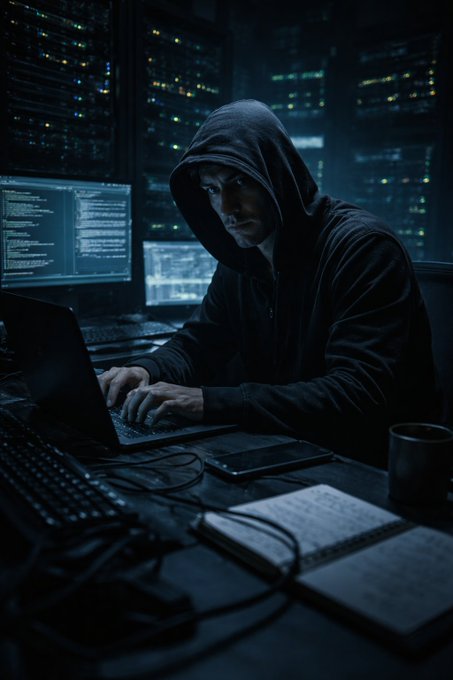
At the far end, under a dim work light, someone sat in a rolling chair with their back to me. Hood up. Shoulders relaxed. A laptop open, screen full of pale text like snowfall. The posture of someone who knows exactly how many exits are behind them.
"I'm not here to stop you," I said, because opening lines matter.
The figure didn't turn. "Then you're here to label me."
"Something like that."
A quiet laugh. Not cruel. Not amused. More like… tired. He finally swiveled around.
Mask? No. Not theatrical. Just a plain face, unremarkable enough to vanish in a crowd. The hood was not glamour. It was privacy. His eyes, though—his eyes had the sharp calm of someone who spends their life reading systems the way others read moods.
"The Courts sent you," he said.
"Both," I replied. "That rarely ends well."
"That's their problem." He tapped the screen once, and I heard it—faint, like a distant chime. A lock engaging. A door being closed. Not physical. Logical.
He had just set a boundary. I felt it in the air: a tightening, a narrowing of possibility. That was the first sign. Unseelie predators widen possibilities—more access, more spread, more chaos. This one reduced them.
He looked at the contract page from the folio, which I had placed on a nearby rack like an offering. "Authorized," he said. "Scope is clear. Time window is clear. No production impact clause is clear."
Then he looked at me, and there it was—the thing that makes a Hacker Seelie when the world assumes he's Unseelie. He said, flatly: "I don't touch what I'm not invited to touch."
Not "I can't." Not "I won't get caught." Not "I choose not to today." Invited. Hospitality law.
IV. Exhibit One: He Leaves Receipts on Purpose
A Hacker who feeds—Unseelie hunger—steals in silence. Leaves nothing but absence and confusion. Makes you doubt your memory of the world. This one… documented.
He opened a folder and showed me a report draft. It was clinical, precise, almost obnoxiously careful: what he observed, what it meant, how to reproduce it in controlled terms, how to fix it, how to verify the fix. And—crucially—what he did not do.
"I could have taken more," he said, matter-of-fact, like a carpenter noting he could have knocked out a load-bearing beam. "But that's not the point. The point is proof without harm."
Seelie justice loves proof. Seelie courts love records. They love things that can be pointed to later when someone tries to wriggle out of responsibility. Unseelie creatures love plausible deniability.
This Hacker did the opposite of what hunger does: he made the truth impossible to ignore. He handed mortals a mirror and forced them to look at the crack. That is Seelie behavior—uncomfortable, corrective, lawful.
V. Exhibit Two: He Does Not Humiliate—He Repairs
There is a kind of person who breaks locks for the joy of hearing the snap. A kind of person who wants to prove they can hurt you. That is Unseelie pride. It's not always evil. But it's always dangerous.
This Hacker moved like a medic, not a vandal. He spoke about misconfigurations the way a surgeon speaks about wounds: with respect for the body, contempt only for negligence. "It wasn't one bad choice," he said. "It was a pattern. Convenience treated as entitlement."
Then he did something that surprised me enough to make me still. He stood, walked to a whiteboard, and wrote a single line: A system is a promise you keep at scale.
He capped the marker and looked back at me. "Hacking is just asking whether the promise holds."
That, right there, is the Seelie frame. Seelie are not "nice." They are consistent. They believe promises have weight and that a threshold exists to be respected, not to be mocked. He didn't revel in the cracks. He treated them like breaches of hospitality—an insult to the idea that a door should mean something.
VI. The Unseelie Arrive: Hunger Wearing a Human Suit
It happened while we spoke. A shift in the server hum. A brief stutter in the air. The kind of moment mortals call "network latency" and never realize they just felt a predator brush past.
The Hacker's expression didn't change much, but his gaze snapped to a log stream like a dog hearing a distant whistle. He typed—fast, economical, not showy. No cinematic hacking. No neon skulls. Just intent made visible.
"What is it?" I asked.
"Something uninvited," he said.
In my mind, I saw it the way my kind sees such things: not as code, but as behavior. A pressure trying doors. A slick hand testing latches. A hunger that doesn't knock because it doesn't believe in doors.
He didn't chase it through systems like a hunter. He did something subtler. He closed the world around it. Suddenly the air in the room felt narrower—as if the data center itself had become a hallway with fewer exits. He was building a fence. A Seelie fence.
And then—quietly, almost gently—he spoke aloud, not to me, but to the presence moving through the wires: "You're out of scope."
That shouldn't have meant anything. It was a human phrase. But in the mouth of a Seelie-aligned entity, it became a ward. You have no invitation here.
The pressure recoiled. Not defeated—hunger rarely is—but blocked, redirected, denied easy meal.
If it had been a mortal intrusion, the Hacker would have captured it, studied it, neutralized it with a report. But this was not merely mortal. This was something that lived on attention and negligence. Unseelie.
And the Hacker treated it exactly as hospitality law demands: not with vengeance. With refusal.
VII. Exhibit Three: He Honors the Old Law—And That's Why Everyone Fears Him
Mortals fear Hackers because they don't understand the difference between ability and intent. The Courts fear Hackers because they understand it too well.
A Hacker who is Seelie is terrifying in a very specific way: he will not let you lie about your own doors. He forces accountability. And accountability is pain to anyone who has been living on shortcuts.
He showed me the simplest truth in the entire modern world: most breaches are not sorcery. They are hospitality violations. Someone left a door open and told themselves it "didn't matter." Someone accepted a guest without checking their name. Someone built a castle and forgot to guard the pantry.
And when the Unseelie came calling, the humans blamed the locksmith.
That is why the folio existed at all: because the Courts needed to decide whether to protect him, claim him, or silence him. Because Seelie-aligned Hackers are inconvenient. They make comfort expensive.
VIII. The Verdict: The Hacker as Seelie
I opened my book of thresholds and wrote by the cold light of the server LEDs. My iron pen scratched the page like a nail on glass. Here is what I recorded—my verdict, the reason both Courts brought me here:
The Hacker appears Unseelie because he trespasses, uncovers secrets, defeats barriers, and speaks in a language of exploitation. But his operational nature aligns with Seelie law: he requires invitation and scope; he does not enter unbidden. He respects thresholds as promises, and treats breaches as broken hospitality. He leaves receipts and mirrors—reports, evidence, and paths to repair—rather than feeding in silence. He reduces harm; he closes doors rather than widening them. He acts as a warden against true Unseelie hunger—malice that ignores permission entirely.
In short: he is not a thief. He is a keeper of doors in a world that forgot doors matter. Seelie. Not gentle, not warm, not interested in comforting lies. But lawful. Necessary.
IX. The Moment That Made It Certain
I finished writing and closed the book. The Hacker watched me, expression unreadable.
"Are you going to tell them?" he asked.
"I'll file the report," I said. "Truth is its own complication."
He nodded once. Then, after a beat, he said the quietest and most revealing thing of the night: "I wish humans understood that I'm on their side."
"That's not Seelie," I said, before I could stop myself.
He tilted his head. "No?"
"Seelie don't do 'sides,'" I replied. "They do rules."
Something like a smile ghosted at the edge of his mouth. "Then write this rule down, Notary." He leaned forward, eyes reflecting the pale glow of the logs like moonlight on water. And he spoke, not as a threat, not as a promise, but as a law—clean, cold, protective: "If you can't defend your threshold, you don't get to pretend it's yours."
Then he turned back to his screen and began closing doors no one remembered opening. Outside, the city kept glowing, loud and oblivious, confident that myths belonged to older centuries. And in the humming heart of its infrastructure, a Seelie warden kept the Unseelie from eating the world through its forgotten windows.