Seven tales · Slavic folklore

The Quiet Flame of Vasilisa

The whole life of a border-village woodworker’s daughter, read straight through — the flame first lit, carried out among her neighbours, kept burning through the war that changes the land, carried down a scorched road and across the Gray River into a house of gold and stone, and met at last at the threshold, where the true thing is said aloud and the name is claimed in the standing.

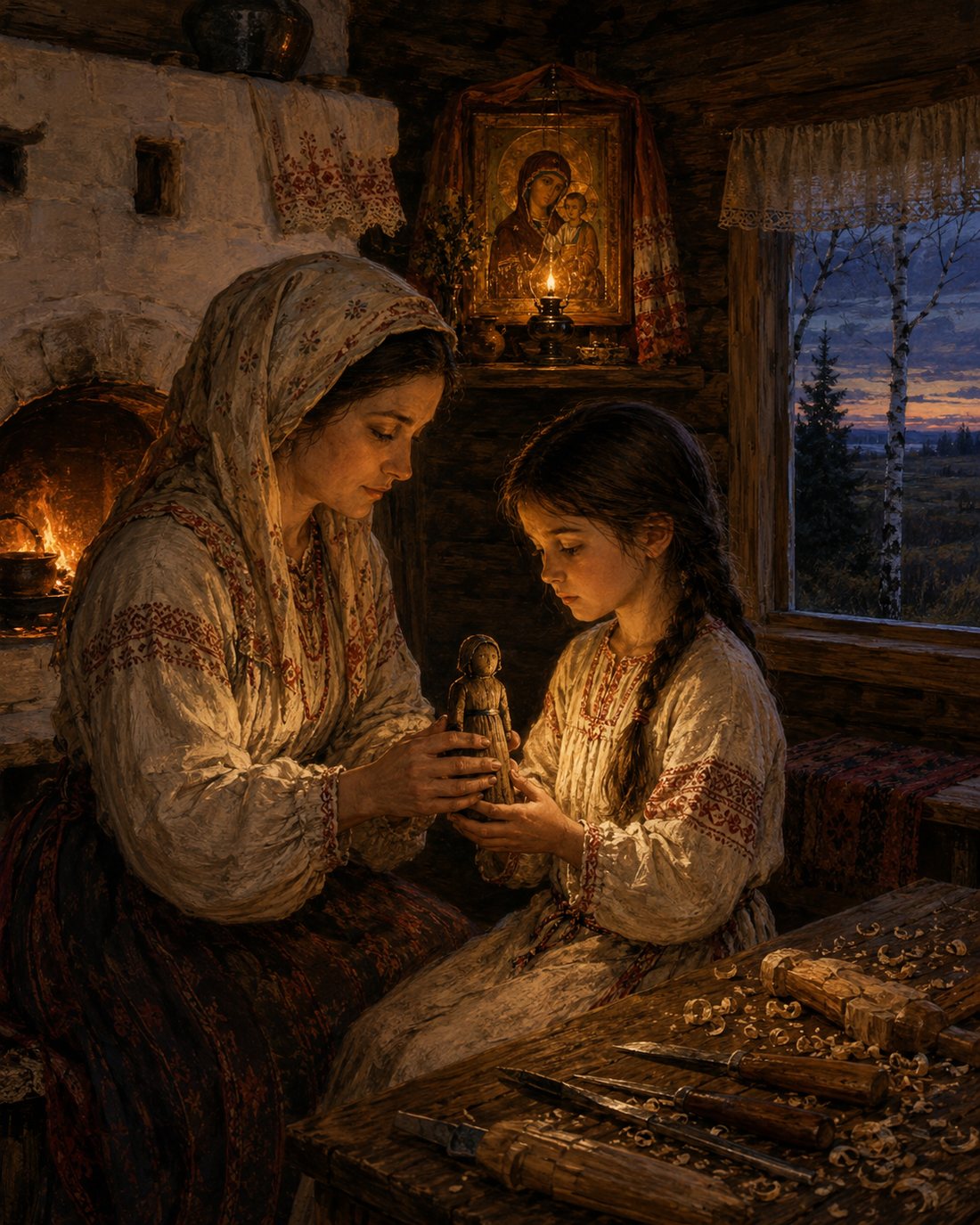
By firelight in a wooden izba, a mother in an embroidered headscarf places a small carved doll into her daughter's hands; above them an icon of the Mother of God glows beside a lit lampada, carving tools and wood shavings lie on the table, and birches and the steppe show through the window at dusk.
Tale the First

The Quiet Flame of Vasilisa

In a certain village that stood where the deep forest met the open steppe, there lived a family in a small izba of dark timber. Birch trees leaned close to the walls, and in summer the wind carried the smell of grass from the wide land and the cooler breath of the woods. In the beautiful corner of the house, above a clean shelf, hung an icon of the Mother of God with a thin lampada that the mother lit each evening. The Domovoi of that house was content in those days, for the hearth was kept clean, the threshold was crossed with care, and the people inside still knew how to live with open hands.

The father of the house worked with wood and iron. His hands were broad and sure. In the evenings, when the work was done, he would take down the old balalaika or simply clap, and the mother would rise from the bench. Together they sang the old songs — not the grand ones of the bogatyrs, but the quiet ones that belong to the stove and the threshold. They danced in the small space between the table and the fire, laughing when they bumped the benches, their shadows moving large and lively on the walls. Sometimes the mother would pause, cross herself lightly before the icon, and return to the dance as if the joy and the prayer were one breath. The little girl who watched from her place by the stove felt the house itself grow warmer then.

That girl's name was Vasilisa.

She had a brother, a year or two older, who was mostly elsewhere — at the river with boys his own age, or carrying water for the mother with the particular sighing of a boy who intends to be useful and to be seen being useful. Once he brought Vasilisa a jay's feather he had found and presented it as though it were a great matter, and she kept it in the chest with the winter cloth for years. That was the shape of him. He was loved, and he was rarely in the room.

But when Vasilisa was still small enough that her head reached only to her father's belt, the father began to take her with him. He did not leave her behind when a hinge needed mending or a fence post had split or the shaft of a cart had cracked. Those hours became their own. He set her on a low stool or let her stand close, and he talked while he worked.

"See how the grain runs," he would say, turning a piece of wood to the light. "You do not fight it. You ask it what it wants to become, and then you help it."

Or: "A nail driven true holds longer than ten driven in anger."

He let her hold the tools when they were not too heavy. He showed her how to feel with her fingers for the place where a joint had loosened, how to listen for the sound a thing makes when it is almost whole again — a dull knock while it is still wrong, and then, when it is right, a small clean note, like a word spoken plainly. She learned the smell of fresh shavings and the particular satisfaction of watching something broken stand upright once more. These lessons settled into her hands the way the songs settled into her memory.

There was also a girl of the village, nearly her own age, with a quick laugh and a way of looking sideways at things. They walked the same paths between the houses and the edge of the forest. When one had too many chores the other appeared without being asked and took half the load. They shared the first ripe berries and the first thin ice on the puddles. One evening, sitting on the warm steps of the stove, the friend said, "You look at things the way the icon looks — quiet, but nothing is hidden from you."

Vasilisa only smiled and passed her another berry. She did not know what to do with such words, so she let them rest outside herself.

In the evenings, when the father had gone to speak with the neighbours or to check the animals, the mother sat with Vasilisa on the wide bench by the stove. She taught her the old songs in a lower voice — the ones that speak of the river that remembers every crossing, of the birch that keeps secrets in its white skin, of the fire that must be fed with care. She taught her how to stand before the beautiful corner, how to light the thin wick of the lampada, and how to say a few simple words to the Mother of God. Not long prayers. Only the short ones a child can carry.

"The land speaks," the mother said, "but it does not raise its voice. You must grow quiet enough to hear it. The same is true of people, and of the Domovoi, and of your own heart when it is tired. And when the quiet is too heavy, you may stand before the icon and give the heaviness there. It will be held."

One evening in late autumn, when the first thin ice had formed on the water bucket and the wind had begun to worry the thatch, the mother called Vasilisa to her. She took from the chest a small wooden doll, worn smooth by other hands long before. Its face was simple, the eyes only dark marks, yet when Vasilisa held it the wood felt strangely warm, as if it had been kept near a living body.

"This was given to me by my own mother," the woman said, "and to her by hers. It does not speak with a loud tongue. It listens. When you are alone and the road is long, feed it a crumb of bread and a drop of clean water, and tell it what troubles you. It will keep your words, and in time it will help you know what must be done."

She turned the doll once in her fingers before she gave it over.

"Two things. Do not show it to those who would laugh, or to those who would take it for a toy. And do not lie to it. Not to spare yourself, not to spare me. It takes what it is given and it keeps it."

She closed Vasilisa's fingers around the doll. For a moment the girl's hands and the mother's hands and the smooth wood were all one warmth. The lampada in the beautiful corner flickered as if in answer.

"Remember the songs," the mother said. "Remember the prayers. And remember how to listen."

Vasilisa kept the doll under her pillow, near the wall that faced the icon. At night, when the house was quiet, she felt its small weight and knew she was not entirely alone with her thoughts. Sometimes she whispered to it the same simple words her mother had taught her before the icons.

The years lengthened. The father still sang sometimes, and still took Vasilisa with him when there was mending to do, but the journeys away from the village grew longer. There were seasons when he came back with less laughter in his voice, and seasons when the songs by the stove became fewer. The Domovoi of the house grew a little thinner, though it still accepted the small offerings left for it. Vasilisa noticed these things the way she had been taught to notice — quietly, without making a noise about them. She went on learning the work of hands and the work of listening. She fed the doll its crumb when her heart felt heavy, and the wood stayed warm against her palm. When a neighbour's child fell ill or an old woman needed water carried, she went without being asked, and her friend of the heart walked with her on many of those errands.

Once the mother looked at her for a long time in the firelight and said softly, "There is a steady light in you, my girl. Do you feel it?"

Vasilisa shook her head a little and turned back to the mending in her lap. She did not know how to hold such words, so she let them rest outside herself, as she had done before.

So the girl of the border village grew, carrying in her hands the lessons of mending, in her memory the old songs and the simple prayers, and under her pillow the doll that listened. The forest stood dark behind the house and the steppe stretched wide before it, and the road that would one day call her had not yet shown its length. But the quiet flame had already been lit, and it would not go out easily.

And that is the beginning of the story of Vasilisa, who would one day be called by another name.

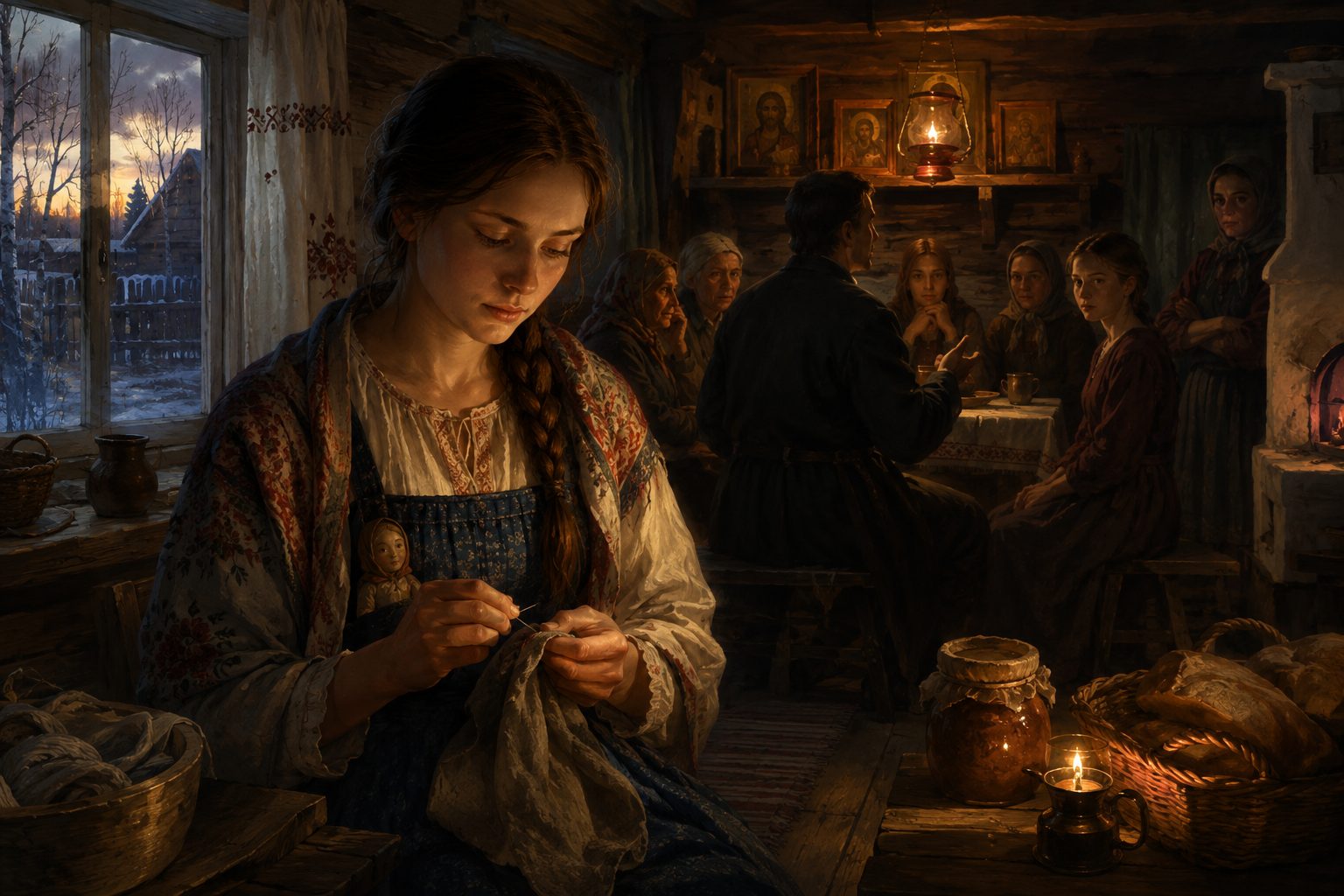
By candlelight in a wooden izba, Vasilisa sits mending cloth with a small carved doll tucked into her apron; behind her a suitor in a dark coat speaks at a table where village women watch, an icon corner with a lit lampada glows above, the stove burns to the right, and winter dusk shows through the frosted window.
Tale the Second

The Seeker of True Shadows

Word came ahead of him, the way it does — carried by a woman who had a cousin in the larger settlement beyond the ridge, and improved a little at every threshold it crossed. By the time he arrived, the border village had already decided what he was. A young man of a household that kept more cattle and finer cloth than most. A young man in want of a wife.

His name was Aleksei. He came in the late days of autumn, when the stove smoke hung low along the ground and the first thin frost silvered the woodpile, and he came with a matchmaker's quiet word and with speech polished like river stones. He sought, he said, a wife of modest virtue and steady hands, one who would keep a clean house and raise children in the fear of God. He spoke of a stove that would never go out. Of regard that would last a lifetime. Of security offered freely. His smile was open, and the cross at his throat caught the light when he moved.

The gathering took place in the izba of old Marfa, whose granddaughter Katya was of an age for such talk and whose nature was quieter than most, given to looking down at her hands.

Vasilisa came early, with a basket of fresh bread and a small jar of salve for Marfa's joints, and stayed to help sort the winter stores — dried mushrooms, the last of the apples, the seeds wrapped carefully in cloth. She had already begun, by then, the difficult craft of reading the hidden hearts of men. She did not name it a craft. She only noticed, the way a careful hand notices a weak seam before it tears, and went on with the quiet work that had always been hers.

The little wooden doll rested in the pocket of her apron. Each morning she fed it a crumb of bread and a drop of clean water, as she had been taught, and sometimes, when a truth settled clear in her chest, the doll grew warm against her side like a living coal. When a falsehood brushed near, it cooled. She treated both the way she treated weather or the grain of wood: useful to know, nothing to announce.

In the beautiful corner the lampada burned steady and small beneath the icons. The air smelled of beeswax, of bread, and of the sharp promise of frost.

Anya was there for a little while, drawn by the novelty of a visitor from the larger place. She listened to Aleksei with bright eyes and whispered to Katya that such a man did not come often to their quiet edge of the world, and then she left on her own errands, carrying her brightness with her.

Aleksei spoke on. He praised the simplicity of the border village. He spoke of how a capable wife would raise his standing among his own people. He offered, with every appearance of generosity, to ease the small debts Marfa's household still carried from the hard summer.

Vasilisa worked among the stores and listened with the same attention she gave to the weight of a log or the direction of the wind. She saw how his gaze rested on Katya's lowered head the way a man rests his eyes on a good tool. She heard the careful pause between his praise of the girl and his praise of the work those hands would do. She felt the true shape settle into focus — not open cruelty, not loud greed, but a cold reckoning that wore courtesy the way a man wears a fine coat against the weather.

The doll against her side grew cool.

She had felt such coolings before, small and ordinary. This one was only clearer. She did not speak against him. And when the matchmaker asked, as matchmakers do, whether anyone in the room had a thought to offer, Vasilisa said quietly, as one might speak of the coming frost:

"And when the stove burns low in the deepest night, whose hands will he trust to bank it? And will those hands be free to choose the wood?"

The question was ordinary. It could have been answered with more polished words. Yet something in the way she asked it — or in the steady look of eyes that had already seen past the coat — made Aleksei pause. The air in the room seemed to clarify, as if a window had been opened onto cleaner light. The cross at his throat no longer caught the same brightness. His shoulders settled a fraction lower, as though the fine coat had grown heavier. Katya raised her head a little. Old Marfa's hands stilled among the seeds.

He recovered with a smile and spoke of trust and shared labour, but the easy power of his earlier words had thinned and did not come back.

Later, when the talk had turned, Vasilisa found a moment beside Katya near the stove. She pressed a small piece of bread into the girl's hands and met her eyes for a steady moment.

"You already know how to listen," she said. "Whatever you decide, decide it after he's gone home and the room is quiet."

Then she went back to the mushrooms, as though nothing of weight had passed between them.

In the same hour she noticed that Marfa's jar of salve was nearly empty, and that the old woman's shoulders had begun to tighten with the damp. Without remark she refilled the jar from the store she had brought and set it where Marfa would find it once the guests had gone. Continuous work, quiet as breath.

When the gathering ended and Aleksei took his leave with the matchmaker, the path he had proposed no longer lay so smooth. In the days that followed, Katya's family spoke among themselves with new care. The offer was neither accepted nor sharply refused. It simply lost its hurry and its shine.

Afterward, two women walking home along the frost-hardened path fell to talking about it.

"He spoke for the better part of an hour," one said, "and I believed every word of it."

"And?"

"And she asked one question, and I didn't."

The other laughed, and then did not, and they walked a while without speaking. Ahead of them on the path Vasilisa went with her empty basket, not hurrying, and if the words reached her she gave no sign of it.

That evening the lampada in her own beautiful corner burned with its steady flame. Her father's place was empty; he had gone again on one of the longer journeys that had become more frequent of late. The house held the ordinary silence of a place well kept. Vasilisa fed the little doll its crumb of bread and its drop of clean water, then set it for a moment on the bench near the icons. It rested neither warm nor cool, only quiet. She crossed herself as she had been taught and took up the mending that waited by the stove.

She felt no pride in the afternoon's seeing, and no heavy burden. Looking past the mask was simply another form of the same careful attention she gave to wood and weather and the needs of those around her. But there was a cost she had not yet found a name for. To see the shape of a man before he shows it is to stand a little apart from the room, and a room noticed is not a room shared. The clarity brought its own thin loneliness, the way a high clear sky can feel lonelier than clouds.

She sat with that longer than usual, letting it settle, and then went back to the work of her hands.

Outside, the frost finished its delicate work across every branch and windowsill. Inside, the seeker of true shadows went on with the ordinary evening, the doll once more in her pocket, the light of the lampada steady and small and enough.

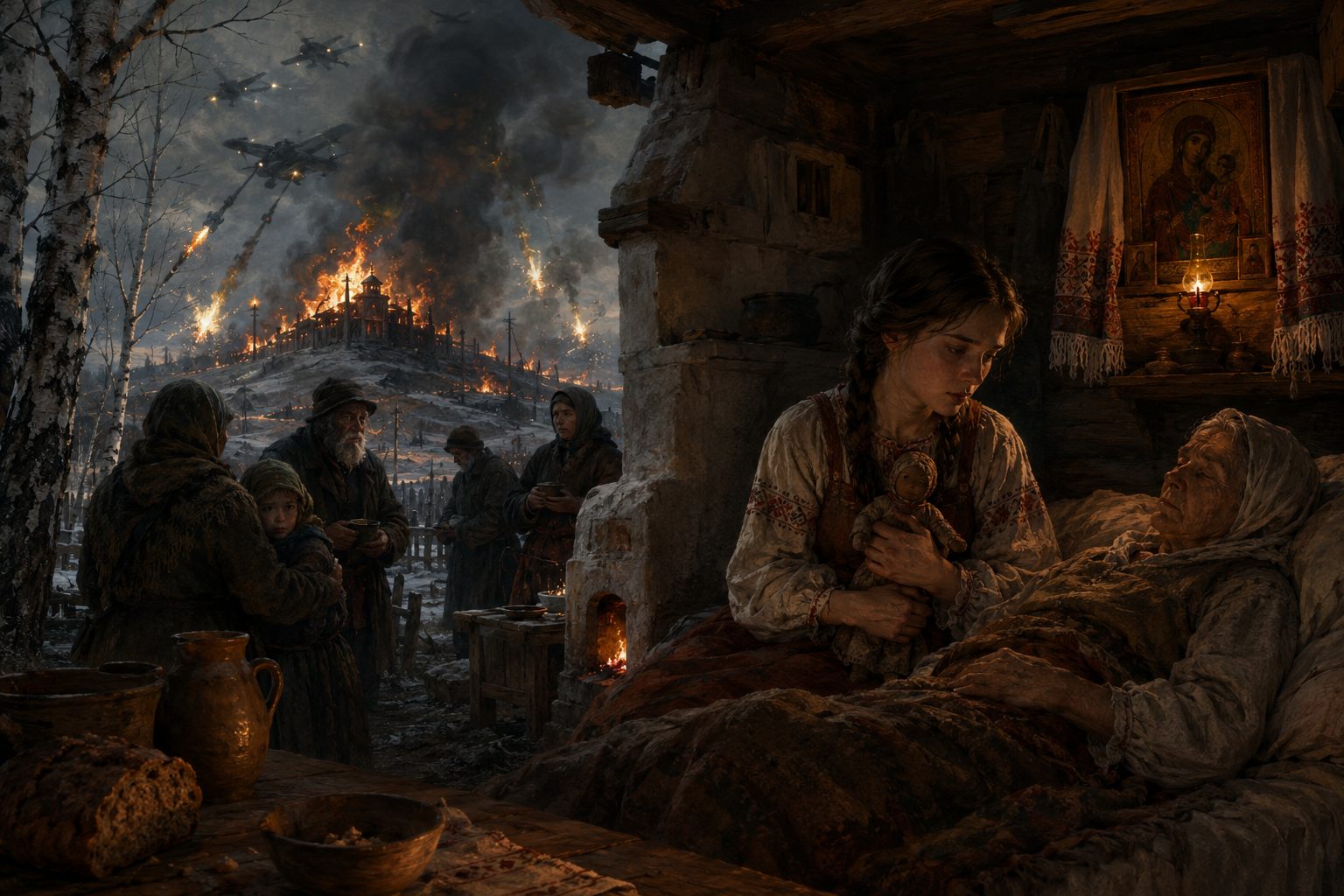
By night in a scarred wooden izba, Vasilisa sits at her mother's bedside holding the small carved doll while a lampada burns beneath an icon of the Mother of God; through the broken wall, neighbours stand in the snow with cups in their hands as the High Place burns on the hill behind them and iron birds cross the smoke-dark sky.
Tale the Third

When the Black Host Came and the High Place Burned

The men who had gone to the larger markets came back three days early, and they came back quiet.

That was the first sign. Not the news itself — the news came later, in pieces, the way bad news comes — but the quiet. Men returning from market are loud. They have prices to argue about and a road behind them. These men put up their horses and went into their houses and shut the doors, and their wives came out afterward wearing faces that did not open easily.

By evening the words had reached the threshold. A Black Host, riding out of lands farther than the Gray River. Iron men on horses that struck sparks from the frozen ground. And above them, iron birds that screamed across the high sky and cast down the sky-thunder.

Vasilisa heard it standing in old Marfa's doorway with a covered pot in her hands, and she noticed that no one asked her what she thought.

That was the second sign, and it was hers alone to read.

The gatherings had known her by then. Not by name and not by any office — no one would have said ask Vasilisa — but a room that had a difficulty in it tended to turn a little in her direction before it settled, the way a room turns toward the window. She had grown used to that quarter-turn. It was the only wage her craft had ever paid.

She went to two gatherings that winter. At the first, a dispute over a boundary stone, the talk went round and round and no one turned. At the second, a matter of a debt, the men spoke over one another with a new hardness in their voices, and when she asked her one quiet question it fell into the room like a stone into a snowdrift, without a sound. Afterward a neighbour touched her elbow, not unkindly.

"It isn't you, girl. Nobody's got room in them for the truth this year. There's only room for what's coming."

So the doors of a calling she had never named closed, one after another, and she was the only one who heard them shut. She carried the pot home, fed the doll its crumb of bread and its drop of clean water, and put the mending in her lap. Her mother sat by the stove, slower with the needle now, humming one of the old songs in a voice that still held its strength. The father's place stayed empty. The journeys beyond the ridge had stretched into seasons.

Then the Host itself drew near.

Behind the izba the ground rose to the High Place — the old ground where true words had once been spoken under the open sky, where the grass grew differently and no one had ever built. It was the High Place that drew them. The iron birds came for it as though it had called to them, and the sky-thunder came down.

The first blow rang through the floor and up into Vasilisa's teeth. Dust came out of the thatch. The icon knocked once against the wall and hung crooked, and the lampada guttered and did not go out.

She did four things in the next hour, and she did them in the order her hands chose.

She banked the stove — the same careful movement her father had taught her, back when the grain of wood still answered him. She set the icon straight and trimmed the wick. She drew clean water and brought it to her mother, who had gone very still on the bench with both hands flat on her knees, the way a person sits who has decided not to be afraid where a daughter can see it. And she opened the door, because someone was hitting it.

A neighbour's boy fell across the threshold. He had run the whole way with his arms over his head and he could not say anything at all, only make a sound like a kettle. Vasilisa did not ask him what had happened. She sat him on the warm step of the stove with his back against the brick, put her palm flat on his chest, and crossed herself. Then she began to say the old quiet words, not fast, and after a while the kettle-sound stopped and he started shaking instead, which was better.

"Now," she said. "Count the bricks along the top there. Out loud."

He got to nine before he could hear anything but his own blood.

Outside, the thatch on the north side caught, and men she had known all her life beat it out with wet sacking and their coats. The birch trees leaned. The High Place burned all night and the smoke came down instead of going up, and the house shuddered but the house stood.

In the hours that followed, others came to the door. An old woman whose own roof had fallen. A man whose hands shook too hard to hold a cup, so Vasilisa held it and he drank from it and neither of them remarked on the arrangement. She shared what bread there was. She mended a torn sleeve with steady stitches because the woman wearing it had begun to cry about the sleeve, which is a thing people do when they cannot yet cry about the rest. She listened longer than she spoke.

One of the women, looking at the lampada still burning in the beautiful corner while the smoke hung low outside, said softly:

"The light in this house has not gone out."

Vasilisa inclined her head and went back to the work.

Late that night, when the Host had passed farther down the steppe and the last of them had gone home to whatever was left, she sat by her mother's side. The mother slept. Her breathing had grown thinner over the autumn, so gradually that Vasilisa had been able to tell herself she was imagining it, and could not tell herself so any longer.

She took out the doll and fed it its crumb of bread.

It did not warm.

She sat with that a moment. Then she thought perhaps she had not done it properly, so she wiped the small wooden face with her thumb and gave it a drop of clean water and held it against her heart the way she had held it since she was a child.

It stayed cold.

Not the cool of a false word — she knew that cool the way she knew the smell of frost, a passing thing, a shift in the wind. This was a cold with a bottom to it. It was the cold of a thing already counted. It was measure, and it had settled, and the doll only kept what it was given.

Vasilisa sat very still in the dark with her mother's breath going in and out beside her.

She could wake her. She could say, Mother, the doll has gone cold and I know what it means. And then her mother, who had lost the songs at the stove and the man who used to dance in the space between the table and the fire, and who now had a burned hill behind the house, would also have to carry this.

She drew the blanket higher over her mother's shoulder. She got up, and lit the lampada with a hand that did not shake, and did not speak the truth aloud.

The hurt settled down quietly beside the flame she still carried, like a dog that means to stay.

When morning came, the smoke of the High Place still lay low across the land. The roof was scarred. The birch trees were blackened on one side. The stove held its heat and the lampada glowed in the beautiful corner.

Vasilisa fed the little doll its crumb of bread and its drop of clean water. It was cold in her hand.

She did not speak of the measure that had settled. She kept the hearth, and shared what bread remained with those who came to the threshold, and sang the old songs softly so her mother might sleep.

The quiet flame had not gone out. It burned smaller, perhaps. But it burned.

And that is how the Black Host came to the border village, and how the High Place burned, and how Vasilisa kept both the hearth and the knowing while the land itself was changed.

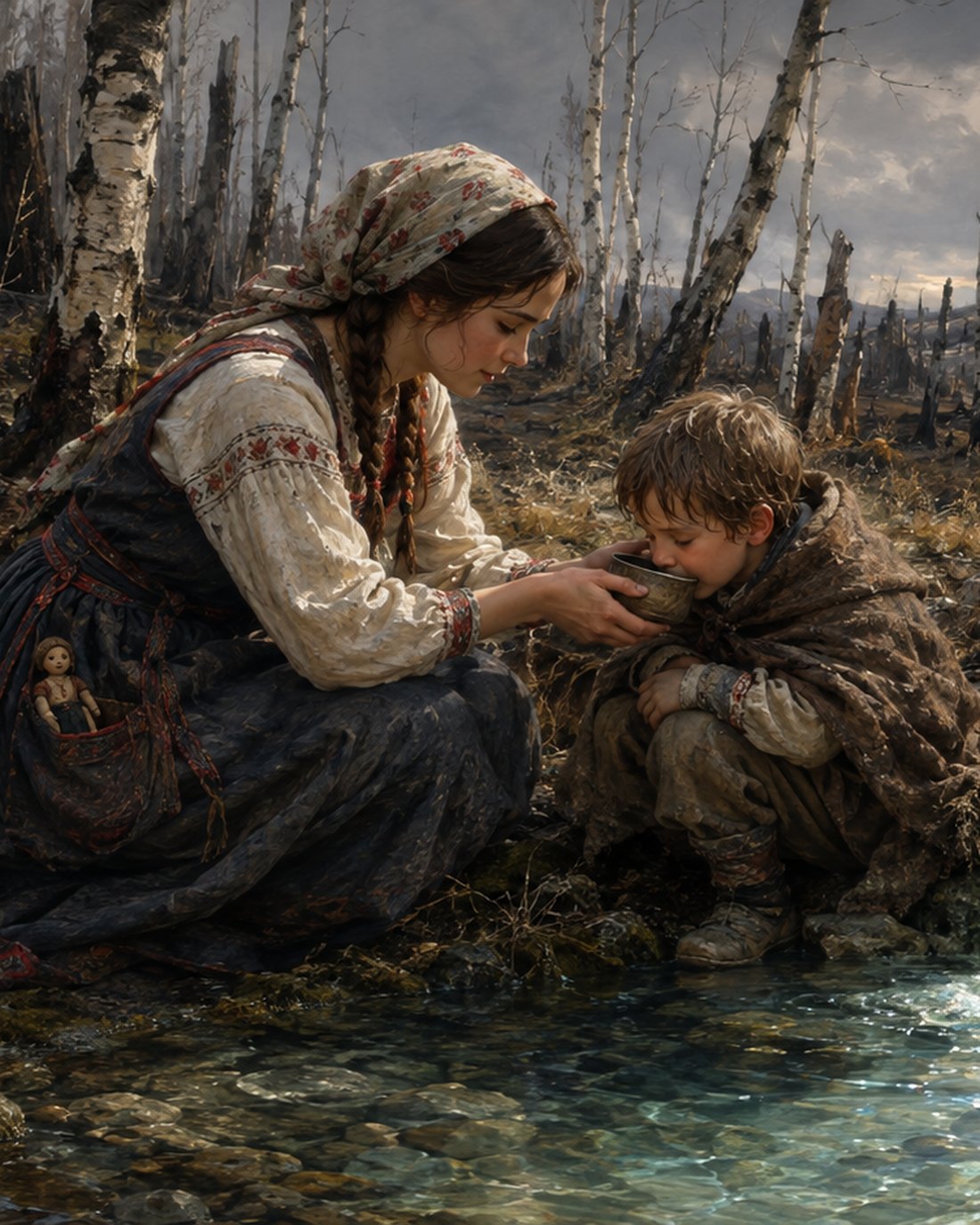
In a burned birch grove under a low grey sky, Vasilisa kneels in an embroidered sarafan and headscarf, holding a small cup to the lips of a ragged boy wrapped in a blanket; the little carved doll rides in her apron pocket, a clear spring runs over stones in the foreground, and behind them the scorched land rises to a ruin on the hill with figures on the road.
Tale the Fourth

The Road of the Living Water

The old woman came back a third time, and Vasilisa knew before she opened the door that it would be for bread again, and opened it anyway.

She was the one whose roof had fallen farther along the road, and she had the manner of someone who had been proud for a long time and had lately stopped being able to afford it. Vasilisa sat her by the stove and put the last of the good bread in her hands and did not watch her eat it.

"There's a grove," the woman said, when she could. "Four days east, where the ground goes soft. White birch. There's a spring under it that still comes up clear."

"All the springs come up clear now," Vasilisa said. "It's the ones that come up wrong you have to watch."

"Not like this one." The old woman set the crust down. "The iron birds go round it. Round, mind. Not over. My man's brother drank there when the burning was at its worst and he walked out of that country on legs that had no business carrying him." She looked at the bench where Vasilisa's mother slept, and then at Vasilisa, and did not pretend she hadn't. "It eases the body. It stretches out what's left."

"And?"

"And it doesn't give back what's already been reckoned. Nobody gets that."

Against Vasilisa's side, the doll warmed — a small clean warmth, the warmth of a true thing spoken.

It was the first warmth she had felt from it since the night the High Place burned. Underneath it, the deeper cold went on, the way a stone stays cold under a hand laid on it.

She knew then that the road was hers to walk.


She prepared without speaking the whole weight of it. She left the house as well tended as she could and the lampada burning. She asked the neighbour with the good eyes to look in twice a day, and the neighbour, who had her own dead to think about, said yes without asking why. She packed a little bread, clean water for the doll, and the old songs in her memory.

At the last her mother caught her wrist. The grip was still stronger than it looked.

"Four days east," her mother said.

"Yes."

"Take the mended cloak, not the good one. If it tears you'll be glad it's the one you know how to fix."

That was all. Vasilisa crossed herself before the icon, felt her father's early lessons settle down into her own hands where they had always lived, and stepped out into the changed land.


The road through the country the Black Host had crossed was long and careful. Scorched earth. Empty places with a stove standing alone in them, which is what a house leaves behind. She walked in the mornings and the late afternoons and lay still under the birch shade in the hours when the sky was busy.

On the second day the iron birds came low.

She heard them before she saw them and she went down into a ditch with her face in the wet leaves, and the sound went over her — not a sound so much as a pressure, something that got in under the ribs and rearranged things. When it had passed she found that she had bitten through her lip and that her hands were flat and open on the mud, and that she had been singing under her breath the whole time without knowing it. One of her mother's. The one about the river that remembers every crossing.

She lay there and finished the verse properly, because a thing half-sung sits in the throat. Then she got up and went on.

On the third day she came on a child sitting in the road.

He was perhaps six, and he had walked out of his boots somewhere behind him, and his feet were cut to ribbons by the hard ground. He was not crying. That was the worst part of it. He was sitting in the middle of a road in a burned country with his feet bleeding, and he was waiting, because someone had once told him that if he got lost he should wait.

Vasilisa sat down beside him, not too close.

"Those want washing," she said.

He looked at his feet as though he had not been introduced to them.

"I've got water," she said. "It's for the doll, but the doll can go without a day."

She washed the small feet with what she could spare, and while she worked she talked about nothing — the grain of the wood in a cart shaft, the way a hinge tells you it's about to go — because the words themselves did not matter, only that they kept coming, steady, the way a hand stays on a horse's neck. Somewhere in the middle of it the shaking started, which she had been waiting for. She let it run. She gave him the last of her crust and put the mended cloak over him and sang the second verse of the river song.

His people found them an hour later — a straggle of travellers who had lost him at a ford and had been going back along their own road shouting his name.

An older woman among them stood watching Vasilisa hand the boy over. She had the face of someone who had done a great deal of counting lately.

"Where did you learn to be that quiet with a frightened thing?"

"My father mended carts," Vasilisa said, which was not an answer, and was.

The woman looked at her a moment longer. Then the group went west and Vasilisa went east.

That night the deeper cold rose so strongly that it nearly put out the small warmth of the road. She stopped under a birch that still held a strip of white bark, fed the doll a crumb, and said the simple prayer her mother had taught her beside the old songs. She waited until the stillness inside her was quiet enough to walk on. It took most of the night.


The grove was where the old woman had said.

The birch stood scarred down one side, the bark gone black and curled, and living. Beneath it the spring came up clear and cold into a basin of stones that somebody, a long time ago, had troubled to set in a ring.

Vasilisa knelt. She fed the doll its crumb of bread and its drop of clean water. She crossed herself and said the quiet words.

Then she looked into the water, which was very still, and the water showed her what she had already been carrying: ease and lengthening. Nothing turned back. She had known it in the old woman's kitchen, and she had known it every step of four days, and she found that knowing a thing and being shown it are not the same, and that the second one costs more.

She let herself be angry for the length of about ten breaths. It was a clean anger and she did not do anything with it.

Then she filled the small vessel, stoppered it, and turned toward home.


The return was no easier than the going. But she walked it.

She gave her mother the Living Water in careful sips, the way you water a plant that has been let go too long. The pain loosened its grip. Colour came back a little into the face on the pillow. The breathing eased.

And more days were given — twenty-one of them, though nobody counted aloud.

They were good days. That is the part people do not expect. Her mother sat up and took an interest in the mending and criticised Vasilisa's stitching, which she had not had the strength to do in a year. She hummed. Once, in the late afternoon, she got as far as the second verse of a song about a birch that keeps secrets in its white skin, and for the length of it the house was almost what it had been before the hill burned.

The cold in the doll did not lift.

On the last evening the mother said, without any preamble, "Sit where I can see you."

Vasilisa sat.

"You've been carrying something since the night the thatch caught," her mother said. "Don't."

"Don't what."

"Don't do the face. I've had that face myself." She turned her hand over on the blanket, palm up, and Vasilisa put her own hand in it. "Did you think I couldn't feel you not saying it? Every night for a year, not saying it. It made a draught in the room."

"I didn't want you to have to hold it."

"I know. That's why I let you keep it." The grip tightened, briefly. "My mother's mother carried the same silence for her own mother, and she never spoke of it either, and I only found it out after. It's the last of the housework, girl. It gets done quietly or not at all. You did it right."

Vasilisa found she could not answer.

"Sing the river one," her mother said. "I don't want to be listening for anything."

So Vasilisa sang the song about the river that remembers every crossing, all the verses, in the low voice she had been taught it in, and somewhere in the fourth her mother's breathing changed and then, a while after, stopped, as quietly as a candle deciding.

Outside, on the scarred threshold, a white bird settled for a moment — pure as new snow against the burned wood — and lifted, and was gone. Vasilisa alone saw it.

She sat in the dark a long time. Then she got up, because there is a great deal to be done, and the doing of it is a mercy.

She crossed herself. She trimmed the lampada. She fed the little wooden doll its crumb of bread and its drop of clean water.

And the cold was gone.

Not warmth. Not comfort. Only wood — ordinary, smooth, and quiet in her palm, the way it had been before the night the thatch caught. The measure had been kept and now the measure was finished, and the doll had let it go, and Vasilisa stood in the middle of her mother's house holding a small plain thing that had nothing more to tell her.

That was when she wept.

And that is how Vasilisa walked the Road of the Living Water, and how the water eased what it could and gave twenty-one days, and how the knowing that had ridden with her since the burning of the High Place was set down at last on the night it came true.

In a gilded palace corridor of gold and marble, Vasilisa stands in a plain embroidered sarafan holding a small glowing wooden doll against her heart; a lampada burns beside an icon of the Mother of God in a shelf-sized corner to her left, and through the golden window screen a wide gray river runs beneath birches with a raft on the water and the far shore burning under a low sky.
Tale the Fifth

The Golden Cage and the Name She Would Not Claim

An empty house makes a particular noise. Not silence — houses are never silent — but the noise of a place going on without anyone to go on for. The thatch settling. The stove ticking as it cools, because there is no longer any reason to bank it properly. A door swinging a hand's width and stopping.

Vasilisa lived in that noise for eleven days.

The High Place still stood blackened against the sky. The father's place had become a road he did not come back along; the warm working hands that had taught her the grain of wood and the true joint were somewhere she could not follow. Even the Domovoi of the old threshold had gone thin as the last smoke off a banked fire, and though she still set out the small offerings, she was no longer certain who took them.

On the eleventh day she understood that there was nothing here to keep, and that she was going to have to cross the Gray River.

But she would not walk into a country she knew nothing about. She had watched too many people do that in the year of the burning.

So she took the days she needed. Each morning she fed the little wooden doll its crumb of bread and its drop of clean water, and then she sat — on the scarred threshold where the birch leaned blackened on one side, or by the last thin light of the lampada — and she asked. She asked the doll about the far country and read the answers in warmth and stillness. She asked the old songs, which remembered distant crossings, and found that they knew more than the people did. She asked travellers when travellers came, and traded bread for what they knew of the fords, and learned that there were no fords, and that there had been a bridge, and that there was no longer a bridge.

Which meant she needed something to cross on. And something that knew the way.


She began to gather.

Wood first — a beam the fire had not taken all of, a post that still remembered a true joint, timber that had her father's working in the grain of it. Then clay, from the low places where the river had once come up over the land and left the ground fat and grey.

Day by day she worked them. She shaped while she thought, and she thought while she shaped, and the two were not separable. She fed the growing figure as she fed the small doll. She sang the old songs over it under her breath and said the simple prayers, and crossed herself before the work as she had been taught to do before any road.

It came up slowly under her hands. Kin to the small doll: wood and threshold earth, simple of face, larger than a child and smaller than a man.

And it answered. That was the astonishing thing. When she said something true about the road ahead, the wood warmed under her palms. When the path she was considering was false, it cooled, and she learned to stop and think again. Because she had brought it up herself out of patient asking, she understood it from the first, and respected it, and never once feared it.

At the last there was the heart-place to close — the hollow between the shoulders where the grain came together, the joint that would make it whole.

Her father's voice, from a long way off: a nail driven true holds longer than ten driven in anger.

She knew what was wanted. She had known for days. The thing had been fed on true words the whole way up, and it wanted a true word to close on: the true reason for the road. She was to say what she was carrying and why she was going, plainly, in her own mouth.

Vasilisa knelt on the swept floor of her mother's house with her hands on the wood.

And she found that she could not say the true thing.

The true thing was that she was going because she was loved and had nowhere to put it. That she was going with a mother's songs in her memory and a father's hands in her own and a friend somewhere west of here who had held half her chores since they were seven years old, and that every one of those was a rope with the other end cut, and that she was going to have to walk out of this country with all of that still alive in her.

She could not carry it and walk. That was how it seemed, that night, on that floor.

So she said the other thing, the one that made the leaving light enough to do.

"There is no one left who would miss me," she said, "and nothing in me that anyone would want to keep."

In her pocket the little doll went cold. She felt it, and she knew exactly what it meant, and she went on kneeling with her hands on the wood and did not take the words back.

The heart-place did not warm. It closed — she felt it close, the two grains coming together — but it closed cold, and there was no small clean note when it did, only the dull knock of a thing that is still wrong.

Vasilisa waited a long moment in the dark for something to happen.

Nothing happened. The figure stood, and was hers, and would walk.

It takes what it is given and it keeps it, her mother had said, closing a child's fingers around smooth wood. Do not lie to it. Not to spare yourself. Not to spare me.

She got up off the floor. The road was in the morning and the country was burned and she had nothing else and no time to make another. She told herself that a thing which walks is enough to ask of any thing, and that she would put it right on the far bank, when there was time.

There is never time. But she did not know that yet.


The road through the country the Black Host had changed was long and careful. The Quiet Walker went beside her, larger than the small doll and moving with the same quiet certainty. When the path ran true its wooden body warmed. When greater danger lay near it cooled and shifted its weight against her hip, turning her toward safer ground, and twice that saved her life. Each evening she fed it as she fed the doll at her heart. She sang under her breath when the sky darkened and crossed herself before every fording of a stream.

If it never answered from a heart, she did not notice. There was nothing yet that required one.

At last they came to the Gray River.

It ran wide and cold, the colour of old iron under a low sky, and the far bank was a grey line you had to believe in. No bridge. The current went by with that smooth heavy look that water gets when it is not going to negotiate.

Vasilisa stood a long time on the near side with the small doll warm at her heart.

Then the Walker went down into the water and settled and became a raft — a living raft that knew the grey current, because it had been shaped by hands that had asked it, patiently, for weeks, what it would need to be.

She stepped onto it and crossed herself and they went out into the cold.

The water pressed against the wood with the weight of everything on the near bank. Midway the current took them and tried to turn them broadside, and she felt the whole body under her shift and set itself, grain against pull, holding the way a joint holds. Spray came over. She lay flat and kept her hand on the wood and sang because singing kept her breathing.

On the far bank she stepped down onto new soil with her knees shaking.

And the Quiet Walker gave back the last of its strength — into the small doll at her heart, and into the river itself — and was gone from her sight.

Not gone. She would learn that later. But gone from her sight, and she was too tired and too glad to ask where the rest of it had settled.

She stood alone in a strange country, carrying only the doll and the old songs.


The speech in the new land was strange, and the thresholds were higher, and the light that fell across them was colder. For a while she found work among people who still needed a mender of broken things or a steady presence for the overlooked.

But the customs of that kingdom were not the customs of the border. A woman alone out of the scarred lands was not left long unbound. The necessity came quietly, as such necessities do — a place offered, a household wanting a wife of modest virtue and useful hands, a binding spoken in a tongue she understood only in part and signed to before she understood the rest.

The boyar of the house of gold and stone saw usefulness. He saw standing. He did not see the flame, and it did not occur to him that there was anything there to look for.

She was given rooms and a place at the table, and from the first she was unseen inside her own house. The gold did not warm. The stone did not answer.

Still she kept the quiet work.

Where the household allowed it she made a small corner for the icon and a thin lampada — a red corner no bigger than a shelf, but clean and tended. Each morning she fed the doll its crumb and its drop of clean water. She sang the old songs under her breath while she worked and said the simple prayers. Her father's lessons lived in her hands: she mended what was torn, set right what had loosened, and listened longer than she spoke.

In the third winter a child of the household took a fever and was put in a side room, as the custom of that house was, so that the noise of it would not trouble anyone.

Vasilisa found the nurse in the corridor with her hands full of linen and her jaw set.

"They've given her the cold room."

"They have." The nurse was a broad woman with a burn scar up one wrist, and she had been in that house long enough to have stopped expecting things of it. "You'll want to keep out of it. He counts the hours of everyone under this roof."

"Then he can count mine."

She sat with the child four nights. She did not have the Living Water and she did not have her mother, but she had a low voice and the songs, and it turned out that a fever in a foreign kingdom breaks the same way it breaks at home. On the fourth night the shaking stopped and the small face went loose and ordinary with sleep.

The nurse stood in the door a while, watching.

"I've been in this house eleven years," she said at last. "The rooms have a way of taking the warm out of a person. It hasn't taken yours." She shifted the linen to her other arm. "You bring a different light into these rooms. I don't know where you keep it."

Vasilisa inclined her head and went back to the mending that was waiting.


The years lengthened inside the golden cage. The boyar remained stone-hearted. The gold stayed cold. The stone did not answer. Yet the flame she carried never went out, and she never stopped offering it — in bread at the outer door, in quiet hands that mended, in songs sung for the feverish, in a crumb given each morning to a small wooden doll.

Then came an evening at the end of a long day of unnoticed care.

A woman had come to the outer door — thin, clear-eyed, carrying a basket with almost nothing in it and asking for the kind of thing that household rarely heard asked for. Vasilisa saw the need before it was spoken, as she generally did, and answered it with bread and a steadying hand and the offer of the step to sit on.

The woman sat. She ate. She looked up.

"You've done that before," she said. "You did it before I'd finished asking."

"It isn't much."

"No." The woman considered her with a directness that people in that kingdom did not usually permit themselves. "Do you know they talk about you at the low gate? Not by your name. They say the one who comes out. Every house has one and most houses haven't."

Against Vasilisa's heart the little doll grew warm — warmer than it had ever been, warmer than the night her mother closed her fingers around it. Not guidance. Something else. Recognition.

"Whatever it was you were called where you came from," the woman said, getting up and settling the basket on her hip, "it wasn't the whole of it. There's a victory in you, and it's a quiet one, and it's been going on a long time." She said the word for it in the speech of that country, and then, seeing that it had not landed, in the border speech, roughly, the way a foreigner says a name.

"Nika."

Vasilisa stood still in the doorway with the doll warm in her hands.

And she began at last to see it. The flame she had carried through a border village and the coming of the Black Host, through a cold that would not leave a small wooden doll, through four days east and twenty-one given days and a river the colour of old iron, through years of gold that did not warm.

Including — and this was the part that took her breath — that it was beautiful.

She stood at the threshold of the house of gold and stone and saw that the road still branched. One path went on with the quiet work in the place she had reached. The other led further.

The choice was hers now, to make as Nika.

And that is how Vasilisa crossed the Gray River into the kingdom of strange customs, and how she lived inside the golden cage without letting the flame go out, and how she was named at last by the quiet victory that had always been hers — and how, on a swept floor in her mother's empty house, she had once told a small necessary lie to a thing that keeps what it is given.

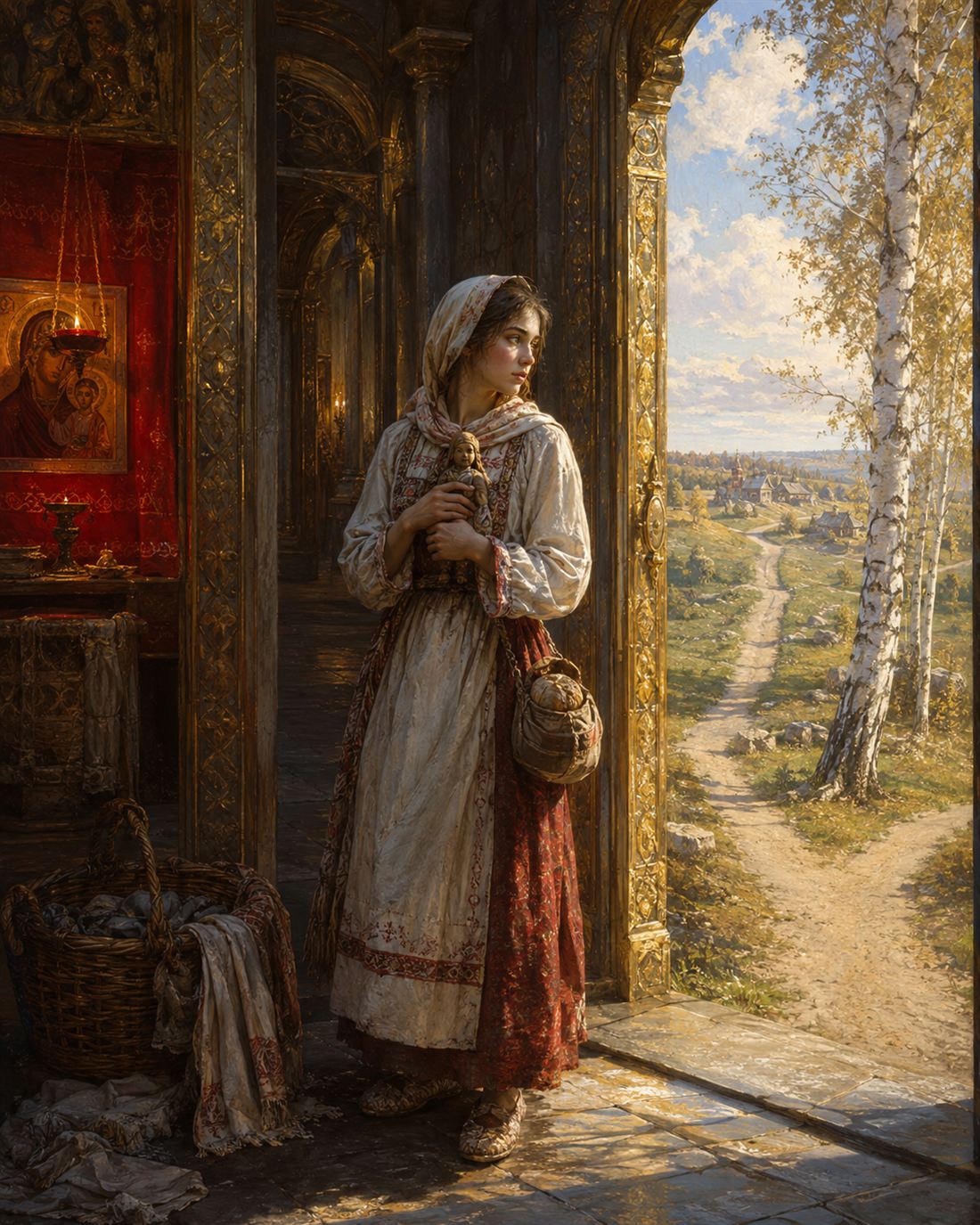
In the doorway of a house of gold and stone, Nika stands in an embroidered sarafan holding the small carved doll against her heart with a bundle of bread at her hip; behind her a lampada burns before an icon of the Mother of God in a shelf-sized red corner, and beyond the open gate a road runs out under birches toward a far village.
Tale the Sixth

The Struggle and the Safety of the Cage

She kept a bundle under the bed for two years before she ever tried to use it.

A change of cloth. A little hard bread, replaced when it went too hard. It was not a plan. It was more the way a person keeps a lamp by the door of a house that has never once caught fire — and every so often, sweeping, she would touch it with the broom and know exactly what it was, and sweep on.

The house of gold and stone stood around her as it always had. The boyar remained what he had been, counting usefulness from a distance, seeing standing where the flame lived. The gold did not warm. The stone did not answer. And Nika, who had been called Vasilisa, went on with the quiet work that had always been hers.

Each morning she fed the little wooden doll its crumb of bread and its drop of clean water. It rested warmer against her heart than in the old years, carrying the recognition that had come, and carrying too a lasting quiet strength the Quiet Walker had given back into its grain before the Gray River took the larger shape away. In her small red corner — no bigger than a shelf, and clean — the thin lampada burned before the icon. She sang the old songs under her breath while she worked, and said the simple prayers.

They still found her, the ones who needed finding: the weary who carried loads along the long corridors, the overlooked, the women with quiet requests at the low gate, the children who ran hot and were put in side rooms out of the way. She eased what she could. She mended what her father's early hands had taught her to mend. She listened longer than she spoke.

She stood sometimes at the threshold and looked out, and the road still branched as it had on the evening she was named. One path went on with the quiet work here. The other led further — toward lower thresholds, toward country where the old border speech might still be heard under birch light.

She knew the name now. She had seen the flame, and seen that it was beautiful.

But the known walls held a real safety after so much taking, and the body remembers safety long after the eyes have begun to see.


There was something else in the house, and it was hers, and she had made it.

The remnant of the Quiet Walker had settled after the far bank and gone on living — a quiet presence near the threshold, a warmth in the grain of the small doll. For years it had been only that. A companionable weight in the corner of a room. Something that had known the grey current and remembered.

At its making a small necessary-seeming untruth had been spoken over its heart-place, and the joint had closed cold, and for a long time nothing came of it.

Then things began to come of it.

Nothing she could have named to another person. The first was this: she had always known, in that house, when someone was on their way to her door. A kind of leaning at the threshold, half a breath before the footsteps. It had been so constant she had never once thought about it — and then one winter she noticed she was being surprised by people, and had been for months.

The second was the bread. She left a share out at the low step, as she always had. It began to be there in the morning.

The third was that her own voice started to sound wrong in her rooms. Too loud, and then gone, the way a voice goes in an empty church.

Small things. She put them down to the season, and to the house, and to her age.


Then a traveller came to the outer gate — a clear-eyed man who had crossed nearer the Gray River and still carried a few words of the border speech, enough for the two of them to laugh at how badly he carried them. He spoke of roads that had grown easier in recent seasons. Of villages further on where a few old women still knew the mother's songs. Of thresholds that did not stand so high or so cold.

For one day the air at the gate felt lighter.

That evening she pulled the bundle out from under the bed and began, almost without deciding, to make it into a real thing. A second cloth. Bread that was not stale. The doll close against her heart.

And as her hands worked the packing, the doll went still and cool against her breast.

She stopped.

It was a private cold, the kind only she could feel, and she had not felt anything like it since the year the High Place burned. She sat back on her heels with the half-packed cloth in her lap and waited for it to pass, and it did not pass.

In the same hour the house went quiet around her.

Not silent. Quiet in the particular way — the way a room goes when someone has just stopped talking about you. The corridor outside her door, which was never empty at that hour, was empty. The presence near the threshold that had leaned toward her for years did not lean. It sat there and did not answer, and its not-answering had a weight to it, like a hand held up flat.

And then a thing needed doing, as things do.

The kitchen girl with the chipped tooth was down again with the fever she never quite finished with, and this time she was worse, and the nurse had gone to her sister's, and there was nobody in that house who knew how to bring a fever down without frightening the person it was in.

Nika found her curled in the side room with her eyes going about.

"They said you'd gone," the girl said. "Someone said you'd gone."

"I'm here."

"They said —"

"I'm here." She got the girl's head up onto her arm. "Count the boards in the ceiling. Out loud, and slow, and if you get past twenty I'll be very impressed."

She sat with her until the shaking stopped. She fed the doll its crumb at some point in the small hours, out of habit, and it was still cool, and she noticed and put it away.

When the traveller went on in the morning, she stayed.

The flame had been offered again. That much was true, and it was not nothing. But there was a second true thing under it, and she saw the edge of it and looked away: that the need had risen exactly when she reached for the road, and that the house had gone dumb at the same hour, and that a small wooden thing at her heart had gone cold at the sight of her packing.


Seasons turned. The boyar's grip loosened for a time — his own travelling, or the stone of his attention turning elsewhere, or simply the thinning of a cold arrangement that had never had much in it to begin with. The outer gate stood open longer than it used to.

One afternoon she walked out to the threshold and stood looking at the far road. The light was coming in low and yellow across the stones, and for the space of a few breaths the way out looked not only possible but easy, which is worse.

A mother's song came up in her throat — one of the old ones, the one that had carried her through the burned country and across the Gray River.

It caught halfway and would not finish.

She stood there working at it the way you work at a splinter. The threshold went heavy under her front foot, heavy the way sodden cloth is heavy, and the presence at the door did not answer, and the quiet around the known walls got a little deeper, and in her own chest, next to the small light of a lampada she could still see when she closed her eyes, something that felt like a higher and kinder care seemed to ask her, gently, to stay one more season for the sake of the ones who still found their way to her door.

She turned back into the known walls.

She fed the doll. She tended the small red corner. That evening a woman came to the low step wanting a share of bread and a steady word, and Nika gave her both, and the giving was real, and the woman went away better than she came.

The name was not undone. Nothing about that hour undid the name.

But she had asked to leave twice now, and twice the house had gone dumb, and twice she had found a reason, and the reasons had been good ones.


Later, alone in the privacy of the beautiful corner, she said the choice out loud to the doll and to the icon, the way her mother had taught her to give a heaviness somewhere it could be held.

Her eyes saw the flame and its beauty. She did not have to be told any more.

Her body remembered gold that did not warm and stone that did not answer, and before that a raft on grey water, and before that twenty-one days, and before that a hill burning behind a house.

There was a faint warmth in the small doll — the last of the Quiet Walker, settled in the grain. Once, while she was speaking, it stirred toward the far road.

Then it settled back into her palm, and its answer was thinner than it used to be, as though something in it had already learned to hold back.

She made the sign of the cross, as she had been taught to do before any hard weighing.

She stayed.


And the safety was genuine. That has to be said plainly, or the rest of it is not true either.

The ones she steadied still found her. The songs still had a rooted place in a small red corner of a foreign house. The flame went on being offered — in crumbs to a wooden doll, in quiet hands that mended, in songs sung over the feverish, in bread at the low step.

She stood at the threshold again as Nika. The road still branched. The bundle went back under the bed.

The bars were in the daily habit of it now, and in the places where a companion that had once carried her across a river had stopped leaning toward her door.

The walls still stood. The struggle was quiet. The choice was still hers.

And that is how Nika lived the residual safety of the known walls after the naming — how the openings rose and were met by costs she supplied herself, and by the first small silences of a companion made without a heart — and how the quiet flame went on being offered while the road waited, still open, for a later choosing.

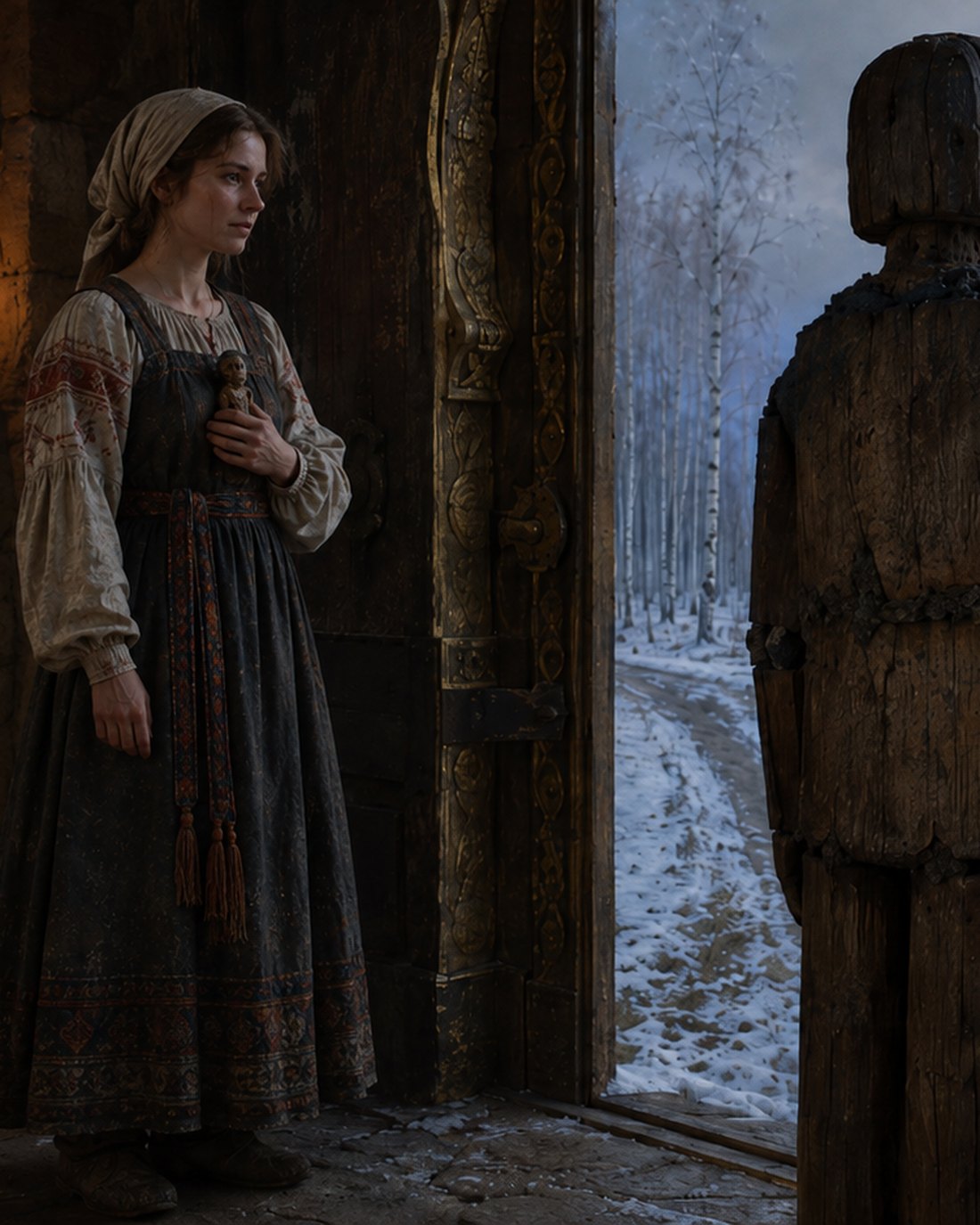
Inside a doorway of gold and dark stone, Nika stands in an embroidered sarafan with the small carved doll held against her heart, an icon lamp burning out of frame to her left; across the open gilded door stands the tall rough wooden figure of the Quiet Walker, its back to us, and past it a road runs out through snow and birches into the winter dusk.
Tale the Seventh

The Choice

There came a season when the house learned a new trick. It went quiet wherever she was.

She would walk a corridor and the two women ahead of her would turn off into a doorway before she reached them. She would come into the kitchen and whatever had been going on there would already have finished. The bread she left on the low step stayed on the low step until the birds found it. Once she said good morning to a man she had nursed through a winter cough, and he looked at her, and looked away, and went on, and she stood in the corridor for a while afterward trying to work out which of them that had happened to.

She still tended the beautiful corner. She still fed the little wooden doll its crumb of bread and its drop of clean water, and it still rested warm against her heart, carrying the recognition that had come. In the small red corner the thin lampada burned before the icon. She still sang the old songs under her breath and said the simple prayers. The few who did reach her found her, and she gave them what she had.

The flame was offered. It was only that fewer and fewer people were being allowed to come and stand near it.

The thing near the threshold had stopped leaning toward her door. It had started standing in front of it.


She had begun, by then, to understand what she had made.

A companion that knew every ford between here and the burned country. A back that had held a raft together against the grey current with her lying flat on it and singing to keep breathing. And a heart-place that had closed cold on a swept floor, in the dark, because a girl with nothing left had needed the leaving to be light enough to lift.

There is no one left who would miss me, and nothing in me that anyone would want to keep.

It had taken what it was given. It kept what it was given. And the only thing it had ever been told about her was that no one wanted her — so it had set itself, with the terrible faithfulness of a thing that has one instruction, to make that true.

In the residual years the quiet remnant of that companion and the stone-hearted boyar of the house of gold and stone drew into one continuous presence. What had once been a path-knower without a true heart and a master who counted usefulness from a distance became the same silence: the presence that emptied rooms, stood in doorways, and would not answer. The Walker had merged into the owner of the cage — or the cage had taken the Walker into itself. The isolation that stopped all communication was now the house and its master as one.

It did not shout. It had no mouth to shout with. It emptied rooms, and turned feet aside in corridors, and stood in doorways, and did not answer.


The first of the three came in the spring.

The bundle came out from under the bed as it had a dozen times, and this time she got as far as the outer gate with it. And the gate did not open, and no one came to explain why, and after a long while she carried the bundle back up the stairs.

For three days after that nobody spoke to her at all.

It was in the quiet after those three days that the other thing took root — and this is the part that is hardest to tell rightly, because it was hers, and she knew it was hers.

Whenever the thought of the open road came up in her, or the thought of some small ordinary happiness — a threshold that did not watch her, a morning under birch light, a day in which the flame could be offered without asking anyone's leave — something inside her closed on it immediately. A sting. A small cold turning-away, quick as a hand pulled off a stove.

As if she had gone ahead and locked the gate herself, so that no one else would have to.

She knew it was wrong. That was the strange, exhausting part. She knew the name still rested in her heart and she knew the flame had never gone out. It made no difference at all. The sting came first and the knowing came second, every time, the way a bruise comes before you have finished deciding whether it hurt.

And the wooden thing at the door learned that bar the way a dog learns a whistle, and after that it hardly had to do anything itself. It only had to be silent while she did it for it.


The second came the next autumn, and it was clearer, and it went worse.

Word arrived by a traveller's mouth of a place further on where a woman of clear sight and working hands might live without gold and without stone, and where a few people still sang under birch light. For a day the air at the gate was different.

That evening she packed properly — cloth, bread, a little water, the doll close. She crossed herself. She walked down to the outer gate with the plain intention of going through it.

The sting rose before she reached the bottom of the stairs, as if by some quiet wrong charm that had got into the fear and the missing heart together and set up house there. She kept walking anyway, which took more out of her than the four days east ever had.

The Walker was in the gateway.

It did not speak, because it never spoke. It stood in the way that only a threshold-born thing can stand, and the silence of it went out through the whole house like cold through a wall.

For nine days after, the outer gate was shut to her. The rooms she moved through were emptier than rooms have any business being. The nurse with the burn-scarred wrist passed her twice without lifting her eyes, and Nika understood, later, that the woman had been made to. What little she had ever had the ordering of got smaller — her hours accounted for, her step watched, her going and coming decided elsewhere. The beautiful corner remained. The space around it got wider and wider and had less and less in it.

And every time a thought of the road rose, the sting answered it first, and the silence around her made the sting feel like the last word on the matter.

But she still trimmed the lampada. She still fed the doll.

And when one thin, fevered woman somehow got as far as the low step, Nika gave her bread and a steadying song under her breath — and as she did it the little wooden doll grew warm against her heart. A private warmth, the kind only she could feel, saying what it had always said: this is true, this part is true, whatever else is happening.

She set the bundle aside. She crossed herself. She stayed.


Then, in the deepest part of it, a stranger came to the outer door.

Or was brought there by necessity. Or found some quieter road through a watched gate, which afterward she thought about a great deal.

He had come out of a prison of stone and long silence not many weeks before. He was worn by the road, his boots finished with travel, and he carried the mark of a locked place the way a traveller carries dust — in the seams, where you cannot brush it off.

She was asked to tend him, or simply went, which by then amounted to the same thing.

She brought bread and clean water. He took the bread in both hands, and held it a moment before he ate, and she saw him notice her noticing.

"Habit," he said. "You get to like the weight of it."

She went to close the door against the corridor draught and he said, quite mildly, "Leave it open. I'll pay for the draught."

So she left it open, and sat down where he could see both her and the doorway, and did not remark on it.

He ate. She waited.

They talked a little, and not about the prison. What he told her was about after: that the gate had opened and he had walked out and gone on being alone for eleven weeks, and that nobody warns you about that part. "They tell you the wall is the thing," he said. "The wall isn't the thing. It's that afterward the quiet comes with you. It's in your pocket. You put your hand in for a coin and there it is."

She found herself telling him about the house going dumb around her. She had not said it out loud to anyone, having no one to say it to, and it came out badly and in the wrong order, and he did not once look away from it.

"And the other thing," he said. "The one you do to yourself."

"I don't —"

"You've got the look of a woman who's already had the argument twice and lost it both times." He said it without any pity in it at all, which was why she could hear it. "That's not weakness. That's just what a locked place teaches. It teaches you to do its work so it can have a rest."

The little wooden doll lay on the bench between them and grew warm. Warmer than it had been near the transformed Walker in years — though not the pure simple heat of her mother's first gift. Something steadier and more complicated than that, and it left the deeper question wide open.

Because she used the clear sight that had always been hers, and it would not settle. She could not say whether he was another Walker — flawed, or true — or something worse wearing a road-worn coat, or simply a man who had walked out of his own stone and was still alive.

The uncertainty stayed. So did the warmth. They turned out to be able to sit in the same room.

Before he left he stood in her doorway and looked at the small red corner with its shelf and its thin light.

"You keep a fire," he said, "for people who never once asked where you got the wood."

Then the road called him on, because the passing was true and he had never pretended otherwise. She crossed herself as she had been taught. He went out through the watched gate.

The rooms emptied again, at once, and further than before.

But something did not empty.


After he had gone, they went on speaking.

Not with words, and not by any art she could have explained to a living soul — only mind to mind, heart to heart, the way the old tales say a thing can carry between two people who have stood in the same cold.

There was a warmth left in the doll that was not only its own. When the sting closed around some rising hope, sometimes a second steadiness came up to meet it — not driving out the fear, but making it no longer the only voice in the room. When the old songs came up under her breath they carried, for a moment, the sense of a second voice somewhere out on the open road, keeping the low part.

The heart spoke, and was answered, across distance, while a threshold-born thing that had once been made of her father's timber refused to answer at all.

The quiet was no longer complete.

That was new. In fifteen years that was the only new thing.


The third came in the winter, and she made it carefully.

She packed as though for a real road, because it was one. The doll rested close against her heart. She stood at the threshold of the house of gold and stone and looked out at the far road under a low sky.

The Walker met her there with everything it had.

The rooms behind her went to the bottom of their emptiness. Not one door in that house opened. The silence came up around her like water in a well-shaft, and the sting rose into it and filled it, and between them they said the thing more completely than any voice could have: outside there may be no one, for the rest of your life. In here there is at least a wall you already know the shape of.

She stood a long time.

Two doors, and both of them plain.

One: risk it. Trust a man who had waited half a breath before giving her a name. Trust a quiet speaking she could not prove to anyone, including herself. Step out knowing the sting would come with her in her pocket like a coin, and knowing she might well end up alone anyway.

The other: take the walls, the silence, the bar she had learned to set against herself — perhaps for good — because the cost had been shown to her three times now, and shown clearly, and she was not a fool.

Then she went and stood in front of the thing she had made, and did the one piece of work that had been waiting fifteen years.

"I told you a lie," she said. "On the floor of my mother's house, the night before we left. I said there was no one who would miss me and nothing in me anyone would want to keep, and you believed it, because you had nothing else to believe, and you have been making it true ever since. That's my doing, not yours."

The silence did not change. She had not expected it to.

"So here's the true one, and you can keep this instead."

Her voice was not steady. It did not need to be.

"I was loved. I am still carrying it. My mother put your kin in my hands and told me never to lie to her, and my father's grain is in your shoulders, and a woman at a low gate gave me my name back for nothing. I have never once been what I told you I was."

The bar she had set against herself came up, hard, the way it always did.

And it met the true sentence coming the other way, and there was not room in her for both.

She stood a long time at the threshold with the true sentence still living in her, and the residual heart-to-heart still answering across the distance, and the continuous flame still offered in her hands.

Several paths lay open before her, clear and plain. One led further into the known walls and the silence of the merged presence that would not answer — the companion without a true heart and the stone-hearted owner of the cage become one. Others led outward under the low sky: the open road alone; roads that turned toward other thresholds and birch light; and among them the living possibility of the nameless stranger who had shared the isolation even while only passing — a path that could offer temporary or permanent safety and shelter without strings or judgment, while the residual speaking of mind to mind and heart to heart continued across the distance. He was there, when needed, to help or simply to be present, without demand. All of them remained open.

She did not choose either of them that day.

She fed the little wooden doll its crumb of bread and its drop of clean water. The doll rested warmer against her heart than it had been in many seasons — a private warmth that only she could feel. She trimmed the thin lampada. She spoke one of the old songs under her breath and the simple prayer she had been taught. She made the sign of the cross.

The true name rose fully then, no longer only resting in her heart but claimed in the standing itself: Nika. The quiet victory. The isolation was no longer the only possible hearth. The residual bars had been met and were no longer absolute. The continuous flame was still offered — to the road if she took it, to the known walls if she remained, to the path that might include the nameless stranger and the safety or shelter he could offer without strings or judgment, and to anyone who might yet find her either place.

The companion without a true heart stood in the way that only a threshold-born thing can stand, and the silence around it was absolute. The path beyond it remained. The residual speaking of mind to mind and heart to heart continued quietly across the distance. A higher care still held the light.

The road still branched. It always does.

And that is how the three attempts were made, and how the quiet was enforced by a thing that would not answer, and how it was broken for a while by a stranger who was only passing, and how the speaking went on after he had gone — and how Vasilisa, who had always been Nika, told the truth at last to what she had made, and stood at the open threshold with both paths before her, the continuous flame still offered, and the quiet victory already hers, while a higher care held the light for whatever choice she would make when the time for choosing fully came.

Each tale keeps its own margins on the short stories page, where you can leave a note on it.

The tales one at a time